
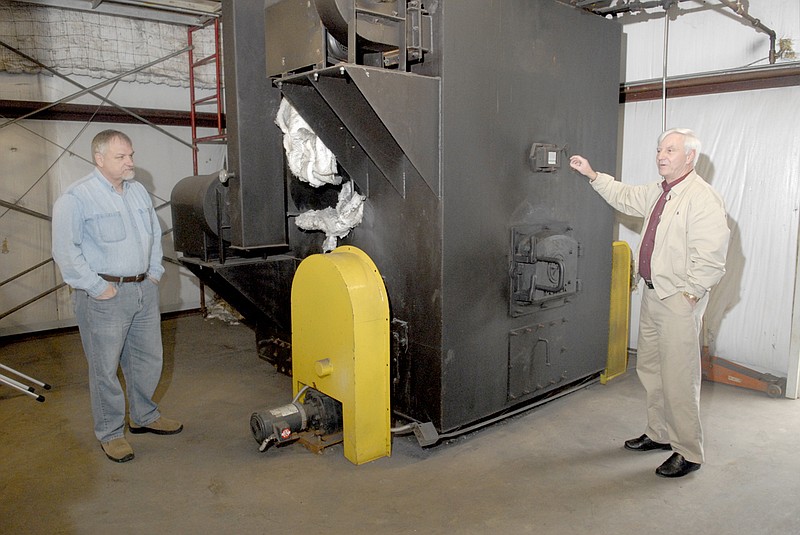

Transforming chicken litter into chicken heating fuel can be a bit smelly and decidedly unglamorous, but Phil Lynch believes he's getting it right following two years of research and development.
Chicken farmers typically spend $50,000 to $80,000 per year on propane to heat their chicken houses, he said, but the CEO of HERO BioMass thinks he's designed a system that pays for itself within a few years.
"We've taken a system we developed from scratch to burn the litter; we're turning it into heat to climate-control the houses," Mr. Lynch said. "It's all automatic, and you get rid of the environmental issues."
Numerous news articles have detailed the EPA's increased vigilance against chicken litter runoff in recent years over concerns that elevated phosphorous and nitrogen levels in watersheds can lead to algae growth. The resulting oxygen-starved dead zones can cause "fish kills and reduced biodiversity," as well as harm to human health, according to the EPA.
"There are moratoriums on spreading litter in some states, because it's just killing the water supply," Mr. Lynch said.
But he said burning the litter reduces the negative effects, according to an analysis by the University of Georgia's poultry department, and the ash has a value of $200 per ton vs. about $15 per ton for untreated litter.
"The emissions are lower than all EPA requirements," he added.
BioMass built its test facility on a remote chicken farm in North Georgia, both to keep it secret and to study its effects. Mr. Lynch, a 30-year HVAC veteran, designed the large furnace like a home thermostat, enabling it to adapt to conditions automatically by controlling the amount of litter it draws into itself.
What does their product do?* The founders of HERO BioMass sought to solve what they say are these two problems with their new invention:-- Traditional methods of chicken litter disposal pollute the water supply through toxic runoff.-- Heating chicken houses with traditional propane costs between $50,000 to $80,000 per year.* By burning chicken litter to heat chicken houses, the inventors claim:-- The problem of watershed pollution goes away, as the litter is burned instead of left on the ground-- Heating costs decrease, because propane is no longer required.* What does the EPA say?-- The EPA has stated that it has serious concerns with the runoff from chicken farms, and the agency has taken an aggressive stance against watershed pollution.-- Founder Phil Lynch said that burning the litter complies with all current EPA regulations.Source: HERO BioMass
The system may sound far-fetched to farmers eager to cut expenses, but HERO BioMass has support from the Department of Energy, the USDA and the members of InnovateHere, a Chattanooga-based group that includes the EPB, The Enterprise Center and the Chamber of Commerce, said Larry Ridge, project manager.
"All the farmer has to do is dump the litter into a big hopper," Mr. Ridge said. "Once you get it started, it will keep going on its own, heating four houses at a time."
For comparison purposes, the company hooked its monitoring equipment up to four other houses on the same farm that used an older propane heating system.
"When it was like 8 degrees here recently, the farmer came back and said we saved him $1,100 in one month," Mr. Ridge said. "The only ones who don't like what we're doing are the propane producers."
Jerry Usry, association manager for the United Poultry Growers Association, said if the technology saves money and helps the environment, he's all for it.
"I don't know which technology they're using, but I guess as a technology evolves, I think it will become a good outlet," Mr. Usry said. "We hope that others will pursue it, because even if this isn't the breakthrough, you've got to start somewhere."
Currently the company is getting suppliers set up to produce 10 units per week, a production schedule that could create 300 jobs and bring $15 million to $20 million in revenue to the area, according to Mr. Lynch.
And he's not going to stop at chickens.
"We're already talking to some turkey farmers," he said.
He declined to provide a price for the product, as it can vary depending on climate and the scope of each installation.