
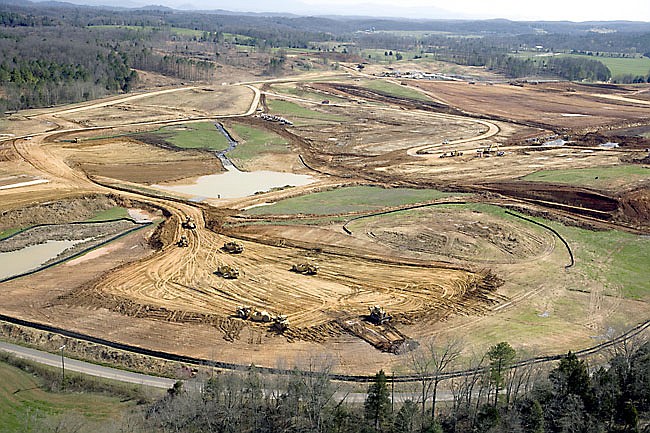
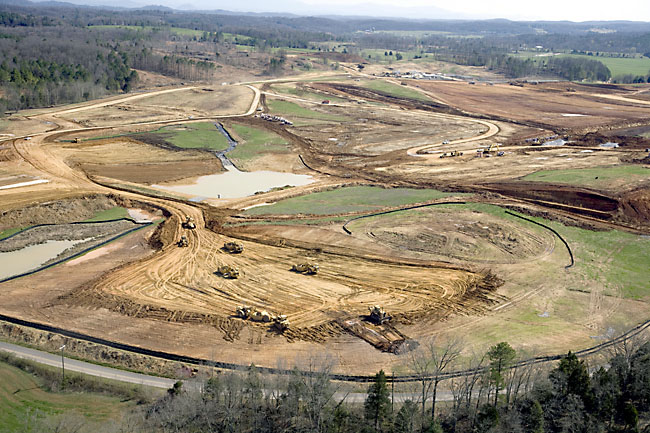
 The Wacker Chemical plant site in Bradley County
Contributed Photo
The Wacker Chemical plant site in Bradley County
Contributed PhotoWacker Chemical chief executive Rudolf Staudigl says there's no reason for people not to run their air-conditioning on solar power because they need relief when the sun is shining.
"Solar is most efficient when the sun shines," he said.
Staudigl's company and competitor Hemlock Semiconductor Corp. are making huge bets in Tennessee on solar energy use and its future in America.
The two chemical companies are investing about $2.7 billion in new plants under construction that will employ more than 1,100 workers when finished.
Wacker, which officially broke ground last week on its project outside Charleston, Tenn., near Cleveland, is investing about $1.5 billion with plans to employ 650 people making polysilicon, a key resource in the building of solar power panels for homes and businesses.
Staudigl said Wacker's polysilicon production business is growing and prospects are bright.
He said the German manufacturer finished last year with a series of high-volume, multiyear contracts at attractive prices that involved prepayments by customers for future deliveries.
"To meet rising demand, we're heavily investing in new capabilities here in Tennessee and Germany," Staudigl said.
Solar power, he said, will be "extremely important" worldwide in the future.
"The world needs more and more energy and safe energy," the CEO said. "Solar provides this type of safe energy."
COSTS DOWN
Seth Masia, a spokesman for the American Solar Energy Society in Boulder, Colo., said technology costs have come down to make it more attractive for people and businesses to use the renewable power. In 2010, the size of the solar market in the United States grew to $6 billion compared to $3.6 billion the prior year, industry figures show.
However, Masia said, in regions of the country such as the South where there are coal-burning power plants, using solar doesn't always make sense in terms of cost.
But in other parts of the country where electricity costs are higher, it works financially for homeowners and businesses to generate their own power, he said.
Chris Davis of the Tennessee Solar Institute in Knoxville said it has seen demand grow for the energy in the year or so it has been in existence. Federal tax credits have made solar more attractive, and the institute has had keen response by businesses in three grant programs during the period, he said.
One program issued $9 million in grants for 110 projects involving businesses, Davis said.
"When you look at investment by companies ... there is a lot of interest statewide," he said.
The institute is a venture of the University of Tennessee and Oak Ridge National Laboratory aimed at solar-generated energy production.
Also in the state, a 20-acre solar-panel array is slated for West Tennessee's Haywood County, and Chattanooga Metropolitan Airport has plans for a solar energy farm that initially could have 4,000 panels on the airfield.
GE PLANT
Last week when Wacker was officially launching construction of its plant, industrial giant General Electric announced plans to construct the nation's biggest solar plant.
GE plans to make solar panels in a $600 million factory that will employ about 400 people. Multiple sites are under study by GE for the facility with a final decision due shortly, according to the company.
J.Ed. Marston, the Chattanooga Area Chamber of Commerce's vice president of marketing, said it monitors potential projects that might fit Hamilton County. But he declined to comment on whether Chattanooga is pursuing the GE project.
Wacker, meanwhile, is continuing to invest in polysilicon production, adding capacity in two German plants as well as its first such American facility.
When the Bradley site comes online, Wacker will have nearly doubled capacity to 67,000 metric tons annually, according to the company.