-
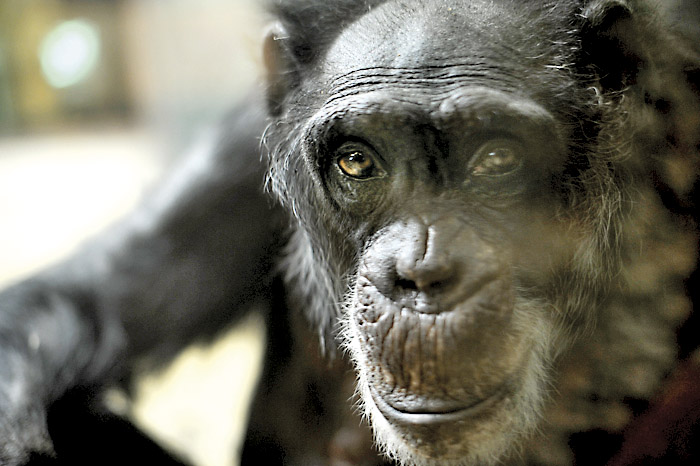
Staff File Photo by Allison Kwesell/Chattanooga Times Free Press Hank, a chimpanzee, looks through the glass of his habitat at the Chattanooga Zoo in this recent photo.
Hank the chimpanzee -- the most famous resident of the Chattanooga Zoo at Warner Park -- died in his sleep Sunday night, becoming the seventh animal to die there in the past month.
That statistic has a number of people concerned.
"It's been kind of a tough time for us, but when you deal with this many animals, you certainly do have losses," said Darde Long, executive director at the zoo. "Our zoo also has often been a home for animals that came from very bad situations."
But some former zoo workers and a local university anthropologist say the numbers bear a closer look.
"For me that's too many animals in the course of a few weeks," said Deborah Bond, who worked at the zoo for seven years until she transferred to another city job at McKamey Animal Shelter when the Friends of the Zoo took over operation of the zoo in October.
"I hear there are two different sides of every story," she said of the animal deaths. "I honestly don't know what to believe, but a lot of staff there now don't have prior experience with large animals. I think a lot of the issues happening there are due to some of the [newer] staff not being taught what to look for."
-
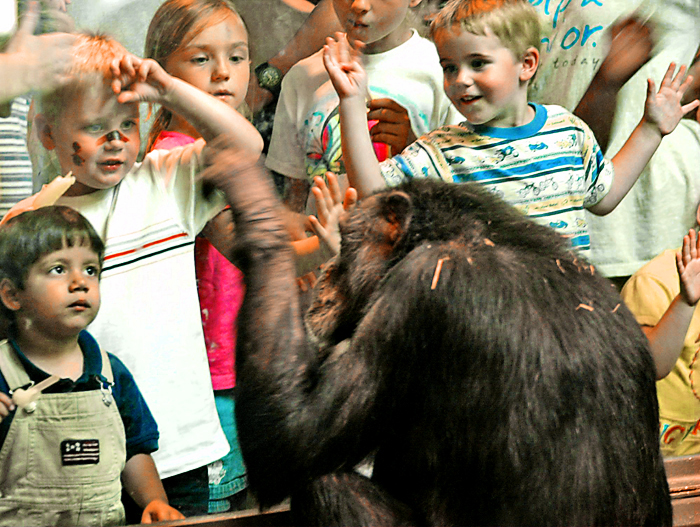
Staff File Photo by Angela Lewis/Chattanooga Times Free Press Children watch Hank at the Chattanooga Zoo during a celebration for Hank's 36th birthday.
Dr. H. Lyn Miles, a University of Chattanooga Foundation Professor of Anthropology at UTC, said she often had sought more access to Hank, who was 42, for study purposes. She now wants to know more about his death.
"I think it's great people are asking questions," she said. "These animal deaths always need to be investigated but particularly those of higher intelligence animals. We need to know more about how we can better care for them in captivity."
Long said necropsies from the University of Tennessee veterinarian school have been ordered on Hank and other animals that died recently at the zoo. Other deaths include:
* A male muntjac, a small type of Asian deer that died last month after a visitor to Holiday Lights at the Chattanooga Zoo noticed he was struggling in the koi pond, according to other former workers.
* Two marmosets that died while their regular keeper was on vacation and another keeper apparently was not scheduled to tend to them, they said.
* A female muntjac that Long said died from a twisted intestine.
* Two baby cub snow leopards that died shortly after being born outside in freezing temperatures while the cats may have been locked outside their shelter, former workers said.
Some good news is that one snow leopard cub survived the cold birthing.
Zoo spokeswoman Robin Derryberry announced the cub's birth Monday afternoon after Hank's death became public knowledge.
The Chattanooga Zoo exchanged one of its female snow leopards with a zoo in Pittsburgh to begin breeding the snow leopards. Snow leopard cubs have only a 40 percent survival rate, Derryberry said.
"We've had a few deaths, but these animals are very well cared for at this zoo," Derryberry said.
"We've been on a bit of a maternity ward binge lately with all of these births," Derryberry said, noting that last January the zoo also helped deliver two cotton top tamarin monkeys.
Hank's timeline
1968 -- Hank is born in a rain forest in Africa.
1969 -- Hank is captured and sold to a circus.
1976 -- Hank is donated to the Warner Park Zoo.
1985 -- Friends of the Zoo is established.
1992 -- "Hank's Playground" is built allowing him to walk on grass for the first time in 16 years.
2001 -- Zoo acquires five chimps from the Fort Worth Zoo. Gombe Forest exhibit is completed.
2005 -- Hank is introduced to the Zoo's eldest female chimp, Josie. This is the first physical contact Hank has had with another chimp in more than 29 years.
2008 -- Hank celebrates his 40th birthday.
2011 -- Hank dies at the age of 42.
The zoo, which is owned by the city, has more than 200 animals and is inspected by three agencies.
Tennessee Wildlife and Resources Agency captive wildlife coordinator Walter Cook said he has never seen significant problems with the zoo in the 17 years he's been checking its facilities, and zookeepers always have complied with his requests.
The U.S. Department of Agriculture is charged with animal safety and treatment inspections.
USDA spokesman David Sacks said the most recent inspection there, dated Dec. 20, 2010, shows a repeat citation -- something that automatically triggers a reinspection within 90 days.
USDA normally does one surprise inspection yearly when new problems are noted, he said. In 2010, the Chattanooga zoo was inspected twice: Sept. 29 and Dec. 20.
Among items noted by the inspector in 2010 were expired drugs in the animal hospital, inadequate pest control, an inadequate fencing issue and several thin animals for which weight records and treatment documentation were inadequate. The September inspection noted that at least one complaint about a thin animal had been filed by a member of the public.
The Association of Zoos and Aquariums also inspects and rates its member facilities every five years.
Long said the Chattanooga Zoo is among the 10 percent of U.S. zoos that are accredited by the AZA.
Pam Sohn has been reporting or editing Chattanooga news for 25 years. A Walden’s Ridge native, she began her journalism career with a 10-year stint at the Anniston (Ala.) Star. She came to the Chattanooga Times Free Press in 1999 after working at the Chattanooga Times for 14 years. She has been a city editor, Sunday editor, wire editor, projects team leader and assistant lifestyle editor. As a reporter, she also has covered the police, ...


Chattanooga will miss 'ol Hank.
It's just part of your job as a parent to educate your children. I've seen Hank many times and never witnessed this behavior. I'll have to sit down with the kids after school today and fill them in. They seem to remember bathroom humor the first time so this may follow suit. Farts are still very funny in our house!!!
How could they? Poop-munching apes prompt quest for answers
Nov. 10, 2009 Special to World Science
Nature can be beautiful. Elegant. Graceful.
But not always. Believe it or not, animals don’t do everything they do to impress us. If you doubt it, look no further than the fact that some animals eat their own feces.
This phenomenon, called coprophagy, occurs throughout the animal kingdom. It is particularly well-known among rodents, rabbits and their relatives, and—less often—dogs and apes.
The participation of this last group has caused caused particular shock among human witnesses, not least because apes are supposed to be our close evolutionary relatives.
But two new studies may offer a measure of comfort. At least, such as can be found in such a dismal situation.
The studies suggest that chimps and bonobos—the two species that are our closest ape relatives—eat poop not for its own sake, but in order to retrieve hard, nutritious seeds from it.
Coprophagy may be an “adaptive feeding strategy during periods of food scarcity,” wrote Tetsuya Sakamaki of the Primate Research Institute at Kyoto University, Japan, in a study published in the Oct. 31 advance online issue of the journal Primates.
Sakamaki reported that he spent a total of no less than 1,142 hours (48 days) watching a group of about two dozen wild bonobos at the Luo Scientific Reserve in the Congo. Among them, “at least five females… practiced coprophagy and/or fecal inspection,” he wrote.
Samakaki found most of the episodes hard to see clearly, because they occurred high in trees, but he came away with the impression that the apes were trying to get at seeds. In the most clearly visible case, a young female “used her lips to extract Dialium seeds from the feces in her hand, ate the seeds, and discarded other fibrous parts in the feces,” he wrote.
Dialum plants are members of the legume family.
A study in the April 2004 issue of the journal suggested similar conclusions regarding chimpanzees, noting that similar seed types were involved: “two types of Dialium seeds were commonly found in the feces.”
The authors of this previous study added that stress, boredom or food scarcity didn’t appear to play a role in the coprophagy. Sakamaki in the more recent study mostly agreed, except he wrote that coprophagy did seem more common when food was hard to find.
"Former employee reported, former employee reported, former employee reported....." Fact checkers, please!!
And I didn't know that Snow Leopards couldn't give birth in the cold....
Chattanooga is left with just one chimp now. He lives in Brainerd and goes by the name of Ron the Mayor
Hank was a cool champ when he did't throw feces at you.
This is one of the most disturbing articles I have read- these images just won't go away. " Two marmosets that died while their regular keeper was on vacation and another keeper apparently was not scheduled to tend to them, they said." WHAT?? Nobody was taking care of them and they died??? Whoops- we forgot to schedule someone?? Does no one else check on these animals for days and days??? " Two baby cub snow leopards that died shortly after being born outside in freezing temperatures while the cats may have been locked outside their shelter, former workers said." Is there any truth to this? This leopard that was due to give birth any time is locked outside of her enclosure? and no one is paying any attention? Why wouldn't there be a special vet taking care of this? This is not just disturbing it should be criminal neglect of an endangered species. What is going on with Zoo Management?? IS there any?? Why isn't someone there all the time keeping an eye on things? And you are all going on and on about poop, and one fool even throws in a silly useless political comment. If there is any vague truth to any of this we just absolutely do not deserve to have a zoo here.
Hey, let's try an experiment! Let's put another one of God's creatures, oh...let's say...a human, in a cage for 35 years and see if it/they develop any less than wholesome habits. Maybe we should have shocked the monkey when he exhibited these loathsome traits. Then we would have had a much more antiseptic back to nature experience for our kids. You FAILED us Hank, you imperfect specimen from the Laboratory of the Lord!
ChattCatt, It is very possible that what is stated in the article is true. The biggest problem is funding. The annual membership is negligible along with the Discovery Museum and the Aquarium. When people do not support these wonderful attractions we have for our families enjoyment the funding to properly staff and maintain do not exist. Maybe we could train some of our homeless population to tend to the animals and provide them shelter and food on the grounds of the property in return. The same could be said for the unemployed. Purpose in life is necessary. Perhaps this could be the answer. Also, dude-abides makes a very good point. Hank didn't ask to be here.
Hank lived in a enclosure with glass wall windows. He never threw pooh at anyone because there wasn't any open space between him and a guest. These arseholes are just trying to get a rise out of people because they are bored dumb rednecks with nothing better to do than to try and get some attention.
Humphrey has been there. I believe there are also other chimps at the zoo. Humphrey is a stand up guy!!!
Wildman you are a moron.
Our condolences to Darde Long and the zookeepers for the loss of the animals so long in their care.
Funding. I doubt that the recent losses of these animals has much to do with funding; yet, every time I went to the zoo years ago, it was clear: they were being ignored.
We have not funded innovation at the zoo as we should have. Instead, we provide the minimum to get by.
Apparently we spend three times as much on public municipal golf as we do on the zoo.
The zoo is an important academic and cultural resource. We spend a little over $500K on the zoo. We spend $1,817,000+ on golf.
It's time to fund the zoo as the million-dollar-plus asset that it is. I'm not sure how golf courses amount to $1.8 million when they provide little educational benefit, if any.
http://www.chattanooga.gov/Finance/66_5386.htm Reference for the figures was 2011 CABR, p.148, PDF file number 3, PDF page 68.
We need to understand that we have to fulfill our responsibilities as intelligent gentlemen when we house primates and large animals in captivity. If we give our people the assets, training, supplies and facilities they need, then the zoo can be a positive experience for everyone.
We cannot have the entire city's zoo operation rely on the efforts and goodwill of Darde Long 24 hours a day.
That means we need to give those people more support than we devote to golf.
The zoo should be funded and supported by the public as the educational and cultural resource that it is. They've had to make do long enough. It's time to double their budget. Perhaps a partnership with UT Chattanooga is somehow in order, to promote academic interest in the live animals at the zoo for passive observation. The zoo is near the university, yet it gets less press than a basketball game.
Clearly, some of our residents could use some educational support when it comes to basic facts about primates and large animals. The tone and content of some of our discussions fall below Dr. Miles' teaching of an orangutan sign language; and, the thoughtful and intelligent care Darde Long has led at the zoo; and, well, just look at what some people have to say about rare and intelligent animals.
We need to fund and position our zoo to teach more in the future.
A third of what we spend on golf is not cutting it.
Hey, Hank's on liveleak.com! Snagging a camera through the cage! Difficult to discern on which side of the fence the higher intelligence resided.
I will miss Hank. Boo at the Zoo was a blast because he would sit there and for no other reason than his love for us ignorant, redneck humans, entertain us. He never failed to bring a smile to my face. I miss his eyes, he would never break a gaze. I wish his life would have been better, but I am glad he ended his days at this Zoo, instead of in a lab.
Or login with:
New Account