
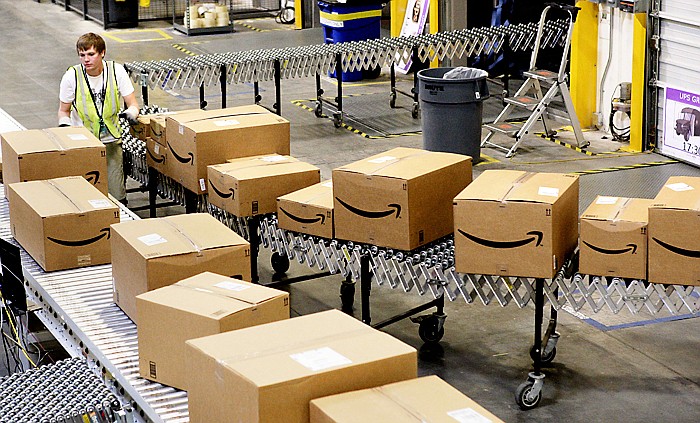
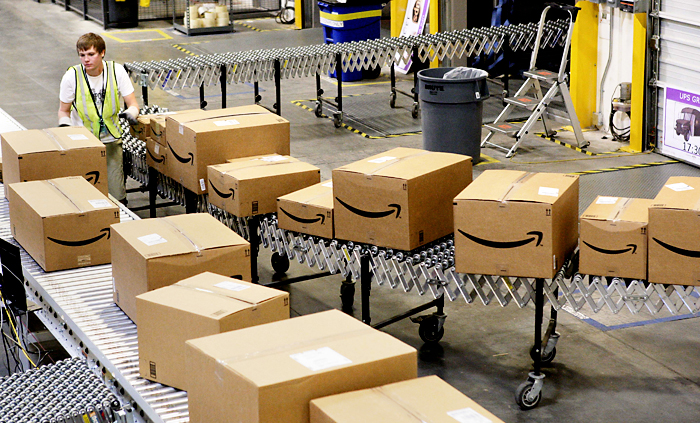
 A worker separates packages for final shipment inside the 800,000-square-foot Amazon.com warehouse in Goodyear, Ariz. (AP File Photo/Ross D. Franklin)
NASHVILLE - A national retailers group is running ads in Nashville, Knoxville and Memphis newspapers urging state officials, including Gov. Bill Haslam, to require Amazon.com collect sales taxes on items it sells in the state.
The ad campaign by Arlington, Va.-based Alliance for Main Street Fairness comes as Amazon, the world's largest online-retailer, moves to build two distribution centers in Southeast Tennessee under an economic development deal struck with the state and Hamilton County.
One of the two ads features two televisions side by side and asks "What's the difference between" them.
It says one was purchased "at a store in your community" that collected sales taxes "turned over to your state government on your behalf." The other, it says, was purchased from Amazon, which did not collect the sales tax. It questions the "fairness" and urges there be "no special loopholes" for Amazon.
While calling it "good news" that Amazon plans to spend $139.1 million to construct the centers in Hamilton and Bradley counties, the ad later cites Tennessee's budget woes.
"Why would the state let Amazon get away with not collecting and paying the biggest source of revenue in Tennessee: its sales tax?" the ad says. "Look at it this way: Amazon.com wants a special deal that hurts Main Street businesses."
Elected officials "should say 'No' to that" the ad says and directs readers to call Haslam's office and "Tell him NO MORE loopholes for Amazon.com."
Amazon officials did not respond to multiple requests for comment. The Alliance for Main Street Fairness, which says it has small and national retailers among its members, also ran similar ads in newspapers outside Chattanooga earlier this year.
The group is waging a multistate battle to compel Amazon to collect sales taxes.
As the issue continues to boil, lobbyists for national retailers such as Wal-Mart are talking to the Haslam administration and lawmakers.
"We hope that Tennessee's executive branch, legislators and regulators will work to stop what amounts to a backroom deal that has unfairly chosen winners and losers in the marketplace and drains much needed resources from Tennessee residents," said Daniel Morales, Wal-Mart's director communications and community relations.
Unlike conventional brick-and-mortar retailers, Amazon doesn't collect taxes on most of its sales in Tennessee and 44 other states. It is able to avoid doing so under a 1992 U.S. Supreme Court decision that says states can only compel companies with an actual physical presence to collect sales taxes.
Amazon officials in previous interviews have defended not having to pay sales taxes in Tennessee. They say the distribution centers are "drop centers" for shipments of items and have nothing to do with actual sales in Tennessee. Customers, for example, would not be able to pick up or return items at the centers, Amazon says.
Haslam, who inherited the Amazon deal from his predecessor, Gov. Phil Bredesen, said in Chattanooga earlier this year that "I don't think because Amazon decides to build a distribution center here, that should change their tax status."
He said earlier this month that he would work with fellow governors to persuade Congress to adopt rules to govern taxation of Internet sales.
"The governor believes the issue of internet sales tax collections is one that will require a unified effort between states but, as he has said previously, he doesn't believe it should impact the [Amazon] project at this time," Haslam spokesman Dave Smith said Wednesday.
Making "the Amazons of the world" collect sales taxes "will have to be a 50-state effort," agreed House Majority Leader Gerald McCormick, R-Chattanooga, in whose district one of the Amazon centers will be located.
"They will simply pick up and move to another state if we don't let them have a distribution center here. And that's what it'll be - a distribution center - and I'm in favor of it," McCormick said.
He said he was visited by lobbyists associated with the Main Street group, which he said is "ironic ... since Wal-Mart is the biggest company involved in that, and they've wiped out a number of Main Streets in Tennessee."
But the issue has local retailers concerned too, said Kim Smith, owner Chattanooga's JK3 SoftWear, an outdoor clothing company.
Smith said that in addition to being unfair to "brick and mortar" store owners such as herself, the Amazon deal would result in fewer sales tax dollars going toward public education.
"I can't believe they [Tennessee] would make that kind of a deal," Smith said, noting her home state, Texas, recently "sent Amazon packing" when officials there demanded the company pay $269 million in uncollected sales taxes.
Amazon responded by announcing it was closing down a Dallas-area distribution center.
Tennesseans may never know whether the state carries through or not with allowing Amazon to maintain its sales-tax free status despite the distribution centers.
"I can't talk about any certain taxpayer because that's all [under] taxpayer confidentiality," said Glen Page, Revenue's deputy commissioner over tax administration, citing privacy laws.
Last month, Revenue dropped plans for a public hearing on a would-be rule proposed by the Bredesen administration. It sought to exempt "any dealer operating as a distribution center" from collecting Tennessee state sales taxes if at least 50 percent of its gross receipts come from shipments on behalf of another vendor "to destinations outside this state."
Officials at the time claimed that was because of a general freeze on new regulations. Revenue officials refused to say whether it dealt with Amazon and still do.
"If we have a rule change we will follow the public rules that make it public notice to notify people," Page said. "I don't know if that's going to take place at this point. At this point I don't know if it's going to come back or not."
There is talk in legislative corridors that Revenue may issues a "private letter ruling" exempting Amazon from having to collect sales taxes. Page said such rulings are issued "all the time" but refused to say whether one has or might be issued for Amazon.
The companies cannot be identified, Page said.