

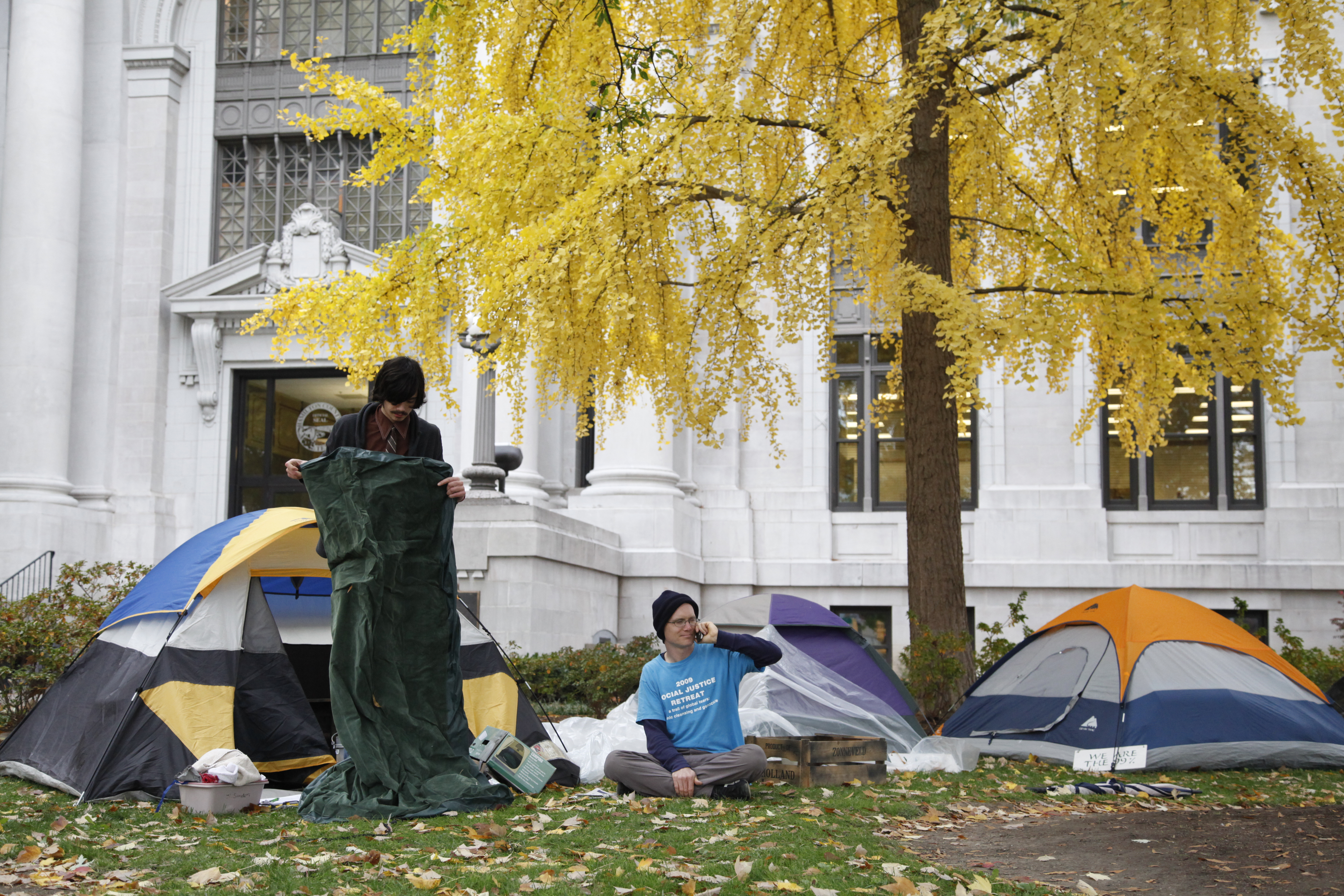
 Daniel Patterson folds up a tarp as Landon Howard makes a phone call at the new camp site of Occupy Chattanooga in front of the Hamilton County Courthouse Wednesday morning. Tuesday night occupiers moved from their original camp in front of the Chattanooga City Council building to the courthouse.
Hamilton County commissioners held a private meeting with County Attorney Rheubin Taylor on Friday to discuss the Occupy Chattanooga protesters camped out on the county courthouse lawn.
The meeting was not announced as required by the state's Open Meetings Act, also known as the "Sunshine Law." Taylor said a Tennessee Supreme Court decision allows some meetings about legal issues to remain private on the grounds of attorney-client privilege. When called during business hours to cite the decision, Taylor did not return the call.
Commissioner Fred Skillern, who did not attend the meeting, said later he was "almost certain" the topic was what to do about the group of protesters that assembled on the courthouse lawn Tuesday night after moving from its previous encampment at City Hall.
"They called, and I gave them my opinion," Skillern said. "I think they were just being briefed by legal about what we could do and couldn't do."
Skillern said those camping in tents on the lawn "are doing things we wouldn't allow the average citizen to do."
Six other commissioners reached by the Chattanooga Times Free Press on Friday afternoon confirmed they attended the meeting and declined to comment about the topic, citing its legal nature. One said the meeting lasted more than an hour.
Asked early Friday about the county's rules for use of the courthouse lawn, county spokesman Mike Dunne said in an e-mail that "Attorney Taylor has informed me there is no county code governing the property's use."
At least twice, the state Supreme Court has said the Sunshine Law allows public bodies to meet privately with an attorney about pending litigation. Taylor said the topic did not involve a suit now in litigation.
The law applies to meetings where commissioners "deliberate toward a decision on any matter," not just ones in which they vote.
According to the state Supreme Court, "Once any discussion, whatsoever, begins among the members of the public body regarding what action to take based upon the advice of counsel, whether it be settlement or otherwise, such discussion shall be open to the public and failure to do so shall constitute a clear violation of the Open Meetings Act."
STATE EFFORTS
The state's effort to oust Occupy protesters from Legislative Plaza in Nashville twice has been stopped by legal hurdles.
On Oct. 27, the state Department of General Services imposed a 10 p.m. curfew. Over the next two nights, state troopers used the curfew to arrest 55 protesters.
Both times, a Nashville magistrate refused to jail protesters, saying the state lacked authority to set a curfew requiring protesters to leave the plaza or face arrest. Those arrested were released with citations.
Protesters sued the state, citing a violation of their First Amendment rights. On Oct. 31 a federal judge issued a 21-day restraining order against enforcing the curfew.
State officials said Thursday that Gov. Bill Haslam would ask prosecutors to drop charges against the protesters arrested last month.
SUNSHINE LAW
The Tennessee Court of Appeals has held that the Open Meetings Act broadly "protect[s] the public against closed-door meetings at every stage of a government body's deliberation."
The full body held a public agenda session Thursday. Commissioners didn't talk about the Occupy protesters, and no commissioner offered an agenda item on the topic for a future meeting. The commission's regular business meeting is set for Wednesday.
The Associated Press contributed to this report.