
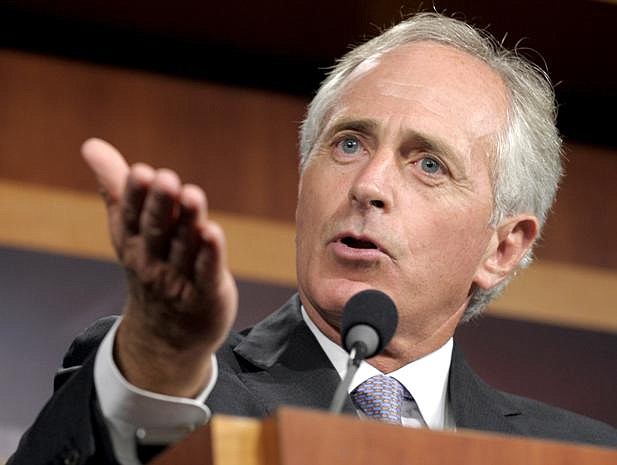
 Sen. Bob Corker
Bob Corker proved over his first term in the U.S. Senate that he is willing to take on huge tasks. He managed the GOP's role in financial reform and the auto industry bail-out, for example, and quietly attempted to push his party toward a more progressive view on health care reform. So it's no surprise that he is trying to secure a bipartisan compromise on deficit reduction to avert the so-called "fiscal cliff" of year-end spending cuts and tax increases that could push the nation back into recession.
The harsh, across-the-board spending cuts in federal programs and general tax increases, which were to be accomplished by allowing the Bush-era tax cuts to expire, were mandated by the 112th Congress last year to force Congress and the White House to agree to a more orderly path toward deficit reduction. That has proved to be virtually impossible, mainly because Republicans have joined in lock-step opposition against gaining some new revenue for deficit reduction through tax increases on the super-wealthy to offset the burden to ordinary Americans of extremely deep spending cuts in Medicare, Social Security and Medicaid.
Corker, in a new 242-page bill, offers a way out of the impasse by proposing a $50,000 limit on tax deductions that would generate $750 billion more in federal revenue over the next decade. (The opposite page carries a column by Corker on his bill which appeared Monday in the Washington Post.)
The deduction-limit Corker proposes would, by its nature, fall largely on the super-wealthy, who currently reap the lion's share of the Bush-era's high-end tax cuts on dividends and gifts, as well as a lower marginal tax rate on income. Though it does not mandate a straight-up tax increase, it would effectively -- and very fairly -- help accomplish the revenue goal Democrats seek.
Corker's proposal apparently skips over the huge loophole of a "carried interest" tax treatment which allows big hedge-fund managers, for example, to pay just a 15 percent rate on earnings from megamillion-dollar investments, but his bill certainly could be vehicle for reform of that appalling giveaway. It also questionably avoids the jungle of tax reform and elimination of corporate tax loopholes, which generally allow most American corporations -- and especially the very richest ones -- to avoid paying taxes at anywhere near the standard rate, if they pay any at all.
That could be forgiven, at least in the near term, if the Corker plan proves a viable route for avoiding the fiscal cliff, which is set to take effect January 1. Corker reasonably argues that his plan does constitute a feasible way out of the pending dilemma. In fact, it may even surpass the $4 trillion in deficit reduction that was envisioned as the "grand bargain."
The math for this is plausible. Congress and Obama have already passed tax measures that will generate an estimated $917 billion in new revenue over the next decade. Added to that would be savings of around $900 billion earmarked for military overseas contingent operations, including the winding down of the war in Afghanistan. Corker further calls in rational phased adjustments in the age for entering Medicare and Social Security, for means testing higher-income recipients, and for revising the formula for indexing inflation and federal benefits.
Indeed, he thinks Congress can easily reach $4.5 trillion in deficits, and he argues passionately that it is time, at last, for Congress to embrace this challenge. His bill offers a well-crafted and welcome opening; Congress dare not walk away.