
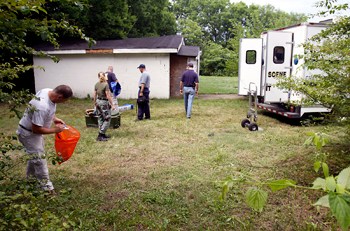

As forensic experts at the University of Tennessee work to identify bones discovered this week in an Arlington Avenue yard, clues about the possible victim have cropped up.
Chattanooga police Capt. Tim Carroll said early in the investigation that human remains found at the site Tuesday are possibly linked to a man reported missing nine years ago.
Police would not name the person, pending identification by scientists at the UT Forensic Anthropology Center. Capt. Carroll said police had contacted the missing person’s family to keep them informed.
Forensic anthropologist Dr. Natalie Shirley said they’d recovered an almost complete skeleton, shoes, socks some remnants of upper body clothing including a jacket, and teeth.
The teeth could prove crucial.
“If we can go by dental records, we do that first,” Dr. Shirley said Friday. “That’s the fastest way to do it and the cheapest.”
Police now are looking for dental records to help the center with identification, she said.
National databases of missing persons called the Charley Project and the North American Missing Persons Network each show only one person listed missing from Chattanooga in 2001 — Garrison Duane Baker.
According to the websites, Mr. Baker was last seen at his grandmother’s Derby Street home on Jan. 9, 2001. He was 30 years old at the time and, according to the websites, “involved with drugs and criminal activity at the time of his disappearance.”
Linda Battle, Mr. Baker’s mother; and his grandmother, Margaret Drew, told local television stations that they believe the bones discovered a two-minute walk from their home are his.
When reached at her home Thursday, Ms. Drew said police had told her not to talk with anyone. Ms. Battle could not be reached for comment.
Mr. Baker was not reported missing for about 18 months because his “wife and his mother each thought the other person had filed a report,” according to the Charley Project site.
Chattanooga police acted on recent tips to check a site at 553 Arlington Ave., where ground-penetrating radar and archaeological sifting techniques discovered bone fragments and “obvious human remains” on Tuesday, said Capt. Carroll.
UT forensic experts completed the excavation Wednesday and transported the remains to their Knoxville center for further work.
Police said they did not know when they might receive more information on the evidence.
Continue reading by following these links to related stories: