
Editor’s note: first in a series.
Warm weather finds local residents enjoying the many Chattanooga and Hamilton County parks that beckon families to put aside their digital screens and journey outside to commune with the trees, green spaces and the glorious Tennessee River and its tributaries.
Interestingly, conversations regarding parks began in the early 20th century among the city’s leaders. By 1910 they had decided to take action.
(READ MORE: Local History: Mitchell’s Gazetteer reports on Hamilton County in 1860)
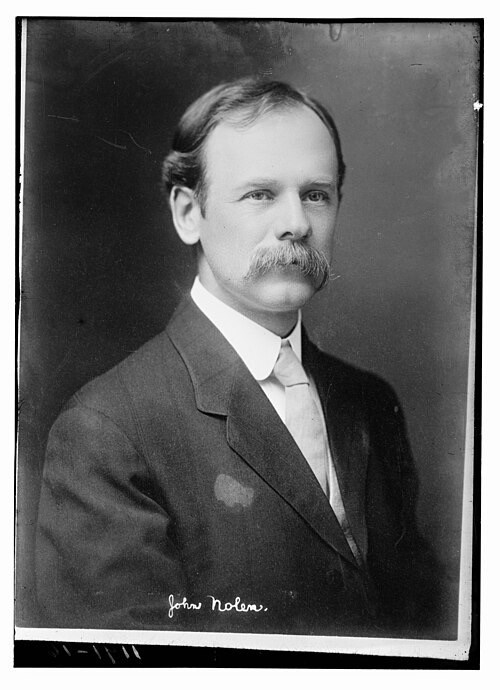
A Chattanooga Daily Times headline on July 6, 1910, read, “John Nolen, Chattanooga’s City Planner,” with a supporting note that proclaimed the “Wisdom of Local Park Commission” in retaining Nolen’s services. The story referred to a prominent article in American City, a municipal affairs magazine, touting Nolen’s vision in revitalizing Reading, Pennsylvania, a city of approximately 100,000, not unlike Chattanooga with its “beautiful valleys, rugged mountains and a river of great possibilities.”
Horace McFarland, president of the American Civic Association, praised Nolen: “Wisely counseled, the advice of an expert was sought and found in the person of Mr. John Nolen of Cambridge, Massachusetts, not a mere landscape architect but one of a circle of men, as yet small in number, who have made a specialty of city planning and replanning.” Nolen’s gift, according to the text, involved “making the best of what already exists, without too great upheaval and expense, as well as planning wisely and at once for a long future.”
McFarland’s words still ring true in Chattanooga, as 116 years later the plans advanced by John Nolen are visible in the footprint of our parks and outdoor spaces.
How did Chattanooga identify John Nolen and ask him to offer suggestions for maximizing Chattanooga’s natural beauty and encourage family involvement in outdoor spaces?
The quest for a visionary parks plan began over a year earlier with extensive research, conversations and proposals culminating in a public meeting on Thursday, June 30, 1910, at the Chattanooga Public Library. In the audience were Parks Commission President Ross Faxon, Judge Martin Fleming, Mayor William Frierson, Lewis Coleman, William Swaney and “a number of other men prominent in the business and political affairs of the city, beside a large contingent of the City Beautiful Club members.”
(A 1907 report in the Atlanta Georgian described a sanitary campaign in Chattanooga being “spurred on by the ladies of the City Beautiful Club.” The organization was working with city officials to enforce the garbage ordinance and improve the city’s appearance. By 1914-15, the organization was sufficiently established that the national “Woman’s Who’s Who of America” listed Chattanooga women as member of the club.)
Within moments, according to the Times, Nolen had the audience’s attention. The reporter noted that Nolen used “no notes and has his subject so thoroughly in hand that he imparted with ease his wise knowledge.” He reminded his listeners that the municipal leaders had realized that “all the citizens need to love their city … men and women can truly love their city when it is made lovely.” This new focus in city planning included “transportation for both business and pleasures, sanitary housing for the poor, parks and driveways, playgrounds for the children and a cumulative effect in the placing of public buildings.”
He reminded his listeners that the expenses associated with planned design “could be extended over a series of years — ten, twenty-five, fifty or even more.” He stressed one final point: “If the city is sordid and ugly, lives of its citizens will be sordid and mean, but if beautiful and lovable, its influence will be incalculable for good.”
His presentation, including a question-and-answer period, was followed by a series of brief “talks” by Mrs. Dwight Montague, Mrs. H. Clay Evans, Benjamin Frits and Chief of Police Thomas McMahon. More questions and general discussion led to the introduction of a resolution regarding “the removal of all overhanging signs on downtown streets” by Edward Abbott, which was unanimously adopted. The resolution included a “thank you” for “the City Beautiful Club due to Chief McMahon and the sign committee of the Merchants’ Association for their efforts to make Chattanooga look like a real city and less like a country village.”
Following the initial first step toward beautifying downtown Chattanooga, Faxon shared that Nolen would leave the following morning for Boston but would begin regular returns to Chattanooga to work with the “city fathers and the park commission in regard to the projected improvements.”
Three months later, John Nolen returned. On Oct. 27, 1910, the Times announced “John Nolen Here and Ready for Business: Plans for Modern Park System Will Assume Definite Shape Now.” The Chattanooga City Council had approved an initial $2,500 for Nolen’s services in identifying current and future park work required so that in “ten years hence … this city may rank with the larger cities of this country in respect to its park system.”
Linda Moss Mines is the official Chattanooga and Hamilton County historian. For more on local history, visit Chattahistoricalassoc.org.