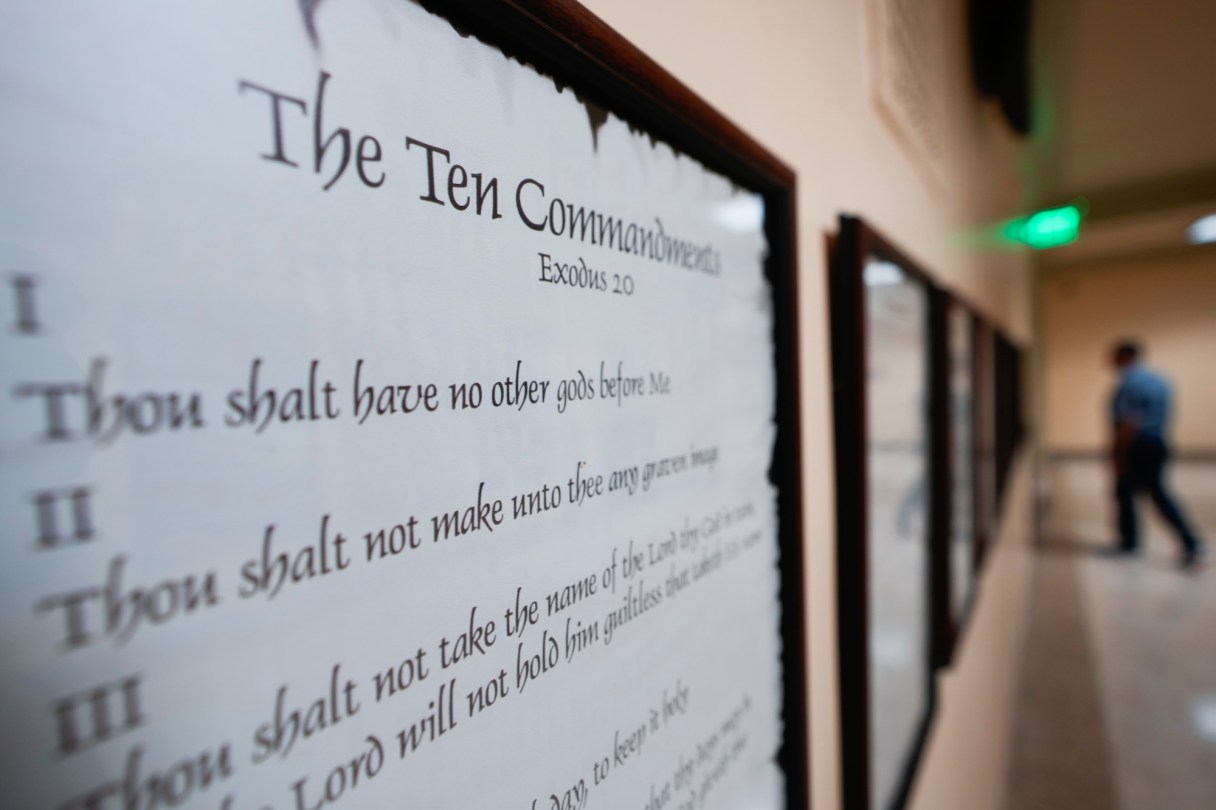
Despite numerous displays of Judeo-Christian symbols adorning our nation’s capital, including three representations of the Ten Commandments in and around the U.S Supreme Court, some folks are not happy with those displays in public schools. One is Mark Herndon, who took to these pages Oct. 11 to post his displeasure.
Mark frames his argument around the religion of his early experience — one that was characterized by “prejudice or conservative fundamentalism or any warped translation of the Bible” and a “Christian heritage” that included slavery, racism and patriarchy.
I get it. There has always been heterodoxy and heteropraxy in the church. The apostle Paul was quick to dress down churches for their failure to teach and practice the faith they received. But that doesn’t justify scrubbing religion, including the Ten Commandments, from the public square.
All institutions have a subset of hypocritical, misguided and corrupt people in their ranks. But no one is suggesting that we keep science out of schools because some people used it to promote eugenics, produce WMDs or develop super-viruses. Or that the Hippocratic oath should be eliminated at medical schools because there are instances of medical malpractice and quackery. The same restraint should hold for religion.
Mark suggests that his opposition to the display of the Ten Commandments is not out of disregard to the principles, per se, but because it “confuse(s) the governing document of our nation with the religious principles we hold.”
However, the governing document of our nation, the U.S. Constitution, is based on religious principles. The founding text, the Declaration of Independence, opens by acknowledging “the laws of nature and of nature’s God,” refers to the “creator” who endows man with “certain unalienable rights,” makes appeal to the “supreme judge of the world,” and closes with an expression of trust in the “protection of divine providence.”
Forty years after penning the Declaration, Thomas Jefferson explained to a friend: “We are not in a world ungoverned by the laws and the power of a superior agent. Our efforts are in his hand and directed by it; and he will give them their effect in his own time.” And this from the man who is considered one of the least religious of the Founders.
That aside, a religious symbol like the Ten Commandments is a value statement of the institution (or individual) displaying it, not direct or inferred connection to the Constitution.
In the end, it would be hard to deny that universal adherence to the second tablet of the Decalogue, detailing our duty to our fellow man, would preclude nearly all of the hurt, harm and misery caused by humans on other humans. The first tablet, identifying our duty to God, reminds us that the principles of the second tablet, as well as those that undergird our concepts of justice, equality and human dignity are enduring because they derive beyond the mind and will of man and are not subject to the vagaries of popular opinion or the strength of the iron fist.
Consequently, the display and promotion of the Ten Commandments in public education as a commendable moral framework should be something that people of good will find uncontroversial.
Regis Nicoll is a retired nuclear engineer and a fellow of the Colson Center who writes commentary on faith and culture for a number of print and online publications. He lives in Chattanooga.