
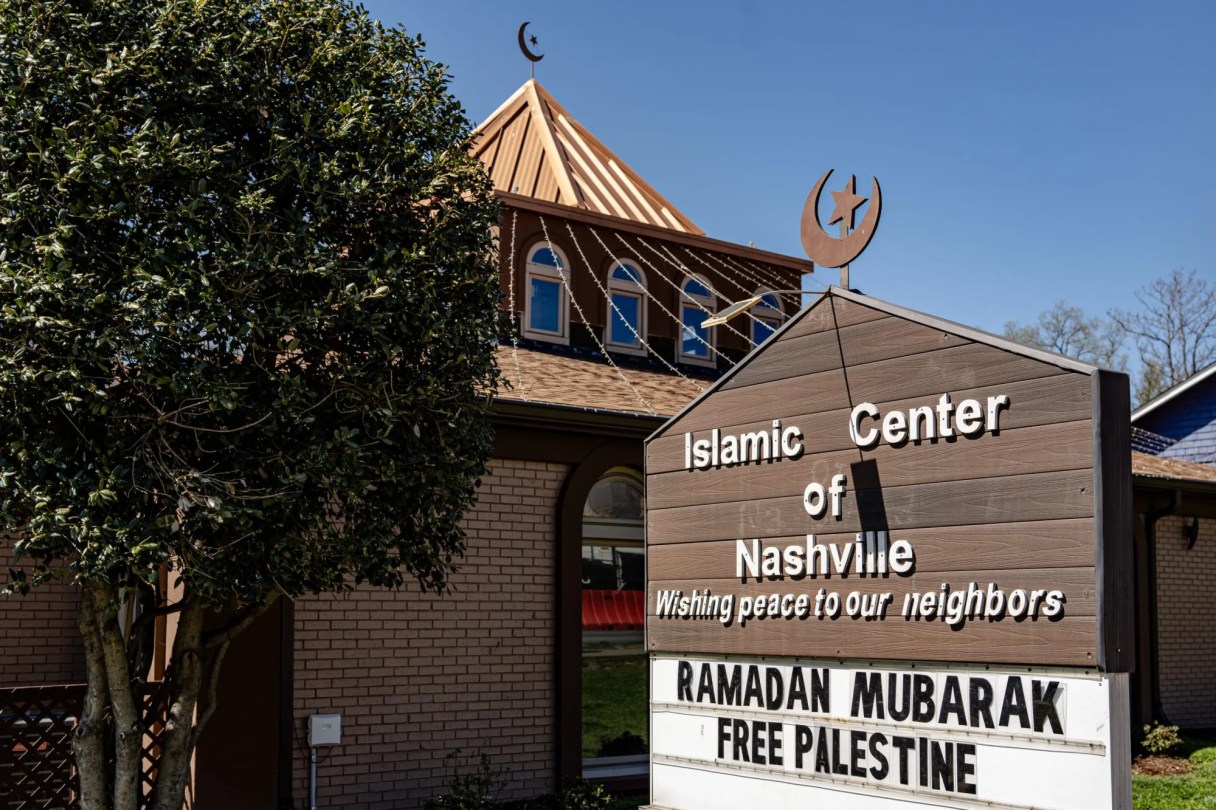
When a white nationalist posted up outside of the Islamic Center of Nashville to tout a hateful and out of place message, he may not have anticipated what would happen as a result.
Neighbors near and far rallied behind the Nashville institution — one of the oldest mosques in Tennessee, a center that has for decades opened its doors indiscriminately, as a place of gathering, education and celebration, in addition to worship.
“It’s a waste of so much of our time and energy. We’re tired of trying to justify our existence in our community,” Rashed Fakhruddin, the mosque’s director of outreach and community engagement, said. “Muslims are here. We’ve been here.”
This is far from the first time his community has navigated this kind of display of hatred, and, Fakhruddin admits, he’s tired of it. But that’s part of why he thinks it’s important to give more attention to the outpouring of support that followed.
“There are a lot of communities in Nashville that go through these episodes, and it’s important to show the support that comes after the hate,” Fakhruddin said. “That emotional support is so important. Otherwise people feel alone.”
‘We’ve got to stand up for our friends’
Historically, the Islamic Center of Nashville has been an anchor of the neighborhood. In 1979, before the area even was known as “12South,” after meeting through Friday Jumu’a prayer at a center on Vanderbilt’s campus, a community of 40 or so practicing Muslims purchased an old house at the corner of Sweetbriar and 12th.
In 1981, Kay West, the Nashville Scene’s longtime food critic, left New York City and moved to what is now 12South and Belmont/Hillsboro. She described once-glorious bungalows and Victorians divided into two, four and even six apartments, offering cheap rent to artists and musicians. Some wealthier neighbors labeled the area the “Bad Side of Belmont.” For that population and anyone who was curious, West described certain local institutions, like the original International Market, as “magnets.”
This was the area in which the original Islamic Center existed, and its members began to reach out to their curious neighbors. CJ Hicks, now a member of Belmont-Hillsboro Neighbors, moved to the neighborhood in 1982. Neighbors at ICN were some of the first people she met. In those years, in addition to running bake sales and potlucks with their signature baklava, the center offered Islam 101 classes, meant to help Nashvillians — a heavily Christian population at the time — understand the similarities between their faith and how Muslims prayed.
“I’m not particularly religious,” said Hicks of the classes, which the center still offers today, “but those were really formative for me.
“As I was trying to grow my worldview as a young woman, this was an opportunity to meet people who didn’t look like me, didn’t worship like me, but that all had the same thought: They wanted to live a peaceful, happy life and wanted to reach out to their community, help build community.”
Over the years, the center has expanded, razing the original house and building a full mosque on the same lot in 1989. In recent years, there has been a respectful dispute between the center and the neighbors over demolition a house across the alley from the center to accommodate more parking. On Friday nights, the mosque is always buzzing, which can create considerable traffic at the corner of 12th and Sweetbriar — albeit no more than usual Friday night business in 12South. Throughout it all, said Tom Campion, current president of Belmont-Hillsboro Neighbors, one thing remains true: “They’re a good neighbor.”
In the wake of the recent attack, Hicks said, those who know about what happened have the same attitude: “We’ve got to stand up for our friends,” she said.
“That that person can do such an ugly thing to one of our neighbors and not be reprimanded in any manner is troubling,” she said. “There’s no reason for that kind of ugliness in our neighborhood. There’s no reason for that kind of ugliness anywhere.”
For the last three years, Rebekah Percival has worked at MODA Boutique next door to the center. The entities feel a sense of solidarity as longtime 12South residents, something of a rarity these days. She recalled that she had just opened the store around 10:30 on Thursday morning. A small group of customers came in, then left to film something.
“Some guy’s yelling some weird s—- out there,” one of the group’s members told Percival when they returned to the store.
“It’s this TikTok-er,” the rest of the group said when they came back inside. “He’s spewing racist s—-.”
Percival’s first reaction was revulsion. At the time, Percival said, she didn’t realize the mystery TikTok-er — Jake Lang — was specifically attacking the mosque. The customers said they were filming him and yelling at him, calling him names. After 10 minutes in the mostly empty streets, the whole thing was over, and the truck had left.
The next day, on vacation and scrolling social media, Percival realized that his target had been the mosque. She immediately sent a message to Fakhruddin, making sure he was OK. She sent him the video she’d seen of Lang to “help with the investigation.”
“I mean, the investigation should be over,” she added. “He should be arrested. I’m the child of an immigrant. My dad is Jewish. I am a full believer in freedom of religion, and [what happened] was disgusting. Like, that’s where people go to pray. I think saying [those things] anywhere is absolutely disgusting, and I would never idly stand by and not support people.
“But I think doing it in front of a [mosque] is even worse.”
Percival said those at the center are great neighbors. Fakhruddin always brings cards with little candies around Christmas, always stops by to chat. Retail on a busy street can get crazy, and he’s offered to share the center’s security with the boutique. He’s extended an open invitation for a tour of the mosque, which Percival plans to take him up on soon.
Fakhruddin, for his part, doesn’t seem to have to think too hard about this. Being a good neighbor, to those near and far, feels ingrained. It’s fundamental to the teachings and practice of Islam — the Prophet Muhammad says, “The best of neighbors to Allah is the one who is best to his neighbors.”
“They’re great people,” she said. And even if they weren’t, she added, “they’re also people who deserve to worship in peace.”
‘We’re glad you’re here’
Waqas Ahmad first moved to Nashville in 1997, when he was nine years old. His family immigrated to the U.S. from Karachi, Pakistan, and, after stints in New York and New Jersey, eventually opened Shalimar, a popular Indian restaurant in Green Hills.
Ahmad quickly became a part of ICN’s community. As a teenager, he sat in on a meeting to revamp 12South on behalf of the center. When he left for college and dental school and spent time in Knoxville, Memphis and Little Rock, whenever he found a local mosque, he shared how ICN did things. The center was a big reason he moved home in his mid-20s.
“[ICN] is the inspiration for a lot of my activism and kind of extracurricular stuff,” he said.
Ahmad is on the security team at the center, and heard about the truck and the sign through a text message. His first reaction was confusion.
“When I first saw it, I was kind of like, ‘Wow! Why would he waste his time here?'” Ahmad said. “There’s no issues [here]. No controversies. No problems.
“But then I realized, within the same day, ‘I think this is gonna backfire on him.’ Like, I think this is gonna be problematic for him and the people who think this way.”
Ahmad had also heard that, during Lang’s brief stay, people from the surrounding areas had told him to leave.
In the early 2000s, Ahmad recalled that, due to a lack of mosques in the area, ICN used to be so full that some people had to pray outside on the sidewalk. And in the wake of 9/11, some protesters had shown up with weapons.
“This is nothing new for us,” Ahmad said. “It’s very juvenile, very immature, right? But our response to that is, ‘Hey, you seem to have a problem with us. Why don’t you come talk to us about it?’ Just come and observe. Our doors are open.”
After the attack, Ahmad appreciated little gestures in the neighborhood. He said he felt like the neighbors had their back, and added that the center was usually there for their neighbors, too. Many people voiced their support on the center’s social pages. When he came in for a coffee after Friday prayer the next day, the baristas at Frothy Monkey asked if he was OK, emblematic of the good relationship the center has enjoyed with neighboring businesses. During Ramadan, the White Bison a few doors down stayed open later so that people could grab coffee after the evening prayer. The assistant manager at White Bison was new to the religion — a revert in Islamic terms — and had started to attend ICN.
“I don’t understand the ideology of folks like Jake Lang,” Ahmad said. “Not really sure what they’re trying to get at or achieve in terms of dividing people into categories. But Muslims have been in the United States since the 1800s. Like any other community, we have some of the most successful and most downtrodden people in the U.S. and everywhere in between.”
The morning after the attack, Ahmad noticed a group of kids and adults had gathered outside the center. He was distracted because a man’s car battery had died at the stop sign outside ICN, and Ahmad was assisting him.
After he finished with the car, he saw that a message had appeared on the sidewalk, written in colorful chalk. The artists have remained elusive. They wrote the message and disappeared. They haven’t sought any credit, perhaps not wanting to make it about themselves.
“We stand with you,” their message read, followed by a heart surrounding “love your neighbors.”
“We’re glad you’re here.”
______
This article first appeared on Nashville Banner and is republished here under a Creative Commons Attribution-NoDerivatives 4.0 International License.