
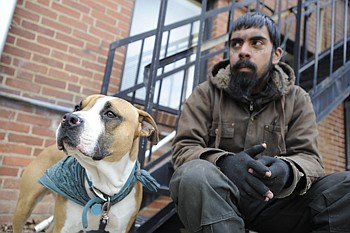

For days he lived in the background of the train yard, hiding behind boxcars and lingering near brushy areas within view of the tracks.
Nails is a veteran among the traveling kids. Still, he hates waiting for the freight trains to come, sitting quiet and sober for hours on end, listening for rumbling down the steel rails.
Then he hears it, the engine, the whistle coming. He struggles off the ground and gets ready.
He throws his heavy backpack over his shoulder and puts a strong hand on his dog, Dante. He tells his traveling partner, a girl with dirty clothes and fire-red hair, to move.
As the train slows, he eyes the metal ladder outside of the engine unit.
Running, he counts.
One -- left hand -- grip.
Two -- right hand -- grip.
Three. He drives his foot toward the bottom rung.
If it misses he will force his knee through the hole in the ladder, anything to keep balance, to save his foot from being lodged under the train wheel and ripping him under the metal behemoth.
His foot catches the step.
Four -- his other foot catches.
He pulls himself up onto the small space at the end of the car, grabs his dog and pulls up his partner, Leilani.
"Get down!" he says, falling on the icy platform, scanning the area for bulls -- train police -- as the train barrels out, carrying them toward their next fork in the road -- Chattanooga.
You have seen them at the edge of the Walnut Street Bridge, on the stoop outside the Signal Mountain Wal-Mart, lying on the grass in Coolidge Park -- kids with skinny dogs, wearing workmen's clothes stained by the black grit of other cities.
Maybe you threw them some spare change for food or curled your nose when you smelled them walking past. Maybe you saw them and wondered where they came from.
They came by train.
Train tracks have been the backbone of Chattanooga, the first major railroad town of the South. Most locomotives bound below the Tennessee line once passed through the industrial city. The multiple rail lines that merged and crossed made it a place where directions changed. Cargo on barges floating down the Tennessee River was loaded onto boxcars that cut north toward the Appalachian Mountains or south to the Florida panhandle.
But with the tons of lumber and coal, the trains brought strangers into the city, too -- hobos, criminals, draft dodgers and runaways. In recent years the train yards have been a playground to young tramps calling themselves names like crusty punks, gutter punks and traveling kids.
* * *
Snow fell as Nails came into Chattanooga. Walking away from the train yard on the edge of downtown, he began wandering the streets of the city, searching for shelter. He looked at boarded-up warehouse buildings on Main Street, narrow alleys and abandoned homes on the North Shore, any place to break the burn of freezing wind.
He had to take care of his traveling companions: Leilani, an 18-year-old California girl who was traveling by train for the first time, and his dog Dante, a mutt he raised from a puppy.
Nails, 24, is muscular and short with dark skin. Tattoos cover his face. Dots under his eyes represent the years he has ridden the rails. Train tracks curve over his eyebrows. A chaos star, the symbol of anarchy, is stamped between them.
They found a place on Tremont Street, a two-story brick house with broken windows and an overgrown lawn. In a small room on the second floor they laid out their sleeping bags. They lived off fast food and bologna and peanut butter sandwiches. When they needed money they sat outside the local Wal-Mart clutching Dante and holding a cardboard sign: "Traveling Folk Hungry and Broke."
Most drivers passing by don't lock eyes with them, but some take pity. One graying woman in a white SUV slows and rolls down her window to hand them $50. "Take care of that dog," she says.
"Thank you. We will."
Nobody passing them knew that under the grime and inking across his skin was a man who didn't know if he could live hand-to-mouth much longer.
Nails was tired. He felt pain in his knees. His back hurt like a man more than twice his age.
A thousand miles away, his parents prayed for him to come home.
He had a decision to make.
* * *
Nails can't hear over the band in the crowded house off Spears Avenue. People pour in through the door before midnight. Tattooed kids with rings in their noses and gauges in their ears mash close together, some grinding, overflowing onto ripped furniture. Drinks splash out of plastic cups. A heavy cloud of cigarette smoke mixes with the dank smell of body odor. Someone passes around needles.
There were parties like this in every city Nails came to. Illegal house parties that drew punks, travelers and underagers hungry to get high, get drunk and have a good time. Being dirty and having the marks on his face were always a ticket in.
The next day, his head pounding from a hangover, he sits outside a café downtown with Leilani and new friends.
"I didn't know you could drink that much beer," Leilani says.
"Trashed out of my mind," Nails says.
"You almost got in a fight with that kid," she says.
"He was mouthing off. Doing stupid s---."
A girl from the night before, with platinum blonde hair and a gold front tooth, smiles at him.
"A lot of the girls said you were really pretty last night," she says. "Those big brown eyes."
"Nails has a lot of women," Leilani says. "Hos in all the area codes."
His cell phone rings. They all look at him. He had told Leilani the phone was paid for by a woman out West who liked dirty kids.
"Sugarmomma," she screams.
"The fancy cars, the women and the caviar," he croons. "You know who we are, cause we pimpin' all over the world."
He clicks the call over to voicemail.
He doesn't tell them it was his parents.
* * *
Doing what you want. Rolling city to city. Never having anyone tell you to go to work. That was freedom. It was an unruly child's fantasy. He could get an ice cream at a crowded Ben and Jerry's and walk out without paying. He could dig in the trash for old movie stubs and sneak into the theater.
He loved the sense of accomplishment he felt every time he hopped a train. Other traveling kids asked for his advice. Leilani asked him to teach her to ride. People looked up to him.
He met other misfits on an Internet site called Squat the Planet, a forum for anarchists and punks who lived by the motto "Do It Yourself or Die."
He learned what to do when he got body lice, scabies or an abscessed tooth.
Pictures on the site show him happy. Toothy grins, hugging pretty girls with patched pants and dreadlocks.
His father, Ralph Baumgartner, a Lutheran minister, pokes around on the site from time to time, exploring his son's underworld. The images and words make him cringe, then pray. He doesn't know the man who calls himself Nails. His son is Matthew.
They talk on the phone once a week, most weeks. His father always tells him he loves him. Nails says, "I love you, too."
Nails' life now was so different from his adolescence. Psychiatrists and counselors weren't asking questions, watching him for strange behavior, telling his parents that it would take pills to fix him. Teachers didn't wring their hands over him anymore. There were no more conferences with his parents about his failures in schools, his disconnection.
He didn't have to be the older, stupid kid in the class, held back, embarrassed.
In elementary school, he said, he was a foot and a half taller than most other kids. He called himself the weird one, hovering on the outskirts.
He was born to teenagers in Corpus Christi, Texas, who couldn't afford to keep him. The Baumgartners, who did Hispanic mission work, adopted him when he was a few weeks old.
In the working-class neighborhood where he grew up near St. Paul, Minn., he always felt suffocated by the middle America around him.
He heard people talking and dogs barking when no one was there and was diagnosed with severe depression and schizoaffective disorder. As a 10-year old he wore all black, tried to be Goth. Then he was a skater.
At 17, he started thinking about escaping on trains. On some weekends he would ride the highline, the major railroad across the northern states, to places like Seattle and Portland. On those trips, he said, he started spanging, asking for spare change he used to get dope. He met punks who taught him to pry plywood off abandoned houses to get inside. His parents didn't ask a lot of questions, he said, even as he got thin from drug use. They wanted him to get a job, take care of himself.
They even put him up in a small efficiency apartment in St. Paul, helped him get work as a dishwasher in a café. He was fired for drinking whiskey out of a flask. He moved back home again.
This time, he would find a way to leave for good. While his parents were gone on a mission trip to Guatemala he hitchhiked out of the city. He was 21, on his own. He didn't look back.
* * *
Around dusk one day, sitting outside a North Shore restaurant, Leilani brings photos from a disposable camera. They show Nails cast against a wall of graffiti in Cheyenne, Wyo., he and Leilani sitting on gravel by the tracks.
"Look at this," Leilani says, pointing to a photo showing them lying across a motel bed in Wyoming, beer cans strewn everywhere.
traveling lingoGutter punk: Member of the punk subculture who lives and sleeps on the streets.Traveling kid: Punk subculture member who travels from place to place, mostly by train, usually with a dog.Oogles: Local punks who dress and act like traveling kids but don't ride the rails.Catching the Westbound: The death of a traveling kid.Dirty face: Riding on the outside of a boxcar.D.I.Y: Do It Yourself, a slogan for traveling kids who want to live off the grid.Bulls: Railroad police.Spanging: Asking for spare change.Flying a sign: Holding a cardboard sign in public asking for money.
"Yeah," he says, laughing.
It's been a long two years, plenty of good times. He's seen the sky fade from pink to orange sitting on top of speeding trains. He's been rocked to sleep so many times by steady wheels that it is hard to snooze on couches and beds. He learned to recast himself on the sharp edge of society.
But with freedom came heartache.
He had seen the worst in some people. He was shooed out of stores, screamed at by crack addicts, locked up for just looking like he was about to cause trouble. He watches his criminal record grow with every city.
Two weeks into their time in Chattanooga he was jailed for squatting in the empty house on Tremont Street, held for 10 days in February.
He was bitten by a dog in Mississippi and got a staph infection that nearly cost him an arm. Now he says he has hepatitis C from shooting up with dirty needles. It makes him throw up, and his body hurts.
And with freedom came loneliness.
He can't trust anyone, the territorial homebums or the younger traveling kids who would beat him in his sleeping bag for fun. He keeps a handkerchief tied to a padlock in his pocket, a weapon, just in case. Everyone knows him as Nails. No one knows him as Matthew.
He knows the deeper he crawls into this life the more difficult it will be to return. Can a man who has never held a job find work? Can a man with tattoos on his face ever buy a house on a neighborhood street?
Besides all that, there is this: death.
Traveling kids die all the time. He calls it "catching the westbound." They stumble into speeding trains or fall drunken off container cars. They overdose on medications or heroin. They kill themselves.
* * *
One night, at another house party off Spears Avenue, the beer is flowing and music is blaring when Nails' cell phone rings.
It's a call from New York. It's about his friend Katie. Heroin overdose.
When he finally ends the call he stares across the room. No one looks up from their drinks when he starts weeping.
He grabs Leilani.
"She died. Katie is dead." he says. "I need to get out of here."
He leaves his pack and Dante inside and stumbles out.
He punches the number on speed dial -- HOME.
"My friend Katie died."
He cries.
"This life is hard."
Then he says it, the thing he didn't want to admit.
"I am about burned out."
* * *
A thousand miles away, in St. Paul, his father hangs up.
Mr. Baumgartner has never heard his son cry. But he is glad for the tears. He wonders if this is the end, if Matthew has finally hit rock bottom.
He thinks he knows why Matt left. They never really bonded, he said. They didn't have deep conversations or long talks. There were only silent expectations. His sister, his cousins, they all went to college. Why hadn't he?
But maybe a chance still exists to bring him home. He loves his son. A year before, he drove across the country to Mississippi. Matt was sick, and he brought him home so his mother could take care of him. He wired money when his son begged for it, nights when he was forced to sleep in freezing grain silos or rummage through a Dumpster for food.
They never want to enable him. They just want to keep him alive.
"I want him to be OK," his father says. "He could get in with some drug people. He could get beat up. He could get hurt jumping these trains."
"I ache," he says.
* * *
The next afternoon Nails is splayed out across the lawn of the house on Spears Avenue with Leilani. Down the street, children play in front yards.
"I am just tired of it," he says. "So many of my friends have died and this is just, like, ... I am just tired of so much death."
He repeats the news. His friend is dead. He smokes a hand-rolled cigarette, and it hangs between his fingers until it burns his skin.
"I already know how it is going to turn out for me."
Leilani sits close and tries to comfort him, worried he might hurt himself.
"If you are going to choose your own death, that's fine," she says. "But it is not going to be right now. You know that. I won't let it be."
He looks at the ground.
"All right?" she shakes him hard. "I need an agreement. I need you to vocalize. OK? Vocalize!"
"All right," he says.
* * *
About this projectThis story is based on more than a month of in-depth reporting in February and March with two homeless youths traveling through Chattanooga. The details and quotes are based on the first-hand accounts of the reporter, police records, interviews with parents and retelling of events in nearly 30 hours of interviews with Nails and Leilani.
Mr. Baumgartner sits in the office of his church. He types the message to his congregation: The prodigal son.
One of the images from that parable is that of the waiting father who yearns to be reunited with his absent, erring son. ... As the story is told, the prodigal son does return home, and his father runs out to meet him.
* * *
Nails could imagine his father waiting. His old room at their house, all his belongings, the traces of him left behind. His mother will make holiday meals and beg him to be there. He can't promise to be there. He can't be there.
He has been in Chattanooga a month and he needs to move. He and Leilani walk to the train yard. The steel giant approaches.
He doesn't know where it will take him, whether it will cut across the state to Nashville or down to Birmingham or Atlanta. He doesn't know where he is going.
Postscript: In the months since Nails left Chattanooga he has continued to travel by train, stopping in Atlanta, Chicago and parts of Ohio. Last week he arrived in St. Paul, Minn., on his way to the Northwest. He visited with his parents but did not sleep at their house. He has no plans to stay still too long.
Click here to vote in our daily poll: Are homeless young people a problem in Chattanooga?
Continue reading by following this link to a related story:
Article: Homeless outreach worker shares insight on traveling youths