
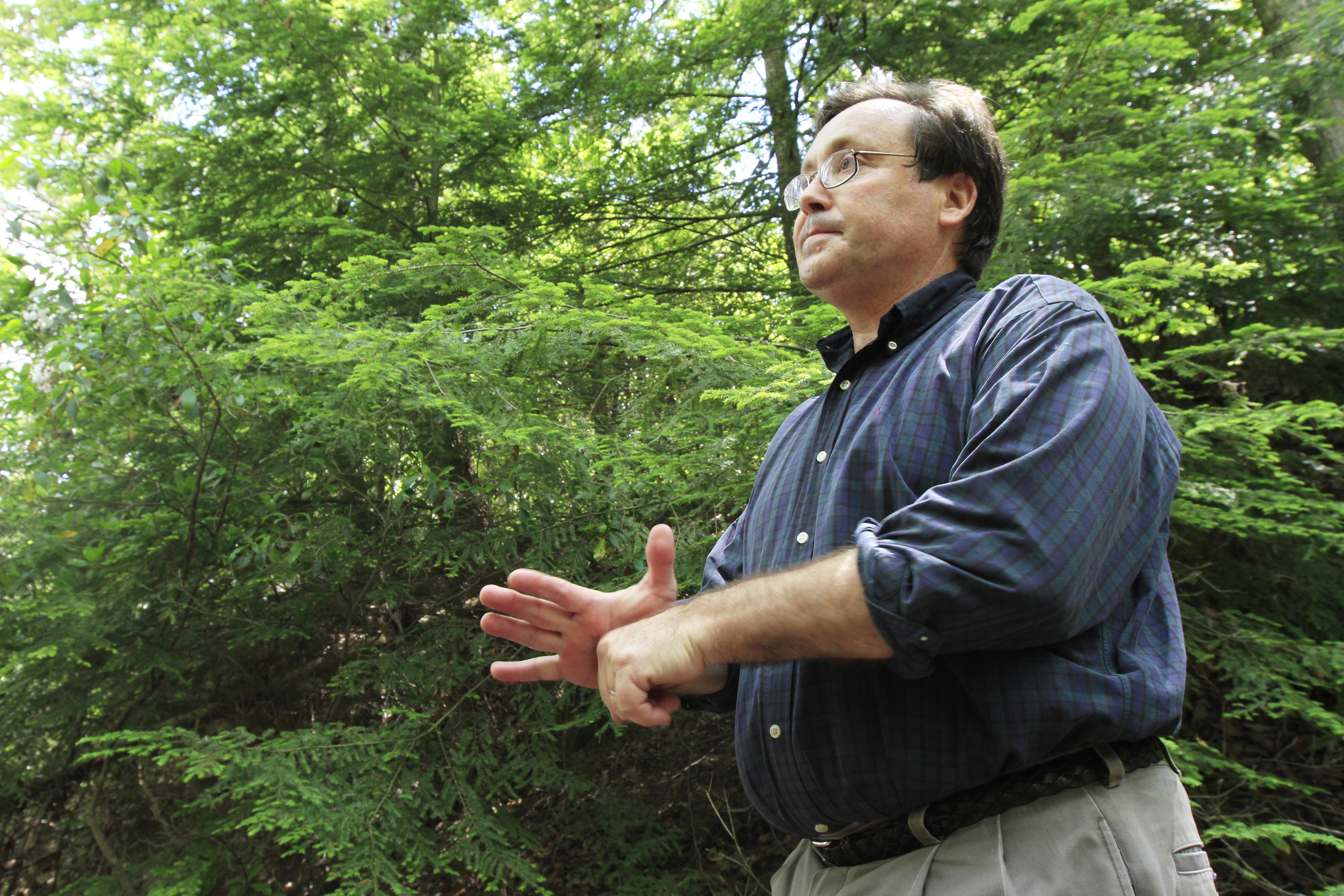
 Bobby Davenport speaks about the impending infestation of woolly adelgids which could kill the Hemlock population on the Lula Lake Land Trust property atop Lookout Mountain.
HOW TO HELP
For information on fighting the woolly adelgid, call the Walker County Cooperative Extension Office at (706) 638-2548 or see the website www.savegeorgiashemlocks.org
The woolly adelgid, a pinhead-sized, sap-sucking insect from east Asia that threatens to wipe out huge stands of eastern hemlock trees around the country, has been found on Lookout Mountain.
"I've found some up on Scenic Highway ... close to Covenant College," Walker County, Ga. Agricultural Agent Norman Edwards said. "The ones we found were at a resident's home that had them on some mature hemlocks."
Bobby Davenport, development director of the Lula Lake Land Trust that conserves 9,000 acres on Lookout Mountain, said, "It's a catastrophe, but it's a slow-motion catastrophe."
He vows to fight the invasive insect, which he's sure soon will start leaving its white, woolly egg sacs on the land trust's hemlocks.
"It's just a matter of time, really. They're just two miles away," he said. "If we don't do something, 100 percent of [the hemlocks] will die in a decade."
Davenport says the land trust and Cloudland Canyon State Park are next in line to receive a release of beetles from the Pacific Northwest that prey on the woolly adelgid. He's also seeking donations from the land trust's supporters to pay to inject pesticide into trees.
It's a daunting task to hike through hundreds of acres to inoculate hemlocks against the adelgid.

"It'll cost us hundreds of thousands of dollars to do this," Davenport said.
Edwards encourages people with hemlocks on their property to familiarize themselves with signs of the woolly adelgid so they can act quickly to fight it.
"If you control it early enough, you can certainly save the tree," Edwards said.
Residents can inject pesticide into the soil that will be taken up into the tree to kill the insects.
Darren Wolfgang, an ecologist with Georgia Forest Watch, said the woolly adelgid first appeared in Northeast Georgia in 2005 and spread from there.
"It's everywhere," Wolfgang said, explaining the insect spreads quickly, because its egg sacs cling to migratory birds "like Velcro."
One hopeful sign is that beetles imported from Asia to eat the adelgid appear to be reproducing naturally in small quantities, he said.
Contact staff writer Tim Omarzu at tomarzu@timesfreepress.com or 423-757-6651.