
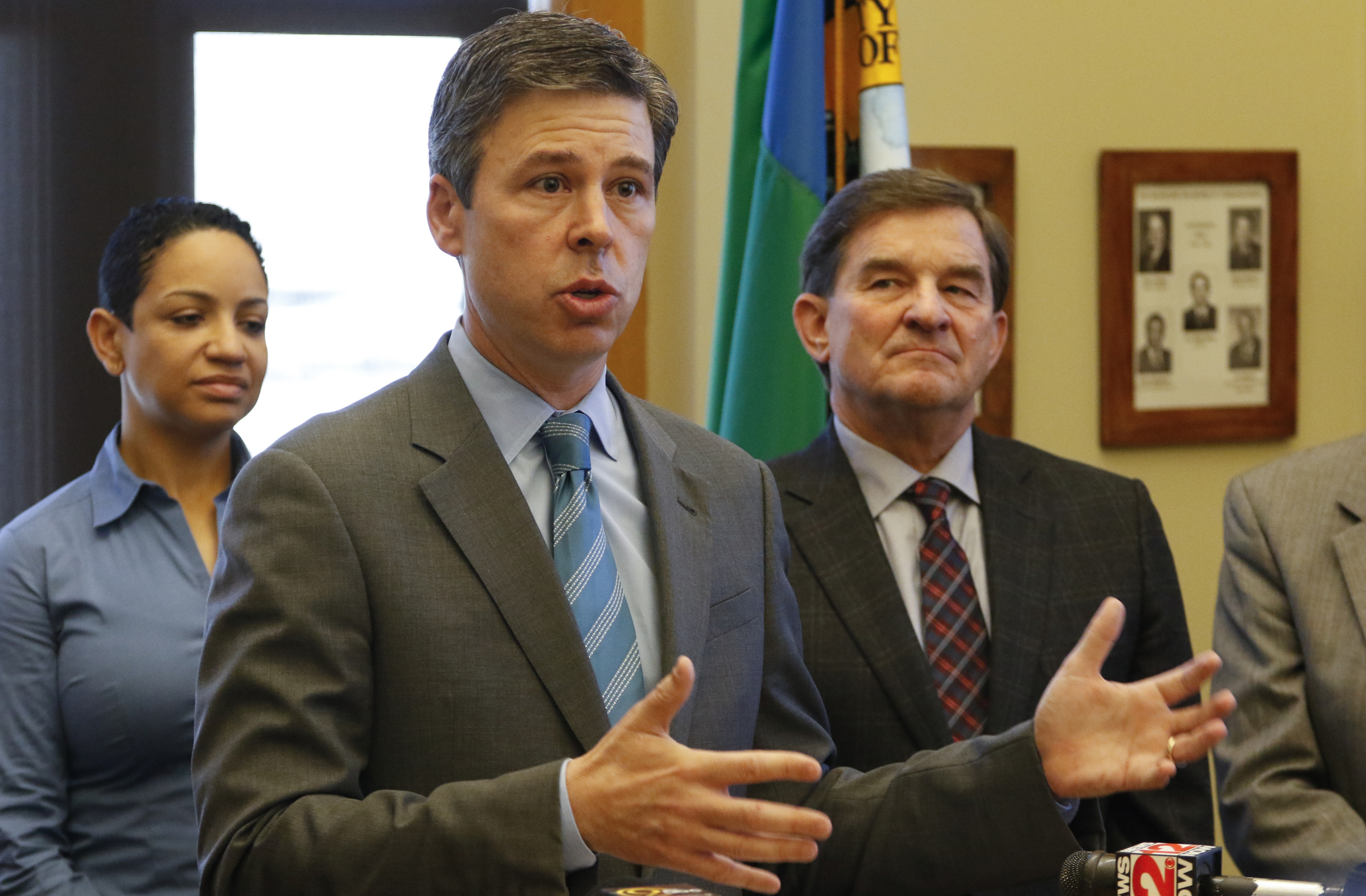
 The Chattanooga City Council is expected to vote on Mayor Andy Berke’s proposed budget in late June.
Chattanooga Mayor Andy Berke’s budget proposal, presented to the City Council last Tuesday, includes increased efforts to fight crime and a boost in funding for programs to support early childhood development, but does not include a tax increase.
The $230 million operating budget for fiscal 2017 presented last week, however, does not include the city’s capital budget, which should be ready in a couple of weeks, city officials said. Early estimates are in the range of $80 million, down from last year’s $96 million.
More than half of the operating budget, some $115.5 million, is devoted to public safety, including $700,000 to establish a Real-Time Intelligence Center to provide information on crimes in progress or the latest intelligence on possible criminal activity to field officers and detectives. As one example, if a gang-related shooting occurs, the center would alert officers to be on the alert for possible retaliatory attacks. Several civilian technicians would take over more of the field work of collecting evidence to free up some officers to staff the intelligence center.
The budget would continue to fund 486 police officers, a record high for the city.
Additional funding would pay for body cameras for officers, more security cameras and computer software to analyze crime data.
The mayor is also proposing a minority intern program to improve diversity in the police department’s hiring, as well as funds for programs to address domestic violence and community policing.
The next largest amount of money, some $42 million, would go to neighborhood development. East Lake Park would be refurbished, the city’s recycling program would receive more money, and more sidewalks would be built, particularly near schools.
The city also wants to attack blight in neighborhoods by hiring an attorney to act as an administrative hearing officer to crack down on code violations. Now, violations are heard in environmental court, with a maximum fine of $50. Under the new plan, the administrative officer could issue fines of up to $500 per day, and unpaid fines could result in a lien on an owner’s property.
The mayor is also proposing more funding to house and support the city’s homeless population, particularly those who are veterans.
The budget for economic development is set at $23.7 million. That includes $3.6 million for road paving, double what the city was budgeting three years ago, according to the mayor’s office.
More than $300,000 in tax rebates will be offered for businesses that locate in neglected commercial areas.
The budget also funds training and workforce development programs, improving access for the disabled to CARTA buses and vans, and additional city-sponsored summer jobs.
There is also $1 million for improvements and repairs to the Walnut Street pedestrian bridge.
About $24.6 million is allocated to the category of education and families. That includes $6 million for a new Avondale Youth and Family Development Center, increased funds for the Baby University in the East Lake neighborhood, and expansion of the program to Alton Park. The Baby University program provides coaching to parents-to-be, to support safe and healthy births.
The mayor also plans to establish a new Office of Early Learning in City Hall to coordinate the city’s early-learning efforts, including Baby University, training for day care providers, and scholarships for early learning programs. The budget also includes money to expand the Chambliss Center for Children’s early childhood education programs.
Some $24.3 million will fund government services.
The city plans to provide raises of 3 percent to city workers for those on the low end of the wage scale, and 2 percent for other workers. The mayor is also proposing longevity pay and other forms of payment such as on-call or call-back pay for city workers who sacrifice their personal time for work.
As part of the city’s consent decree with the U.S. Environmental Protection Agency to improve the way stormwater is handled, the sewer rate will rise by 9.8 percent, or $3.77 cents per month for the average customer.
Revenue for the city is estimated at $230.3 million, according to the mayor’s office, 4 1/2 percent over the estimate for 2015, but only 2 percent above the actual revenue. Property taxes will make up 57 percent of the city’s revenues, some $131 million, according to budget officials. Various sales taxes add another $60 million, or 26 percent, while other local taxes and investment earnings make up most of the remainder.
The council will begin working through the budget over the next month and is expected to vote on it in late June.