
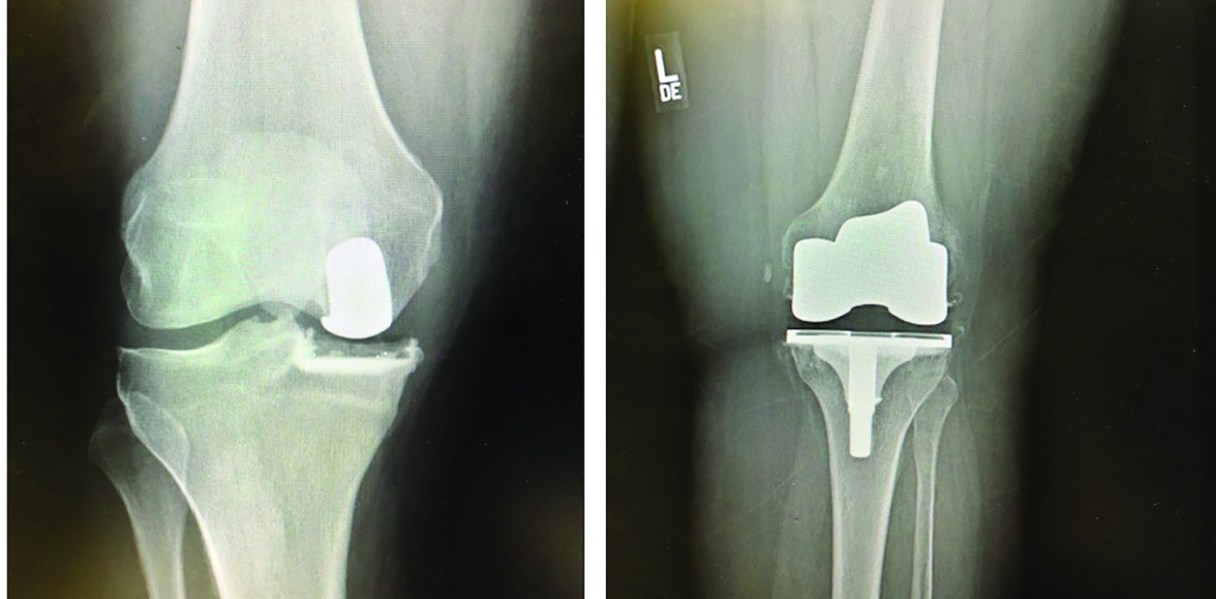
Total knee replacement is a big, brutal operation with a long recovery. It is usually effective at eliminating debilitating knee pain from end stage arthritis, but it comes with some risks and a long arduous rehabilitation. Some studies have shown up to a 20 % rate of dissatisfaction after surgery. In one local orthopedic surgeon’s opinion, at least half of these surgeries are not needed, instead a much safer technique that spares muscle and ligaments and utilizes a short incision and a small fraction of the amount of metal and plastic. This procedure, minimally invasive partial knee resurfacing using the Repicci technique, has been a special interest of Dr. Marty Redish for nearly 20 years.
“At least half of the patients who undergo total knee replacement today do not need the surgery in my opinion,” explained Dr. Martin Redish, local surgeon who is both practicing and advocating for a new, less invasive option. “This is because they have unicompartmental arthritis and could instead get a better result with less risk and recovery with minimally invasive partial knee resurfacing (MIPKR). Roughly 60-70 percent of the knee replacements I do are partial knees; the rest I do total knee replacements.”
The procedure itself consists of an outpatient surgery that utilizes a small high speed burr that requires the surgeon to freehand sculpt only the diseased portion of the knee so that small metal and plastic implants, the same material as used in total knee replacement, are implanted to patch the worn surfaces.
“The majority of arthritic knees are only worn down on one of the two weight bearing surfaces, so in this procedure only the diseased portion is resurfaced, leaving the other healthy parts of the knee natural. Everyone has a different anatomy, total knees are done with cookie cutter cutting guides and big incisions,” Dr. Redish explained. “Every total knee is put into the same shape and alignment regardless of the patient’s pre-existing anatomy. This technique simply adds a few millimeters of plastic and metal to make up for the cartilage that has been lost, re-establishing each patient anatomy and alignment as it was before the knee became arthritic. It also leaves intact the ACL which is removed in Total Knees, and doesn’t cut through the quadriceps muscle.”
Dr. Redish learned this technique in 1999, when it was introduced to orthopedic surgeons throughout the world as a long awaited improvement to total knees. It was developed by Dr. John Repicci, a dentist before becoming an orthopedic surgeon.