
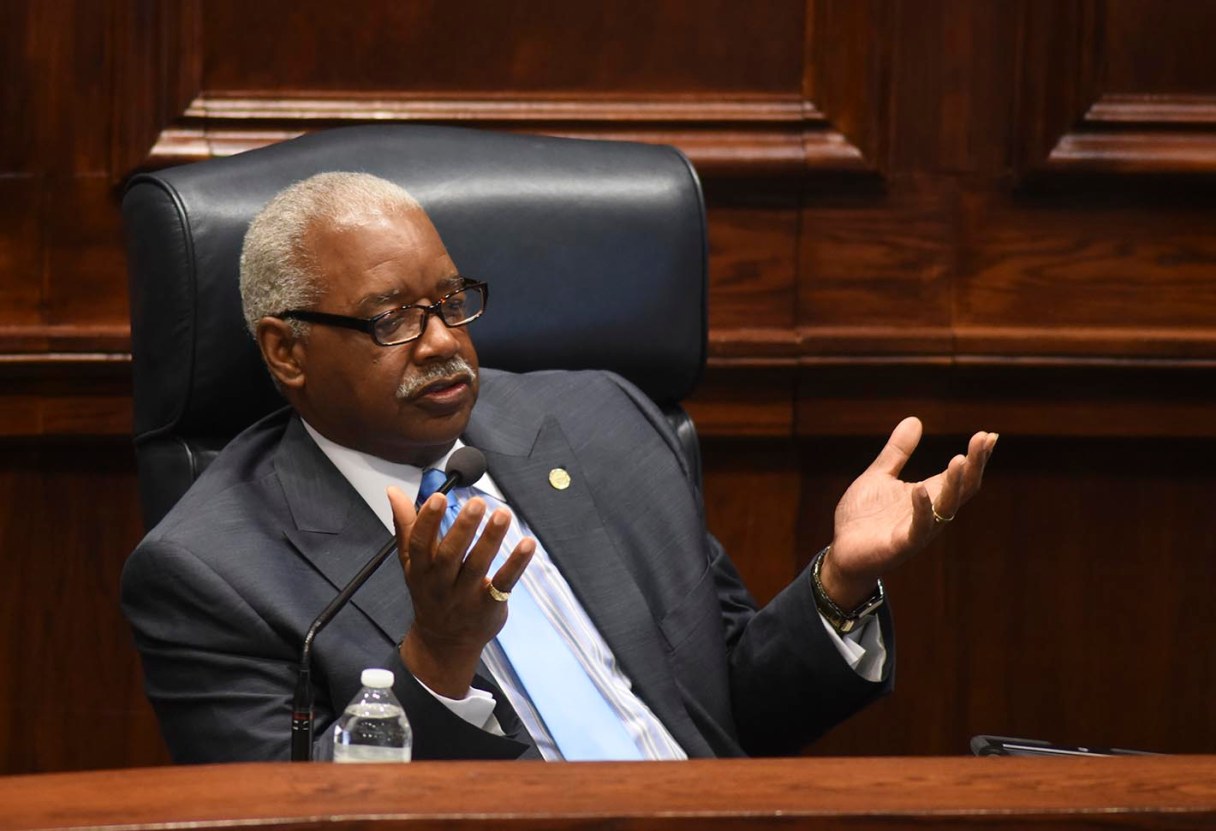

Coty Wamp and Greg Beck have something in common with Hillary Clinton and Mitt Romney today. And it’s not that they all have run, or are running, for elected office.
Both Wamp and Beck in recent days made remarks they probably thought would never reach the wider public. Bad assumption.
Wamp, a candidate for Hamilton County district attorney general in the May Republican primary, expressed her thoughts about the NAACP in an address to a Republican women’s group. Beck, a Democratic candidate for the District 5 Hamilton County Commission seat he held for more than three terms before losing it in 2018, unspooled his thoughts about jobs and homelessness on an open microphone during a break in a recent radio show.
Romney and Clinton, in successive presidential campaigns in 2012 and 2016, made remarks to groups they probably figured would never be aired in public.
Romney, at a campaign fundraiser, told attendees: “There are 47% of the people who will vote for the president [Barack Obama] no matter what. All right, there are 47% who are with him, who are dependent upon government, who believe that they are victims, who believe the government has a responsibility to care for them, who believe that they are entitled to health care, to food, to housing, to you-name-it … These are people who pay no income tax. Forty-seven percent of Americans pay no income tax.”
No matter that Romney was 100% correct about the percentage of people who pay no income tax, the remark sounded elitist and as if he wouldn’t care about them if he were elected.
Clinton, also speaking at a fundraiser, told attendees: “You know, to just be grossly generalistic, you could put half of [Donald] Trump’s supporters into what I call the basket of deplorables. Right? The racist, sexist, homophobic, xenophobic, Islamaphobic – you name it. And unfortunately there are people like that. And he has lifted them up.”
She obviously was making a point about a tiny number of the then-candidate’s supporters but chose to exaggerate her remark. It was probably the most damaging statement of her campaign.
If you have forgotten, both Romney and Clinton lost their races.
Wamp, who had skipped speaking to the NAACP because of a previous commitment to the Republican women, said she “just can’t stand behind [the NAACP] right now.”
“[T]he NAACP has accomplished some good things in the last hundred years, but one of them is not the way they’ve treated law enforcement … And until on their website they talk about, they have the statistics about how many African Americans are shot by police every year, but they don’t have the statistics about how many African Americans are shot by African Americans or how many police officers are shot by anybody … anybody.”
Though Wamp’s remarks were intemperate and ill considered (and she said the audio was released as a diversionary campaign tactic by her opponent, incumbent Neal Pinkston), she was accurate about the organization’s national website. On its front page is this statement: “From police brutality … Black communities are under attack.” Under a “Race & Justice” page are these words: “[U]njust policing … unfairly impact[s] Black communities,” “Our criminal justice system is shaped by biased policing … rooted in anti-Blackness,” and “The criminal justice system is heavily impacted by the bias of police mentality.”
Nevertheless, instead of saying she couldn’t stand behind the NAACP, it might have behooved her to cite the website’s statements and tell the Republican women that, as DA, she hoped to change the minds of the local civil rights organization about law enforcement.
Ann Pierre, head of the NAACP’s local branch, said she hoped Wamp would apologize. In a news conference Friday, Wamp said she wouldn’t apologize for her statements but said one of the reasons she got into the race was to help the Black community.
Beck, during a break on the WPTP talk show, was answering a man unseen on the video feed about jobs.
“Man, we got a lot of jobs,” he said. “Nobody wants to work,” the man said. “That’s the thing, that’s the thing,” Beck said.
“They want the check,” said the host, “but they don’t want to clock in.” “They would rather beg,” Beck said.
He then asked the unseen man, “What are your ideas about the homeless?” The man said something that couldn’t be understood, then Beck said, “Don’t ask me, OK, because you know what I’ll say. I’ll say, ‘They’re too doggone lazy.'” The host then pointed out they were live. He then said many homeless have mental problems. “My thing would be this – that you would help the people,” he said.
The labor force participation rate in Tennessee, which had reached a nine-year high of 62.1% in 2019, fell to 59% during the April 2020 COVID shutdowns, rose to 60.6% in September 2020, but gradually has fallen to 60.3% over the last year.
Beck is unlikely to tell those gathered for a campaign event in his majority Black district that some don’t want to work, would rather beg or are lazy. But whether his three Democratic opponents for the seat will make any hay of it is anybody’s guess.
The lesson to be learned for all candidates is to say only what you mean and never assume someone else isn’t listening. They probably are.