
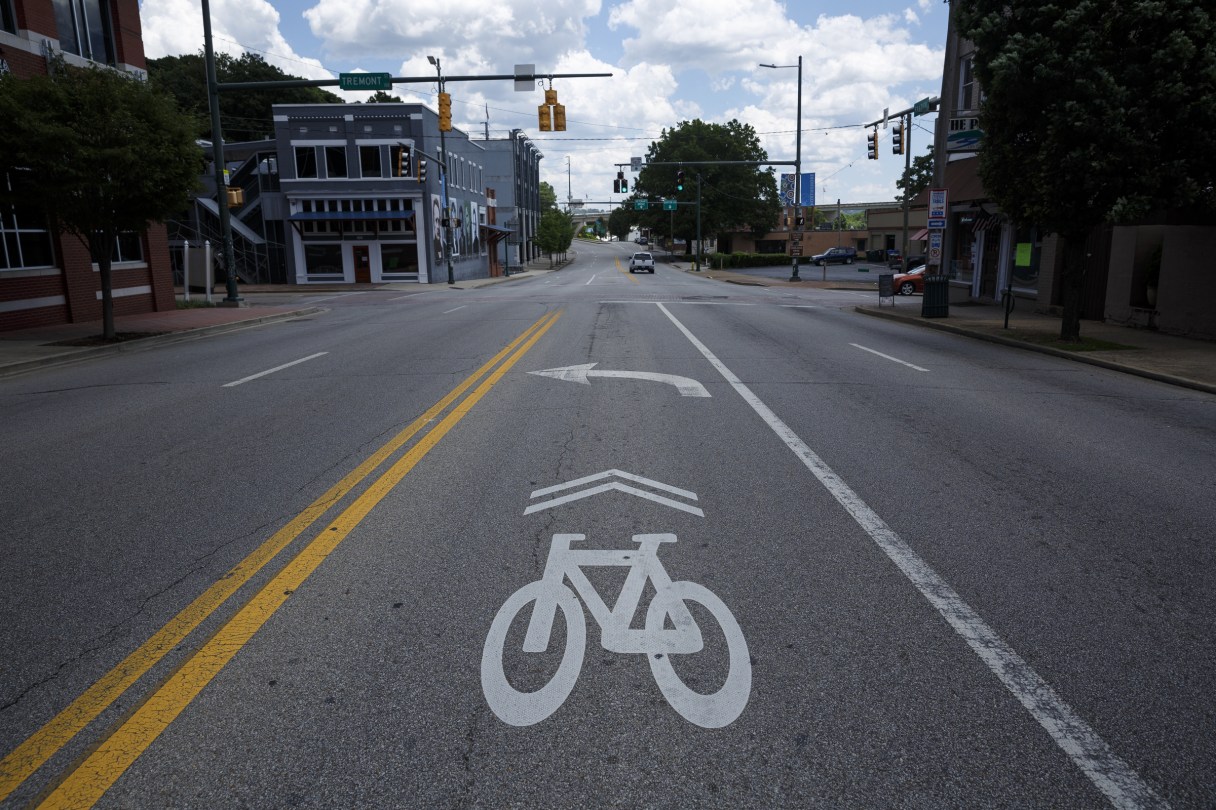
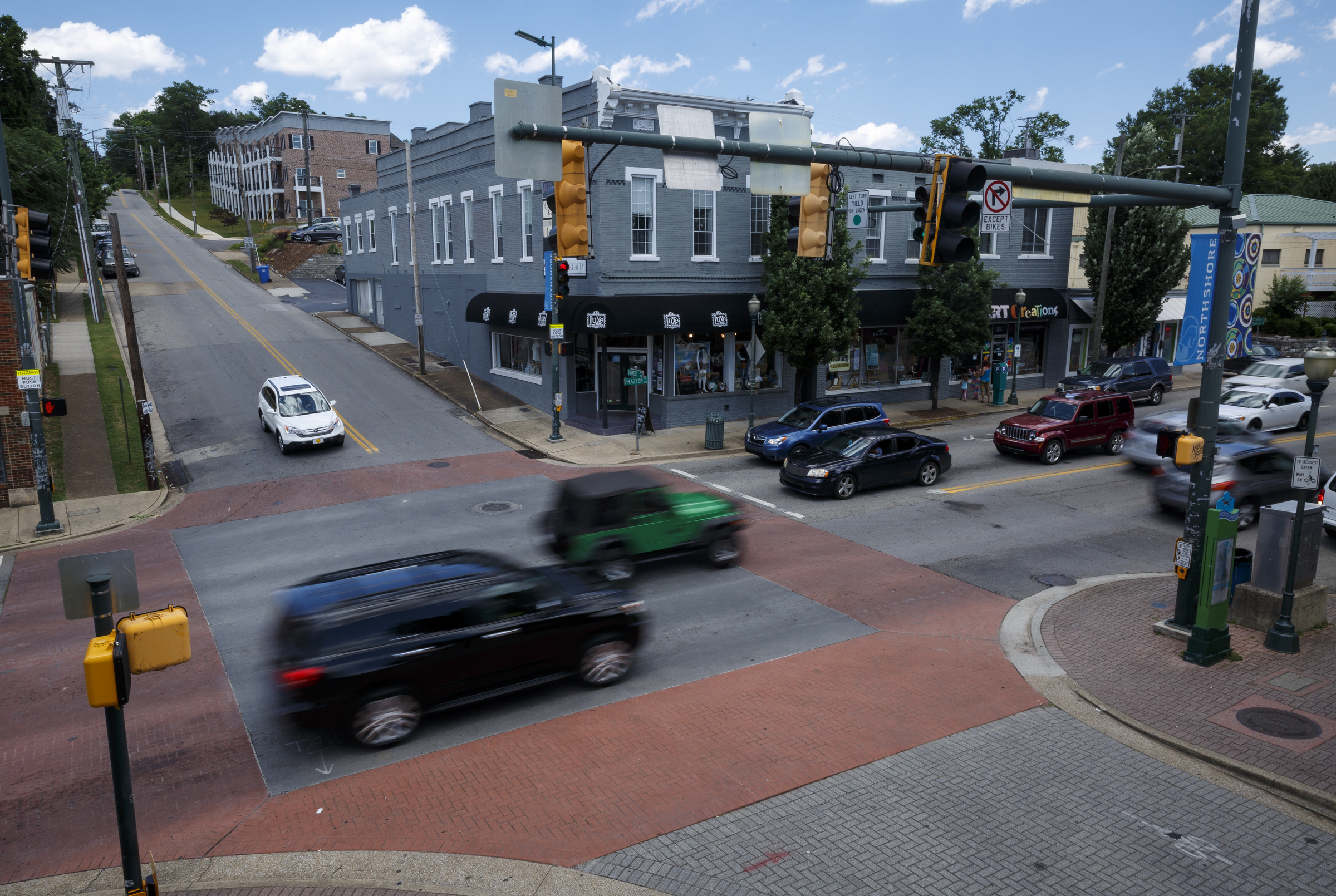
 Vehicles travel past Forest Avenue on Frazier Avenue, which would be reduced to two lanes and a turn lane if proposed bike lanes are added.
If Frazier Avenue merchants are in favor, the city may test out bike lanes on the busy North Shore street.
A transportation design firm hired by the city to evaluate the potential traffic impact of bike lanes recommended the city conduct a pilot project on Frazier before deciding whether to add bike lanes there.
Bike lane pilot projects consist of temporary road restripings or the placement of traffic cones and are frequently used to simulate the road conditions that installing bike lanes would create.
City transportation director Blythe Bailey said last week there are no plans for a temporary pilot project now, but such a pilot project would be considered if area merchants are in favor of the idea.
“We’re focused in 2016 on getting as much input as possible,” Bailey said. “If the community or the merchants want to see a temporary installation, we would certainly consider it.”
Alta Planning and Design conducted a 500-plus-page analysis, sent to the city in April, that covered how traffic might be affected on a handful of streets where the city is considering adding bike lanes as part of its bicycle implementation plan.
The Times Free Press obtained a copy of the study, which found that all the corridors in consideration meet the requirements for lane reductions “based on traffic volumes per [Federal Highway Administration] guidelines.”
However, the study did add that Frazier Avenue traffic is “on the higher end,” before suggesting a pilot project that would help the city determine if the additional delays are acceptable.
The study highlighted the intersection of Cherokee Boulevard at Frazier Avenue and Market Street as the most complicated intersection within the project limits “due to its high volume during the peak hour.”
“The value of doing the pilot project is that it’s not permanent,” said Michael Repsch, a senior engineering associate for Alta who worked on the Chattanooga analysis. “It’s temporary. It’s generally low-cost to try and install what you would like to see the permanent condition be.
“Rather than putting in millions of dollars of improvement work and not knowing how the facility is going to be perceived, you can put out these temporary pilot projects. People get to experience it for good or bad, and then you can tally up all that information and make the decision on if it’s a project to go forward with and construct in a permanent manner.”
The proposal to add bike lanes to Frazier, reducing the street from two lanes in each direction to one lane in each direction with a center turn lane, has met varied reaction from area residents and business owners, many of whom have expressed fear that increased traffic congestion may hurt their businesses.
Bailey has emphasized repeatedly that getting input from merchants on the idea is a top priority as the city evaluates the project and said in April that, “if it doesn’t benefit the commercial district, it won’t go very far.”
Merchants have been more receptive to the idea on M.L. King Boulevard, Bailey said.
The proposal there also calls for the current four-lane road to be reduced to three lanes with bike lanes added between Georgia Avenue and the railroad bridge.
From the railroad bridge, M.L. King turns into Bailey Avenue. The proposal calls for the bike lanes to continue on Bailey Avenue to the intersection of Dodds and McCallie avenues.
Traffic volume along M.L. King and Bailey ranges from 57-63 percent of the Frazier Avenue volume, according to Tennessee Department of Transportation figures cited in the Alta study.
City traffic officials have been meeting with business owners along the street and planned to have a booth at the Bessie Smith Strut to discuss the project, which could move forward as early as this fall.
“The traffic volume on MLK is much less than it is on Frazier,” said Bailey. “There’s a momentum of redevelopment happening on MLK, and the merchants are very interested in the project. There are also a lot of safety issues because of the configuration of the road.
“The MLK project is very much about creating a more comfortable and safer place for businesses, as well as students in the vicinity and other people that are coming around to MLK. It’s a different type of street right now than Frazier.”
Contact David Cobb at dcobb@timesfreepress.com or 757-6249