
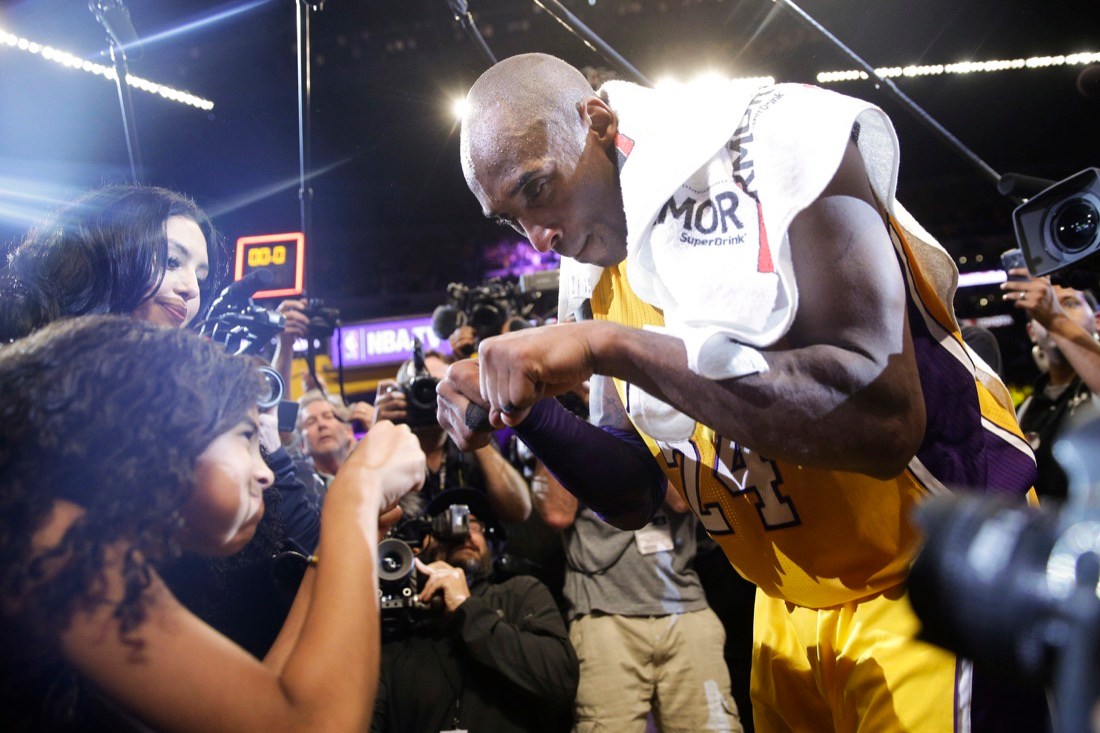
Gone in an instant
Can you remember a celebrity death that has affected us more than Kobe Bryant’s?
Sunday’s sweeping news was everywhere. Bryant and eight others, including his 13-year-old daughter Gianna, were killed in a helicopter crash.
Of course, it was emotional. Lost life, especially young life – like Bryant, who was just 41, never mind the young girls on board – is tragic.
Of course, it was all-consuming. Bryant was a five-time champion, an Academy Award winner and a face of a generation in the NBA.
Of course, it was about reflection, too. The images and our memories of him as a player felt as fresh as the day he won his first title, the day he won his third in a row, that time he walked with a torn Achilles to the foul line and made two free throws before walking to the locker room, the day he scored 81 points, when he scored 60 in his final game and so many more.
But this is not about basketball – not today and at least not in this space. Sure, there were a slew of basketball stories to share. Here’s TFP ace sports columnist Mark Wiedmer’s view on Kobe the hoop star. Here’s Stephen Hargis, the TFP ace Sports Editor, on Kobe’s impact on area basketball figures.
I found myself thinking several times Sunday about the avalanche of emotion the death of this basketball superstar had on almost everyone.
The tributes from those in the game of basketball were understandable. They ached in L.A., where he played his entire career. Even the tributes from other sports – the Pro Bowl, the Australian Open, Tiger Woods at Torrey Pines, European soccer among them – made sense because of Kobe’s reach and respect.
But we’ve lost stars before. We have mourned celebrities’ deaths.
This reached a lot of us on several different levels.
First, Kobe’s work ethic was legendary. Whether you had elite skills in your chosen endeavor – and there’s no doubt that Kobe’s skills were all-time elite – his competitiveness, his determination, and his overwhelming will to win were Jordanesque. And truth be told, that is relatable and commendable way more than putting a leather ball through an iron hoop.
Whether you ever played the game, shot a wadded-up piece of trash into a waste basket or didn’t know Kobe Bryant from Kobe Beef, we all know the sacrifice and effort and work it takes to be great. Kobe combined the gifts with the grit, and that demands respect.
Kobe, as much as any superstar in almost any genre, carried an air of humanity that so many of the one-named stars simply do not.
We can’t help but feel like we know the superstars we place on insanely misguided pedestals for vastly overvalued skills such as remembering lines, making 3s or throwing 95-mph baseballs.
But Kobe’s humanity and realness was more than almost all the other super-celebs. He grew up in front of our eyes, coming onto the scene as a teenager who spoke several languages and was dealt to L.A. for Vlade Divac. His very public shortcomings – from whatever happened that night in Colorado to his much-debated and much-less-serious feud with Shaq – were part of the narrative and set the stage for a comeback in terms of public approval.
And it was the humanity and the fragility of life that touched us deepest Sunday.
He was 41, for Pete’s sake, and he had adjusted to the role of living legend and husband and father and youth league sports coach in such a smooth and gliding way that you couldn’t help but be excited about his future, because it was going to be in some ways part of our future, too.
Death comes for us all. It’s the only certainty of this life.
What we do before it comes calling is our legacy.
In that regard, Kobe’s 41 years were every bit as legendary as his basketball career.
The end was sudden, but the very end is always sudden, whether it’s a crash or cancer. That suddenness brings sadness for all touched by the life lost.
Death makes me think of my father, who wisely told me that whatever it is “it’s not really a problem if money can solve it.”
Kobe’s death was the ultimate definition of that.