
Today, two becomes 20 – and first-year University of Tennessee at Chattanooga men’s basketball coach Lamont Paris and his Mocs move into the first true phase of the 2017-18 season this afternoon at Chattem Practice Facility.
The UTC men are set to open practice at 4, after the women wrap up their first practice of the new season.
An NCAA rule allows coaches to work with players for two hours a week during the offseason, which has given the new UTC staff a chance to start drilling home their style and system. Starting today, the coaches are allowed to work with the players for 20 hours per week.
“That’s one of the best things the NCAA has decided, is getting these two hours per week of actual basketball instruction leading into the first official practice,” he stated. “Some of the drills we’re going to do (in practice), we’ve introduced during the two-hour sessions. It should make for a smoother transition into practice.”
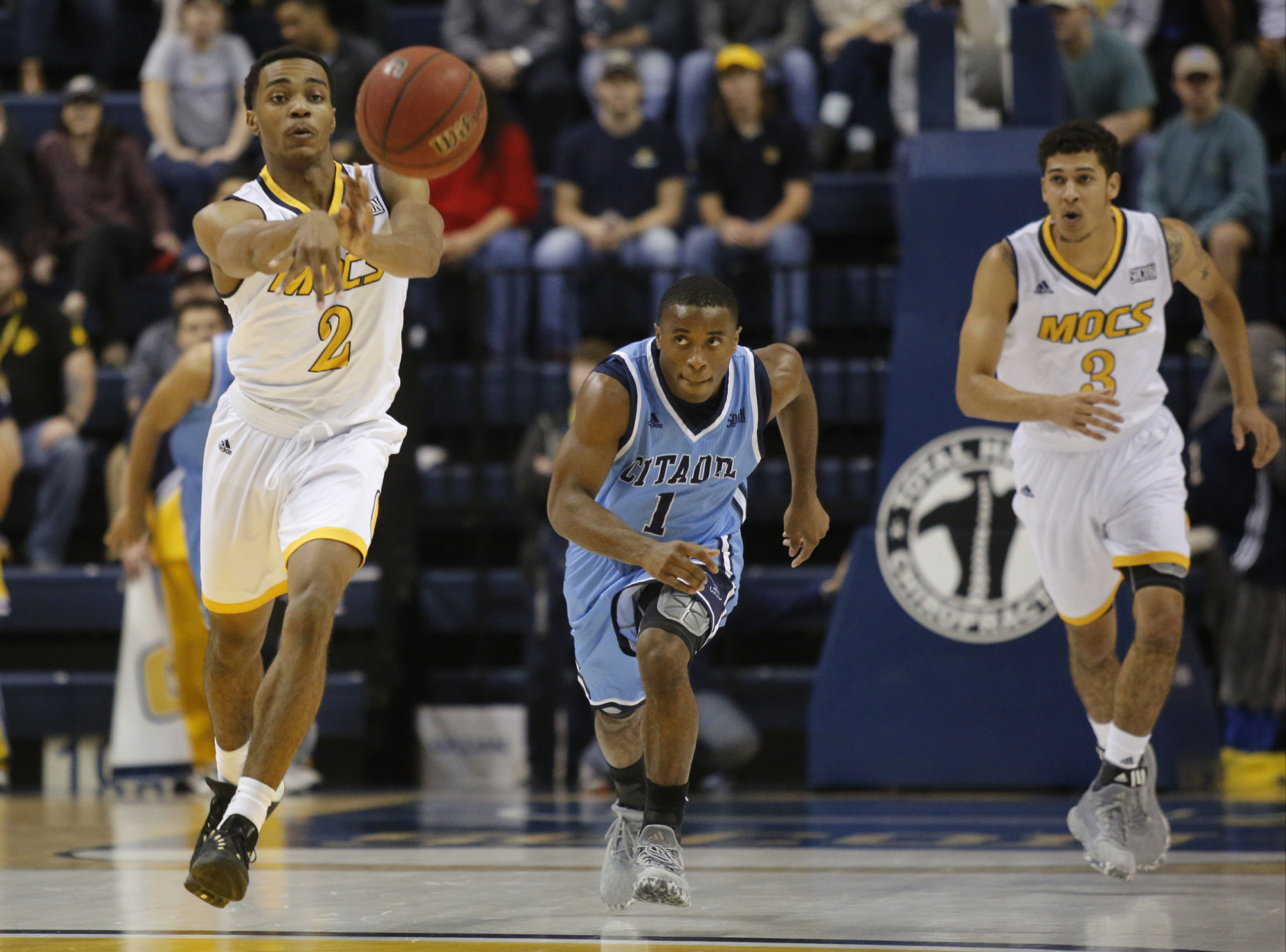 UTC guard Rodney Chatman, left, passes the ball ahead of teammate Nat Dixon, right, and Citadel guard Frankie Johnson during a home game last season.

The youthful Mocs, with no seniors, four juniors and six freshmen, have been put through the basics already concerning every detail from jump stops on catches to pass fakes. With the returning players lacking a ton of experience (they averaged 17.5 points, 8.5 rebounds and 3.9 assists – combined – in 2016-17) there’s some talent, but mostly greenness leading into today.
“We’ve keyed in on a lot of details (in the preseason),” junior Nat Dixon said. “Coach Paris is big on that. We’re learning a little different offense.
“It’s kind of tough, but we have to remember it’s all a process.”
The Times Free Press looks at five questions surrounding the men’s basketball team entering today’s first practice:
1. What’s left? A little, but not a lot. Rodney Chatman was the only returning player to appear in all 31 games last season, and the sophomore point guard started the last three and was solid. Forward Makinde London is as talented as anybody in the Southern Conference, and he will have to take a big step forward for this team to be successful. Junior Nat Dixon and sophomore Makale Foreman had some big moments in their first seasons with the program, such as Dixon’s two 3-pointers to help beat Wofford on the road and Foreman’s three 3s in a big home win against Samford.
2. Can Chatman and London take the next step? People around the program think so. Chatman was as hard to guard as anybody in the league last season, but he had some struggles finishing around the rim. London was a talented inside-outside prospect, but he had some highs and lows in his first full college season. Other players will be needed to be good, but those two are the most indispensable in part because they’re the team’s known quantities.
3. How has the team adjusted to the new system? Seemingly well so far. Paris employs a system that doesn’t stress quick shots but encourages them if they’re considered good opportunities. It’s not quite as free-flowing as former coach Matt McCall’s system, but looking back at past teams at Wisconsin – where Paris worked as an assistant before coming to UTC – the Badgers were as efficient offensively as any program in the country, including the 2014-15 team that was the most efficient team in the history of the Ken Pomeroy advanced stat system.
4. Who steps into the leadership role? It started to become painfully obvious late last season that the Mocs lacked a true leader. The season before, that person was Eric Robertson who, while not the team’s leading scorer or best player, was its most vocal member at all times. Dixon would appear to be the best suited for that role, but Chatman and London would certainly qualify as well, because London was seen doing some mentoring with younger post players recently.
5. Is there any interior depth? If there’s a position the Mocs need a freshman to step up at, it would be inside, as London is the only player returning who has any experience there. James Lewis has the build to eventually be a banger on the interior, because his 6-foot-6, 215-pound frame could easily hold about 20 more pounds. Duane Moss is 6-6 like Lewis, but with a completely different skill set that could pose problems at the position at times. Justin Brown, who is small (6-10, 200) but skilled, may take a little longer to develop, but he could be a talented big man down the road. One of the three will have to step up.
Contact Gene Henley at ghenley@timesfreepress.com. Follow him on Twitter @genehenleytfp.