
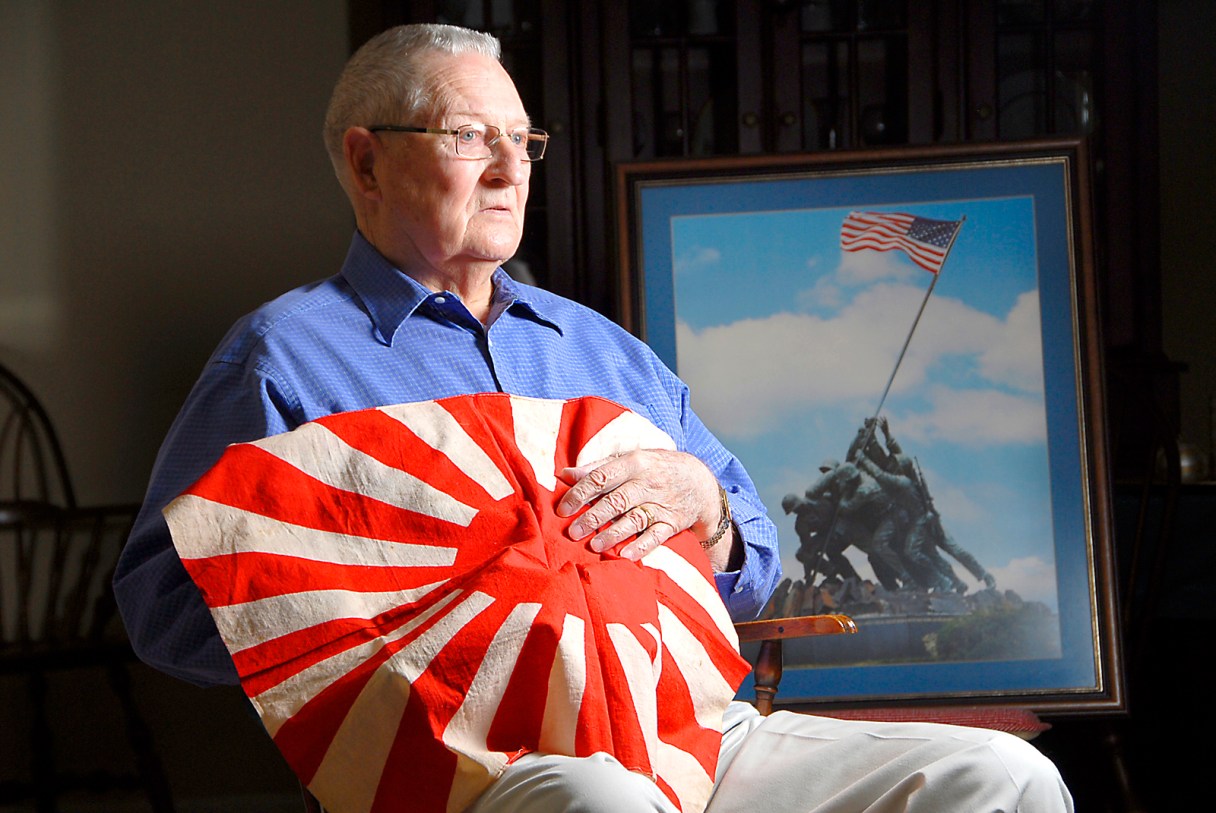
The water was cold, the sand soft and “black as soot.” Gunfire popped all around and there were bodies lying on the beach.
Those are the sights that flash into Clarence Schutt’s mind when he recalls his first step into combat — a 19-year-old Marine carrying a 21-pound machine gun into a hail of Japanese bullets from the looming hilltops.
Sixty-five years ago today, Marines landed on the Pacific Island of Iwo Jima in what has been called one of the most horrific amphibious assaults of World War II.
“The battleship Tennessee came so close to the island that it took some mortar fire from the island and it had to back up a couple of thousand yards,” said Mr. Schutt, 84, who lives in Hixson.
Following the Dec. 7, 1941, Japanese attack on Pearl Harbor, the United States entered World War II and slowly fought a long island-hopping campaign throughout the Pacific Ocean that ultimately defeated Japan.
Once he landed on Iwo Jima, it took days for Mr. Schutt to climb the rocky 540-foot Mount Suribachi, where the iconic flag-raising took place. The Tennessee native was only 50 feet away from the historic flag-raising.
“I just thought, ‘It’s over now.’ Once the flag went up, everybody thought it was over then,” he said.

But during the raising, he said a Marine was shot.
“I turned around and looked and saw dust coming up from — I call it a spider hole — and I went over there and took the end of my (rifle) and there was a Jap down there and I shot him and pulled him out and I got a sword off of him,” Mr. Schutt recalled.
That was day five.
Pfc. Schutt would tromp alongside his fellow Marines through the jungles of Iwo Jima fighting to the ends of the island for the next 27 days.
Along with the short sword, he carried home a Japanese rising sun flag, banned after the war, which he keeps folded in a plastic bag among his military memorabilia.
Dr. Kurt Piehler, professor of military history at the University of Tennessee, notes that, though coverage of both the war in the Pacific and in Europe was detailed during World War II, few Americans know much about battles in the Pacific.
“I think Iwo Jima is remembered because the Marines were there and the Marines won’t let America forget,” Dr. Piehler said. “And the image.”
The image he refers to is Joe Rosenthal’s photograph of five Marines and one Navy corpsman raising the flag on Mount Suribachi. The battle and the flag-raising were the subject of two Clint Eastwood-directed films, “Flags of our Fathers” and “Letters From Iwo Jima,” both released in 2006.
FAST FACTS* Iwo Jima means “sulfur island” in Japanese.* Nearly 70,000 Marines fought 21,000 Japanese in the battle.* There were an estimated 28,000 U.S. casualties, 6,821 dead.* Following a 72-hour naval and aerial bombardment, Marines landed Feb. 19, 1945 and fought for control of the island until March 26.* The Mount Suribachi flag-raising immortalized in the Joe Rosenthal photograph took place on the fifth day of the 35-day battle.Source: Department of Defense
A combination of media coverage, geographic closeness and an American public more familiar with European culture than Asian culture all contributed to general fading of the war in the Pacific in American memory, Dr. Piehler said.
“I also think some of it is that there was such a visceral hatred of the Japanese and we wanted to forget that hate,” he said.
Ed Robinette, 84, a Chattanooga native, saw the battle from a ship waiting offshore. As the waves tossed around him and his fellow Marines and the days passed, they wondered if they were going into the fight.
After nearly two weeks officers told them that they’d lost too many Marines on Iwo Jima and commanders decided to save them for an upcoming battle on Okinawa.
Okinawa was the last major battle in the Pacific before the atomic bombings of Hiroshima and Nagasaki, Japan, which ended the war.