


After having her second child, Jennifer Knowles struggled juggling both being an educator and raising her two children. “I felt like there was a tornado in my head at all times,” she says. It was around this time that she was introduced to the concept of mindfulness. The term first surfaced in the 1970s, when psychologists began to develop therapeutic techniques involving the process of focusing one’s attention on the experience of the present moment, a secular concept derived from meditation practices of the Buddhist religion intended to lead to enlightenment and the end to all suffering.
A friend recommended that Knowles check out Headspace, an app focused on mindfulness and meditation. Around the same time, she also came across articles about mindfulness in her research on metacognition, the awareness of one’s own thought process, or “thinking about thinking.” But it was when she reconnected with an old friend, who had moved to New York City and was teaching mindfulness full time in schools, that Knowles learned of Mindful Schools, a California-based nonprofit that offers a mindfulness curriculum for educators and students, along with training and certification for educators.
A veteran educator of 15 years, Knowles then began to see how the practice might benefit her students’ classroom environment in addition to her own mental well-being. She’s taught in special education classrooms as well as those for typically developing students ranging from kindergarten through eighth grade. Knowles is currently a part-time literacy coach for Hamilton County Schools.
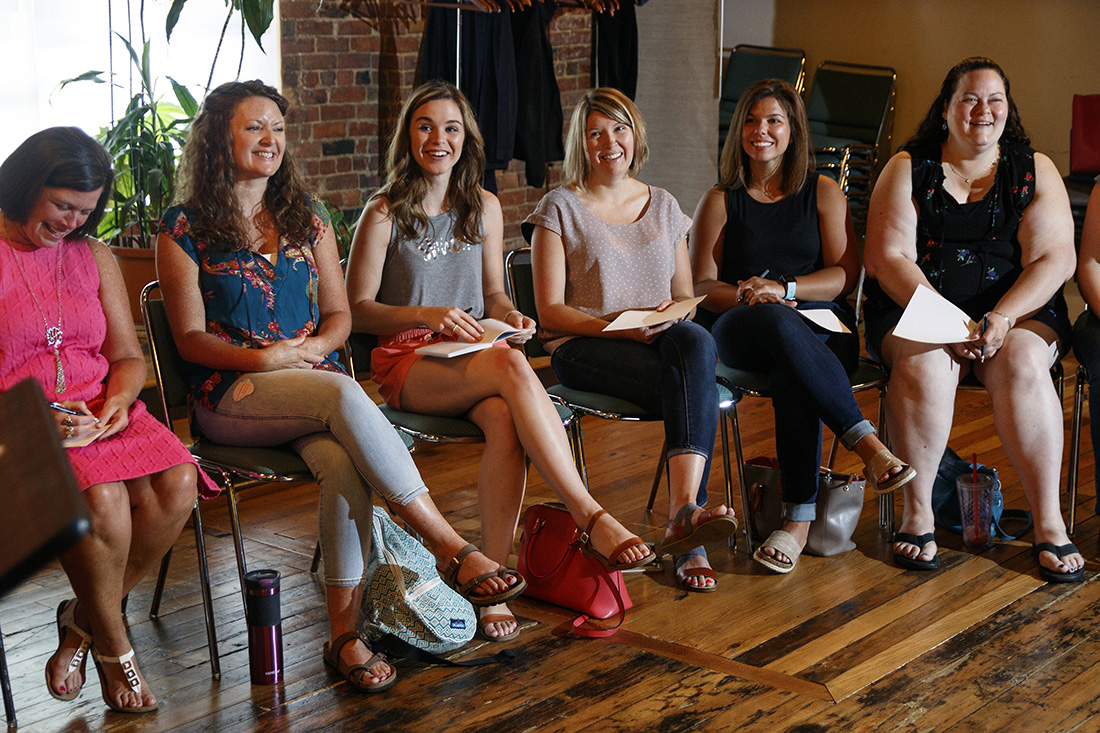 Teachers share personal anecdotes and laughter during a mindfulness training event for teachers at Middle Valley Elementary.
She’s also instructing and designing a pilot mindfulness curriculum, called PAUSE (Practices in Awareness & Understanding for Sustaining Educators), for the Center for Mindful Living that’s being debuted at Ganns Middle Valley Elementary, DuPont Elementary and Hardy Elementary schools this fall.
In the context of education, mindfulness training focuses on self-regulation – being present in the moment, taking responsibility for oneself and teaching strategies for balancing stress. Knowles went through the Mindful Schools training program two years ago, and got the OK from the principals of the schools where she was a literacy coach at the time – East Side and DuPont Elementary schools – to take a small amount of time during the day to practice mindfulness with her students. Elizabeth Kabalka, who became the Center for Mindful Living’s first director in 2015, came to watch her teach one of her lessons, and asked her to work for the center as a part-time instructor soon after.