
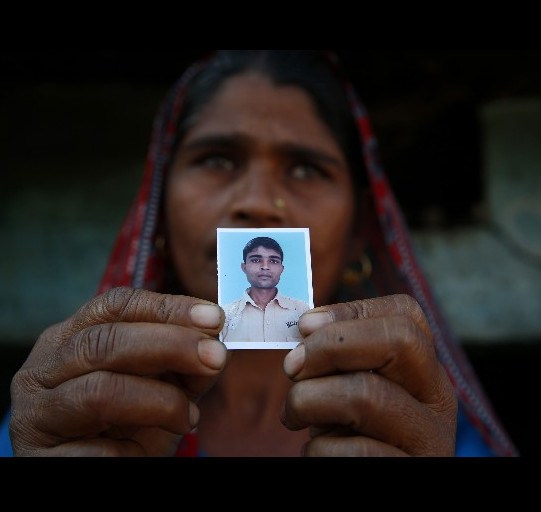
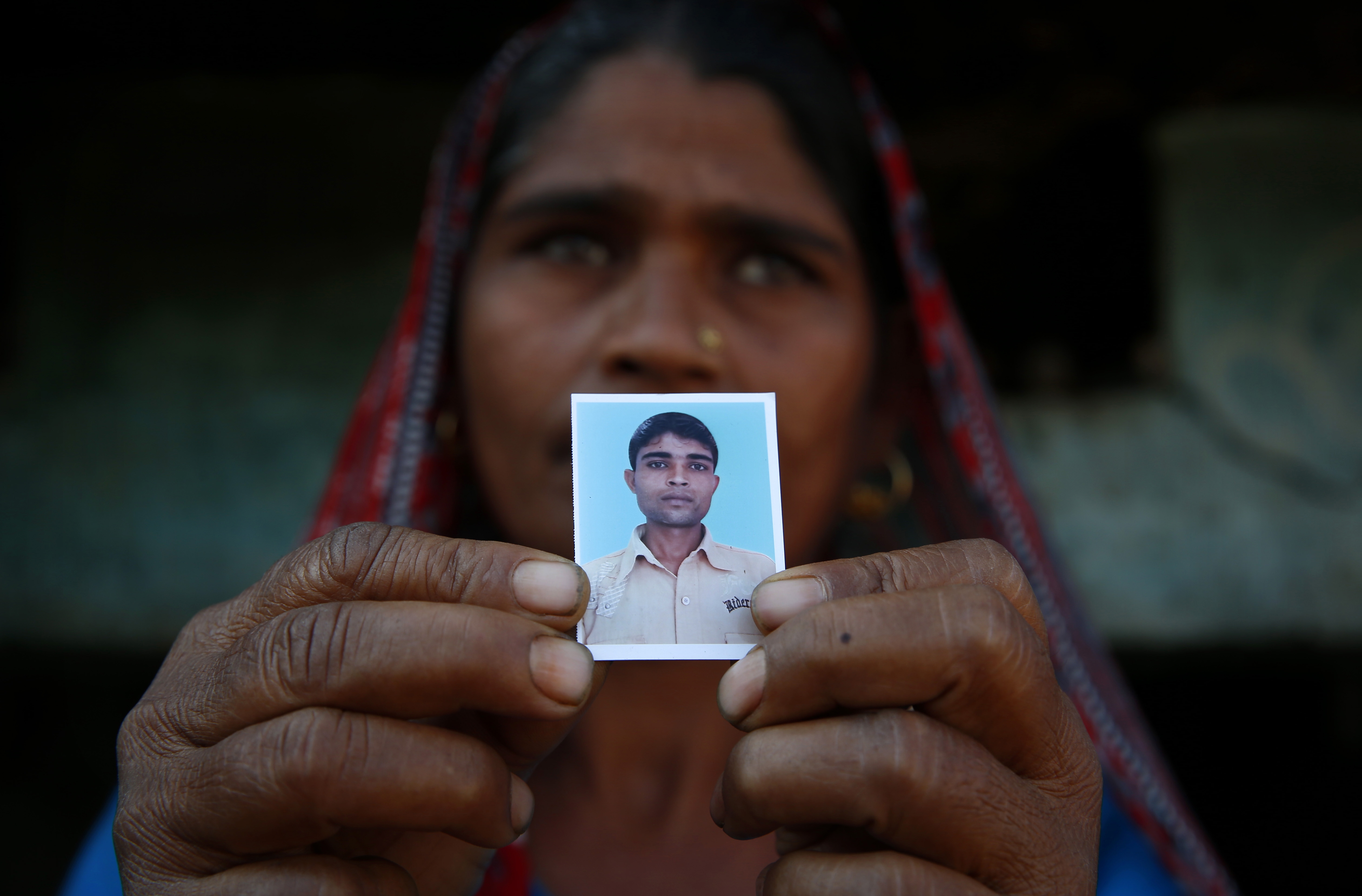
 Taravati, who uses only one name, shows a photograph of her son Shiv Kumar Singh, a daily wage laborer, who was killed by a tiger at Maniawala, in northern India. The tiger that killed Singh on Jan. 10 has killed at least nine people so far, traveling over 120 miles between villages, small towns and even a highway, spreading fear among the villagers, many of whom are either farmers or laborers working the the large swathes of sugarcane fields which need harvesting now.
MANIWALA, India – She lies in wait while her victims are collecting firewood, or taking cattle to graze, or working in the fields. She has grabbed people in broad daylight, carrying them away silently into the forests or the sugarcane fields. By the time the victims are found, often little is left but a pair of shoes, unspeakable gore and a ring of drying blood.
Over seven weeks she has traveled, almost completely unseen, for more than 120 miles (190 kilometers). She has crossed villages, small towns and at least one highway.
A killer is stalking the villages of north India. She has killed at least nine people, all of them poor villagers living on the fringes of one of the world’s last wild tiger habitats. They are people who cannot afford a day off work, people who have no indoor plumbing and must use the fields as their toilets. They are people who know little about India’s recent successes in tiger conservation.
But with the sudden appearance of one tiger, they look at an animal so beloved to outsiders and see only a monster.
“She has turned into a man-eater,” said Vijay Pal Singh, whose neighbor, a 22-year-old farm laborer named Shiv Kumar Singh, was killed as he worked at the edge of a sugarcane field in January. In an area where nearly everyone works outside, this means life has been completely upended. “People are afraid to go into the fields,” said Singh. “Everything has changed.”