
PHOENIX – Major League Baseball’s COVID-19 testing sweep appears to be having some success even as large swaths of the United States continue to struggle to contain the fast-spreading virus.
MLB and its players’ union released statistics Friday saying six of 10,548 samples were new positives in the week ending Thursday, a rate of 0.05%. In addition to five players, one staff member tested positive.
That’s fairly good news for a league that’s trying to begin its abbreviated 60-game schedule next week, but players and coaches are also aware the optics of baseball’s relative testing success – especially in hard-hit states including Arizona, California, Florida and Texas – might not be ideal considering demand for tests has sometimes been higher than the supply for the average person.
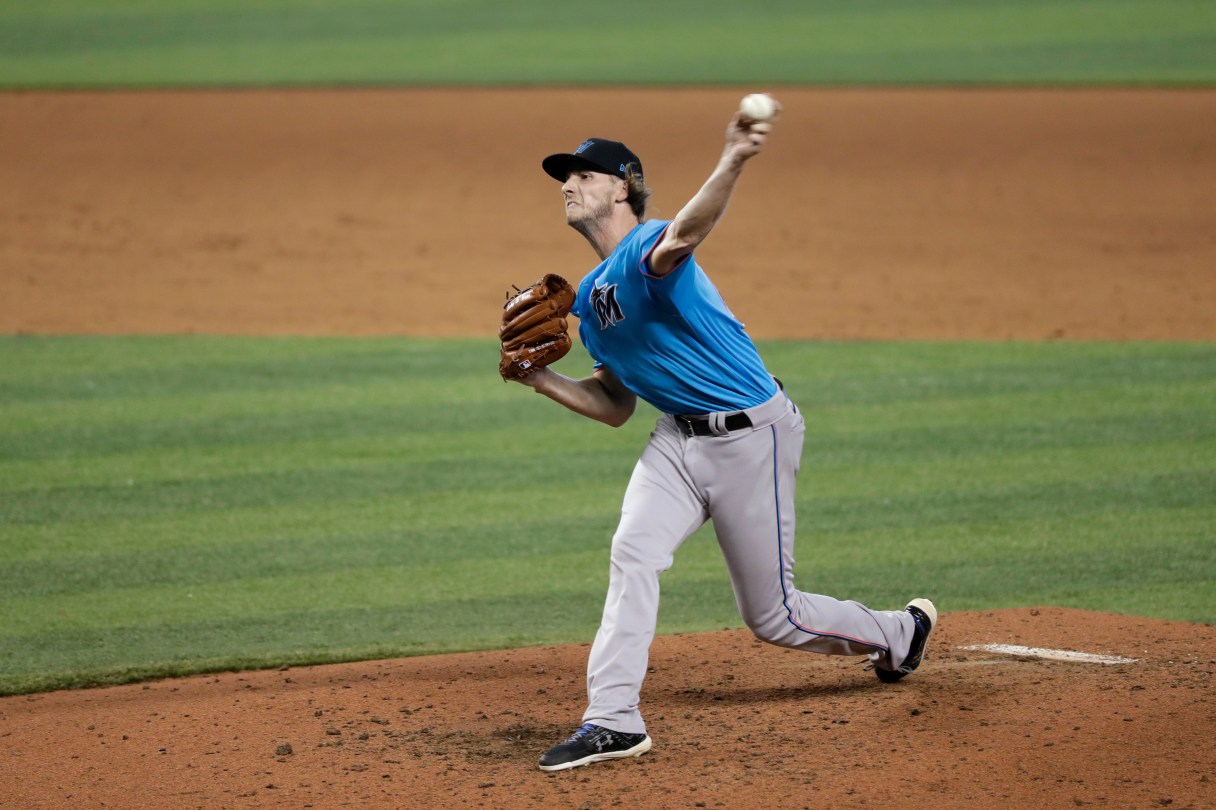
“If they’ve deemed that players being tested is necessary to provide jobs, opportunity, entertainment, TV, all that’s going on – if they think that’s really valuable – then they’ve weighed it’s important for us to be tested this often for the season to happen,” Miami Marlins pitcher Adam Conley said. “But it makes me sad if someone is desiring or needing to be tested and doesn’t have the means to get that. It’s heartbreaking.”
MLB is trying to ensure its nearly 10,000 weekly tests don’t strain public resources by using private facilities. The avalanche of tests has allowed the league to keep on top of potential outbreaks.
Dr. Amesh Adalja, senior scholar at the Johns Hopkins Center for Health Security, said it was possible baseball’s rigorous testing could create conflicts regarding resources in test-strapped regions, but he also thinks MLB’s investment might spur much-needed innovation and boost production in testing.
“The solution here is really to make sure that we expand testing,” Adalja told The Associated Press. “And maybe because MLB will be putting resources into trying to buy all these tests, that might actually be a way to expand capacity. I don’t know if that’s going to happen or not, but we want to be in a place where testing can be done as quickly and as easily as possible for all purposes.”
MLB’s approach to its return has been different than the NBA and the NHL, which both opted for a bubble-like atmosphere in hub cities. The NBA has 22 teams in Orlando, Florida, while the NHL’s teams will be split by conference into playing games in Edmonton and Toronto.
MLB’s 30 teams are all planning to play in their home markets, meaning there will be much more travel for all involved. Teams have spent the past few weeks in one place but will start traveling for exhibition games soon.
The Arizona Diamondbacks leave Sunday for two exhibition games in Los Angeles against the Dodgers.
“This first trip to L.A. is going to be new for everyone,” Diamondbacks closer Archie Bradley said. “From the check-ins to the hotels to the way we travel, eat and prepare. So I think the first two days of travel are going to be a very big orientation of what the season’s going to look like and how we’re going to handle not going out to eat, not going to the mall, not going out to restaurants after games.”
On Friday, Pittsburgh Pirates outfielder Gregory Polanco and free agent outfielder Yaisel Puig both tested positive for COVID-19, while New York Yankees infielder DJ LeMahieu and Atlanta Braves first baseman Freddie Freeman, both MLB All-Stars last season, returned to the field after missing time with the virus.
The 28-year-old Polanco is a key part to the Pirates lineup, especially after they traded Starling Marte to the Diamondbacks during the offseason. He battled injuries last season and hit .242 in 42 games.
Puig was near a one-year agreement with the Atlanta Braves that was contingent on him passing a physical. The 29-year-old posted a statement on social media on Friday saying he had the virus. He also said he is asymptomatic and feels “absolutely fine.”
He hit a combined .267 with 24 homers and 84 RBIs for the Cincinnati Reds and Cleveland Indians in 2019.
Kansas City Royals prospects Nick Dini and Daniel Tillo also tested positive for the virus. They are now quarantined.
The 32-year-old LeMahieu signed with the Yankees before the 2019 season and hit .327. He set career highs with 26 homers and 102 RBIs while splitting time at first, second and third base. Yankees manager Aaron Boone wants LeMahieu to build up his legs and said it’s not clear whether he will be ready for Thursday night’s opener against the host Washington Nationals, the reigning World Series champions.
Freeman and Atlanta pitcher Touki Toussaint – who also previously tested positive for the virus – worked out at Truist Park on Friday. Freeman appeared to be fit in video posted on the Braves’ Twitter account. He took swings in the batting cage and worked out in the field and could have time to prepare for the team’s Friday opener against the host New York Mets.
Royals pitcher Brad Keller also returned after a pair of negative tests. He immediately hit the field for a 30-pitch bullpen session and had no problems. The Oakland Athletics received good news when 22-year-old pitcher Jesus Luzardo returned to camp. He’s expected to begin the season out of the bullpen.