
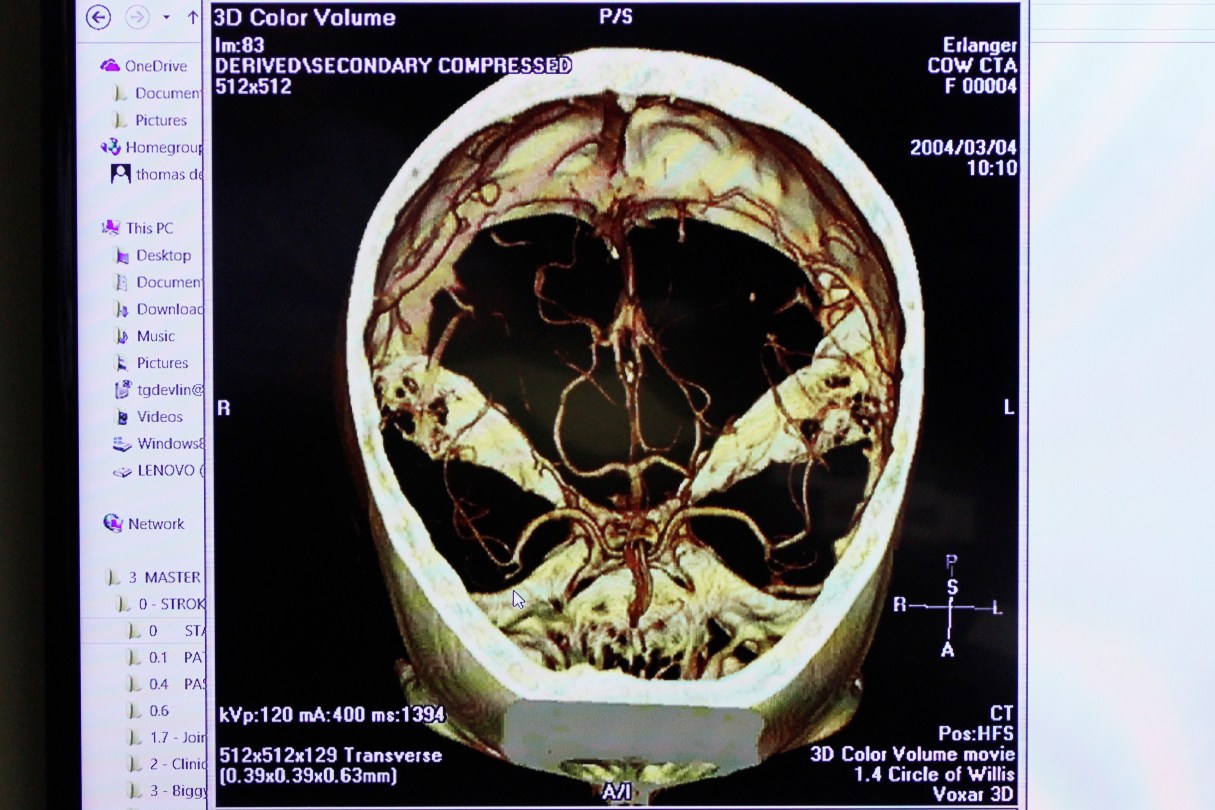
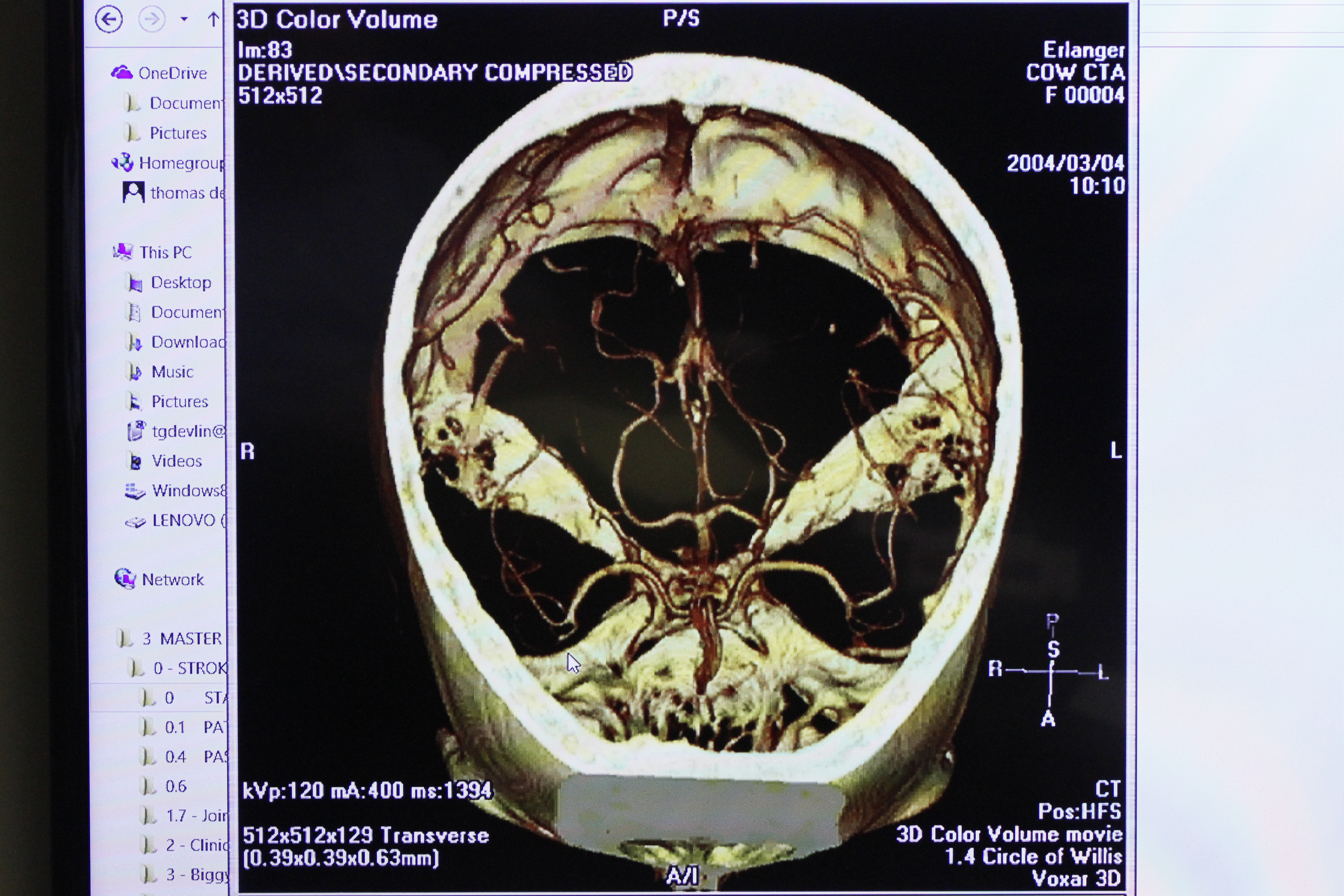
 Dr. Thomas Devlin shows how doctors can pinpoint a blood clot location by brain imaging.
When stroke patients are wheeled through the doors Erlanger Health System, they have just arrived on the frontier of U.S. stroke treatment.
Seconds matter, and patients are whisked down to a bustling, brain-saving operation. A 24/7 stroke team sprints patients into brain scanners within 10 minutes. A doctor snakes a device into a patient’s leg that reaches deep inside the brain to retrieve a clot. A billion stem cells, stored at -180 degrees Fahrenheit in liquid nitrogen, are thawed and added to a stroke survivor’s blood in an experiment meant to speed recovery.
STROKE STATISTICS
About 795,000 Americans each year suffer a new or recurrent stroke. That means, on average, a stroke occurs every 40 seconds. On average, someone dies of stroke every four minutes. Stroke kills more than 137,000 people a year. That’s about one of every 18 deaths. It’s the No. 5 cause of death. About 40 percent of stroke deaths occur in males, and 60 percent in females. Americans paid about $73.7 billion in 2010 for stroke-related medical costs and disability. Source: American Stroke Association
When doctors worldwide talk about the future of stroke treatment, they cast many predictions that are already day-to-day reality in Chattanooga. Erlanger, best known as the region’s public safety-net hospital, is also home to the Southeast Regional Stroke Center, which is spearheading some of the nation’s foremost research on stroke care.
Doctors at the center have long said that one of its more pioneering stroke treatments – fishing out a blood clot that has lodged in one of the brain’s blood vessels – leads to massive improvements for people who suffer the most severe strokes.