
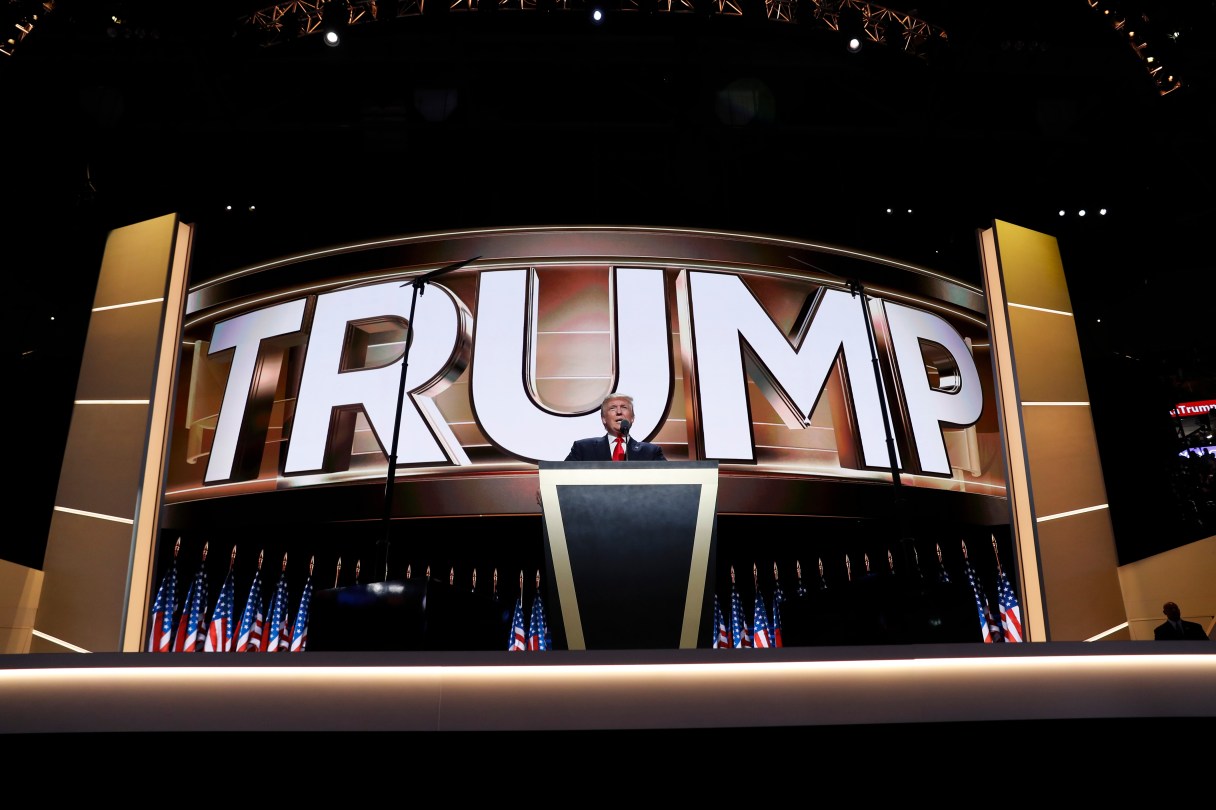

Donald Trump told potential presidential voters what they longed to hear in four short words Thursday night.
“I am your voice,” the unlikely nominee said in his Republican National Convention acceptance speech.
Just how many of them – those who have felt they had no voice the last seven-plus years and were living in a country they no longer recognized – believe his is the right voice will determine the outcome of the election in November.
In the longest presidential acceptance speech since 1972, Trump delivered many of the words and phrases that were music to the ears of those who have felt disenfranchised: “Crime and violence will come to an end”; “we can’t afford to be so politically correct anymore”; “we will put America first”; “we are going to defeat the barbarians of ISIS”; “we are going to build a great border wall”; “Americans want relief from uncontrolled immigration”; we will “appoint justices of the Supreme Court who will uphold our laws and our Constitution”; we are “going to make America rich again”; we “will create millions more jobs.”
If he did all that, he could become president for life; if he did half of it, he would become one of the most popular presidents in history. More realistically, if he convinces enough people that he’ll attempt some of it, he could be elected.
Trump, the billionaire businessman, has spent more than a year saying outlandish things, insulting women and minorities, and acting less than presidential. His nominating speech would be his last, best chance to allow a television audience – one that just might stop taking selfies and playing Pokémon Go long enough to listen – to take the measure of the man.
What they got was the teleprompter version of the bombastic candidate on the campaign trail. He still wants to make America great again, he still wants to build the wall, he still wants to mow down the Islamic State. To that, he added salient facts about crime, unemployment and trade deficits. He took deserved shots at President Barack Obama and presumptive Democratic candidate Hillary Clinton. He made a play to the inner cities, which he rightly said had been failed by the present administration. He reached out to the LGBT community, vowing to protect it from terrorist attacks like the one earlier this summer in Orlando, Fla. And he claimed “my greatest compassion [is] for our own struggling citizens.”
Yet, Trump was still occasionally vintage Trump, adding parenthetical comments to his prepared text, flashing his sardonic smile, chanting along with the crowd and giving a handful of thumbs-up gestures.
He was not mad, and he was not maniacal. But is he someone enough people will vote for to make him the 45th president?
Trump, in the Cleveland, Ohio, convention finale, was part Richard Nixon with his call for law and order in a violent year that eerily recalls 1968. He was part Ronald Reagan in earnest pleas for citizens to “start believing in our country and ourselves again” and “to show the whole world America is back – bigger and stronger than ever before.” And, at least according to daughter Ivanka, he was part Barack Obama in advocating for “quality child care affordable and accessible for all” and “equal pay for equal work.”
Let’s face it. As a Republican, Trump doesn’t tick off the usual-suspects box. He’s not polished and he’s not ideologically pure, but he’s the candidate the people have chosen in the most unusual of election years.
The people, after nearly two terms of foreign policy disasters, an economic recovery that left many people behind and a health care system they don’t like, didn’t want one of the usual suspects. So they gathered around a name they knew, a man who talked back to the media, a man who refused to couch his words, a man who was rich enough not to care what people thought of him.
On Thursday, at 10:19 p.m., that man accepted the presidential nomination of one of the country’s two major parties. Next week, the country’s other major party will nominate its first woman standard-bearer. Yet, the two are likely to leave their respective party’s convention as perhaps the two least popular presidential candidates in American history.
Trump, for his part, at least urged voters to try to distinguish between the two.
Her slogan, he said of Hillary Clinton, is “I’m with her”; “mine is, ‘I’m with you, the American people.'”
Trump’s ability to convince enough voters of that will determine his fate.