
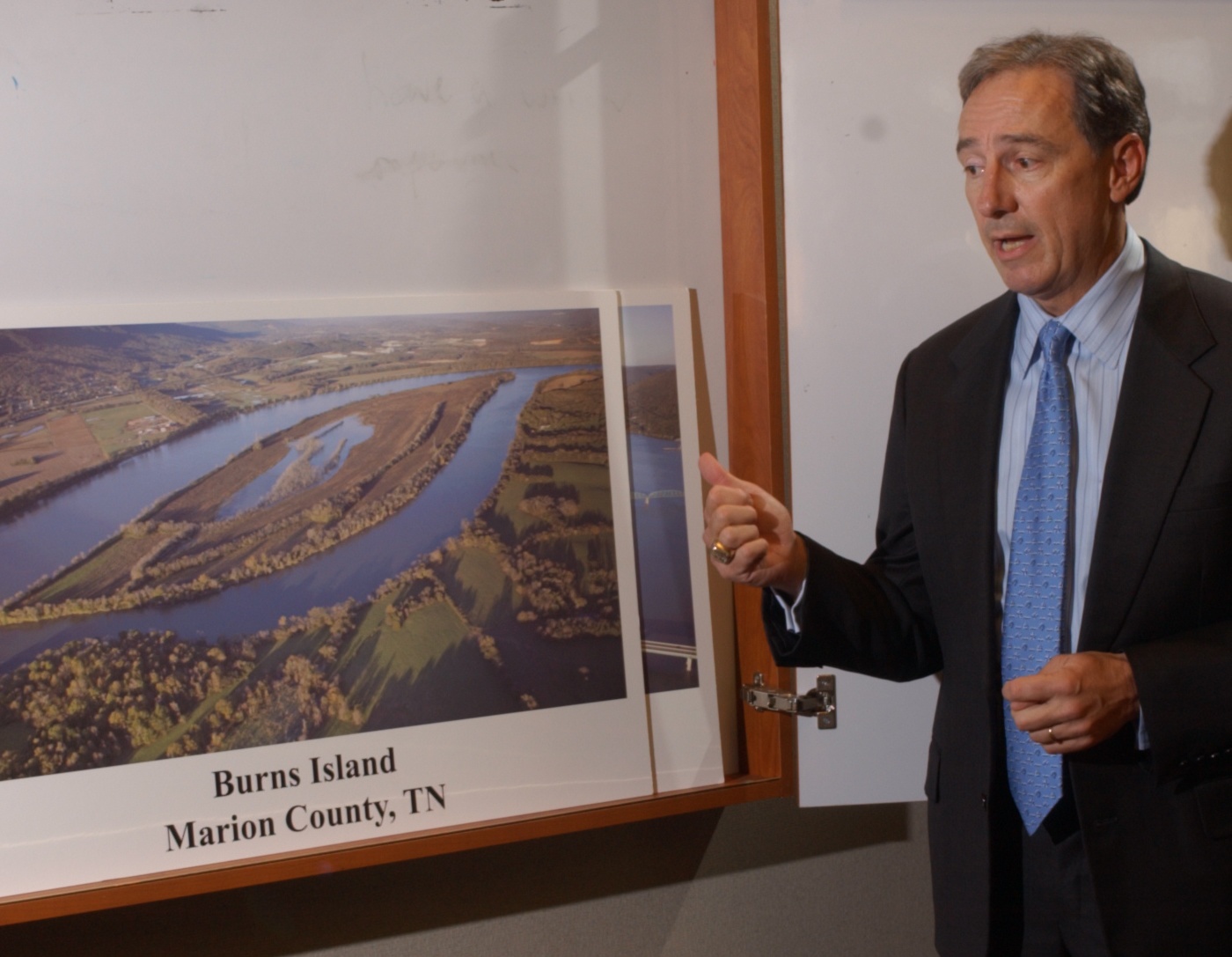
 John Thornton talks about plans for land acquisitions in nearby Marion County, Tenn. at the Times Free Press on Friday.
In response to the recent “broadband battle” covered by the Times Free Press, one of the reasons the opposition continues to not budge on lifting the territorial restrictions on public providers (i.e., EPB) is that the proposed legislation isn’t the perfect answer to the problem.
State Economic and Community Development Commissioner Randy Boyd put it this way: “A solution for some, but not a solution for all, is not the way we want to go.” If a doctor had a prescription that could cure a lot of ill people but it couldn’t cure everyone, would you ask the sick patients who could be cured to wait until there was a perfect prescription for all? Of course not. We’ve all heard before that “perfect is the enemy of good,” which I believe is happening in this case.
State Sen. Janice Bowling and state Rep. Kevin Brooks have proposed legislation that doesn’t provide all of the solutions to solve the entire statewide deficiency in the deployment of broadband, though that should not be a requirement for any policy. It is a good start and will affect first responders, school children and businesses all over the state.
Tennessee Municipal Electric Power Association (TMEPA) members serve more than 70 percent of all Tennesseans. There is a huge opportunity for the electrical municipalities to work with co-ops, running fiber that a municipality could provide services over. Just because the municipals can’t serve all of the underserved doesn’t mean they should not be able to serve any. The benefit of this bill is that tens of thousands of Tennesseans will have immediate access to fiber, and it won’t cost the state a penny. In fact, I understand if SB1134 were passed, then the state would drop its suit against the FCC for eliminating Tennessee’s barrier legislation as that ruling would be moot. A substantial savings of legal fees and effort would be realized. Let’s not wait for a big government, one-size-fits-all, “perfect” solution. There will be many solutions.
Many parts of our state are being held in the past. Some are using the recent proposed study by the state (it ironically includes a 20-minute online survey, which is probably more like 60 minutes if you don’t have EPB) to delay a vote on the Bowling/Brooks bill. How are the people with lack of Internet access supposed to even take this survey? Tennesseans should not have to wait any longer than they already have. I don’t understand why we can’t study the issue and encourage the General Assembly to allow the local control option at the same time.
Private carriers, some taking millions in federal funds to provide speeds that will be outdated once actually finished, have had more than 15 years to do this and have not. It is time to put more options in play. These carriers are fighting tooth and nail because they don’t want competition. Some providers will continue to provide inadequate service or no service at all, and they don’t want anyone else to be able to bring rural Tennessee into the 21st century, either.
One such provider has stated that I’m simply a developer trying to get free high-speed Internet to my project in Marion County, Tenn. Not true. I’m actively working on my own solution for our development that is not dependent on this bill. We all must encourage our legislators to pass the Bowling/Brooks bill and eliminate the unserved and underserved in these “digital deserts” of Tennessee that are leaving our citizens behind and have been for over 15 years.
Chattanooga resident John Thornton is a developer.