

For the last five years, Luka Hyde’s family has argued in multiple federal courts that their 15-year-old son should have been allowed to stay in a public school classroom, despite his intellectual disability.
On Monday, the 6th Circuit Court of Appeals handed them a major victory that will have a broad effect on student disabilities rights in Tennessee, Michigan, Kentucky and Ohio.
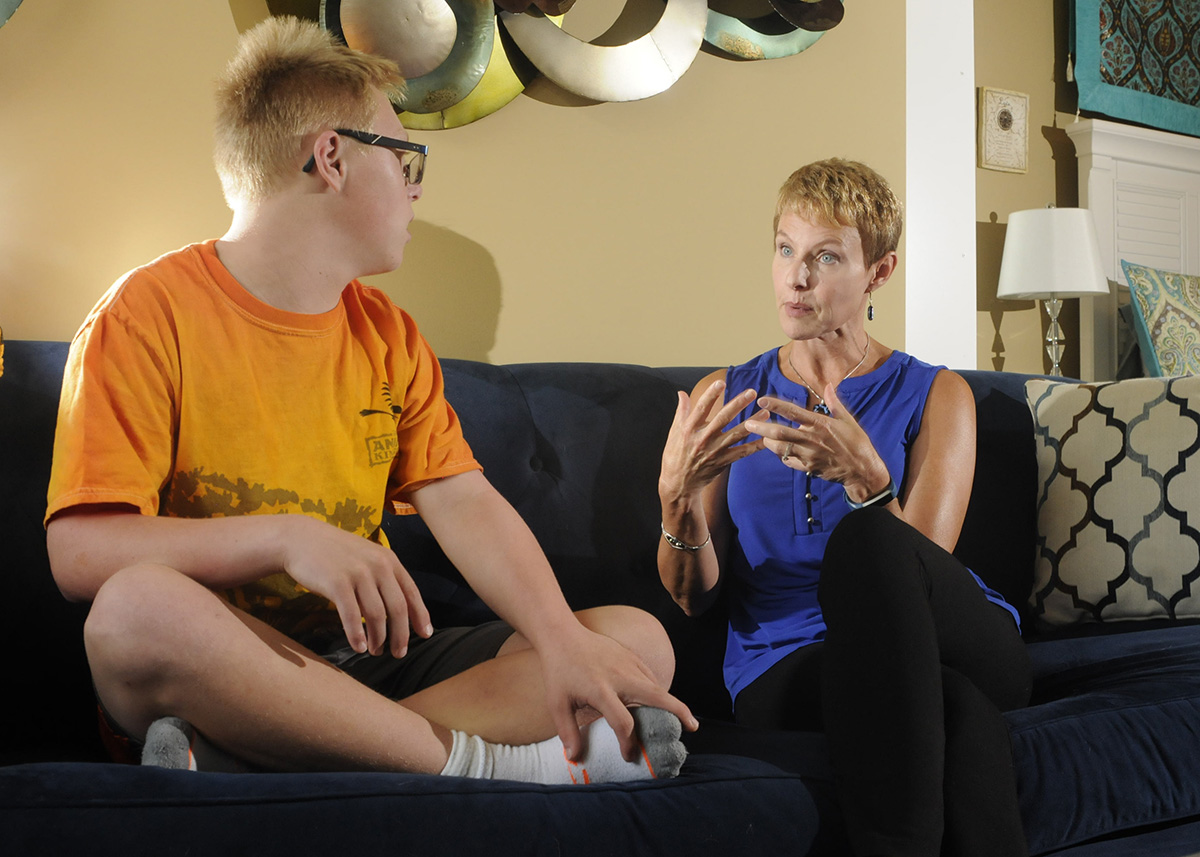 Deborah Rausch talks about special education beside her son, Luka Hyde, at the home in Chattanooga.
“Throughout history, the stain of unnecessary segregation has been overcome through the law. I am tremendously proud of this contribution, and a little boy – now young man – named LH,” said the family’s attorney, Justin Gilbert. “The law of Tennessee, Michigan, Kentucky and Ohio will bear his name, reminding us all that kids with intellectual disabilities belong. They are to be included. And we are all the better for it.”
Sixth U.S. Circuit Court of Appeals Judge Alice Batchelder ruled Monday that Hamilton County Schools violated a federal guideline that protects students with disabilities when it sent then-second-grader Hyde to a Red Bank Elementary comprehensive development classroom in 2013, where he would spend half his days separated from general education students. Hyde has Down syndrome.
Batchelder’s 25-page opinion dealt primarily with mainstreaming, which calls for students with disabilities to spend as much time as possible in regular classroom settings. She said the case, which came to her from Chattanooga’s U.S. District Court, “is really an argument against ‘mainstreaming’ as a concept, because HCDE believes it is impossible, impractical or counterproductive.”