
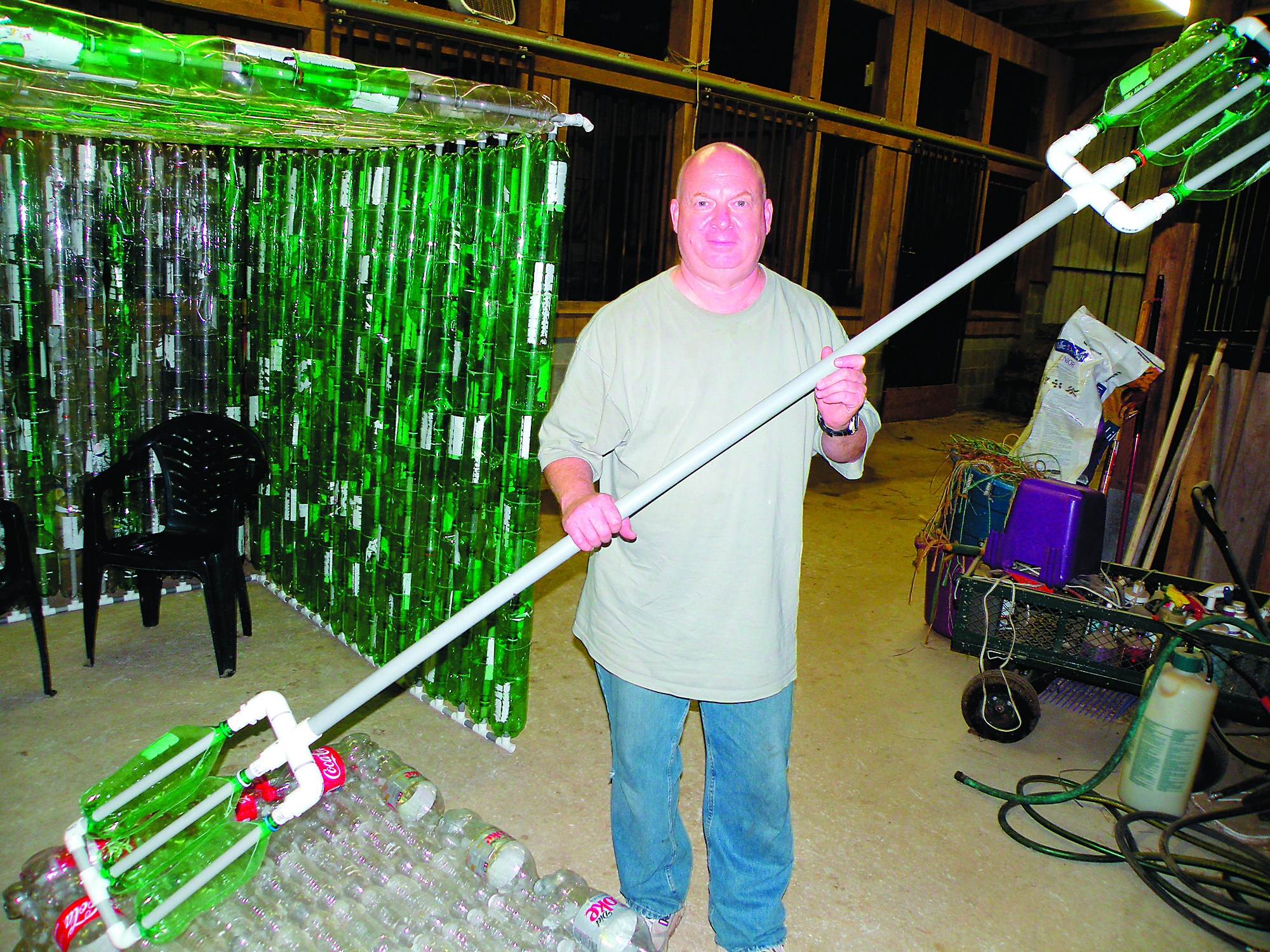
 Dr. Robert Spalding teaches readers “How to Live Homeless in Style: 50 Ways to Survive on Plastic Bottles in These Economic Times” in his new book available soon online, including instructions on how to build a shelter and canoe entirely from plastic two-liter soda bottles.
Photo by Emily Crisman
Signal Mountain author Dr. Robert Spalding introduces two new titles this spring, both non-fiction works exploring subjects few if any other authors have touched upon previously.
“Drug Subs” delves into the subject of semi-submersive fiberglass submarines being manufactured in Colombia and North Korea, which Spalding said they are willing to sell to anyone who can afford them and are capable of smuggling up to seven tons of cocaine apiece through the vulnerable U.S. coastline.
“I wanted to basically educate the public,” he said. “There’s no book on the market that has information about this.”
The concept is similar to a possibility he said he originally hypothesized in his fictional book “An American Playground” written 20 years ago and to be released this summer, in which submarines are used to bring drugs into the United States through Florida’s massive system of underground caverns.
He said the type of submarine he references in “Drug Subs” was until recently referred to as “Big Foot” until the first was identified and captured off the coast of Colombia in 1997.
“They allow easy access to the U.S. coastline for something more serious like a nuclear threat,” said Spalding.
MEET THE AUTHORDr. Robert Spalding plans to hold a book signing at Wild Hare Books for “Drug Subs,” “How to Live Homeless in Style” and “An American Playground” once the latter is released this summer.
He said North Korea has already sold a fleet of 30 of the submarines to Iran.
Spalding said he uncovered another previously unrecognized threat to homeland security while researching his new book “How to Live Homeless in Style: 50 Ways to Survive on Plastic Bottles in These Economic Times.”
The many homeless who sleep and travel around in rail cars are ignored by the public and go largely unnoticed by law enforcement unless they are called regarding a specific problem, a weakness he said terrorists could easily exploit.
Spalding said he has worked with the homeless as a full-time deputy and reserve officer of the Hamilton County Sheriff’s Office in addition to treating them as a podiatrist and paramedic.
“The real meat about this book is how homeless people are able to survive,” he said.
Through interviews with the homeless and the use of his own imagination, Spalding reveals inventive ways to live better without a home, featuring instructions on how to build a shelter and a canoe (“the Coke float”) entirely from plastic two-liter soda bottles.
Among the other 48 uses Spalding demonstrates for the used bottles are a mousetrap and a generator conducting 1.5 volts of electricity, which he said is enough to light the smallest bulb available at home improvement stores.