
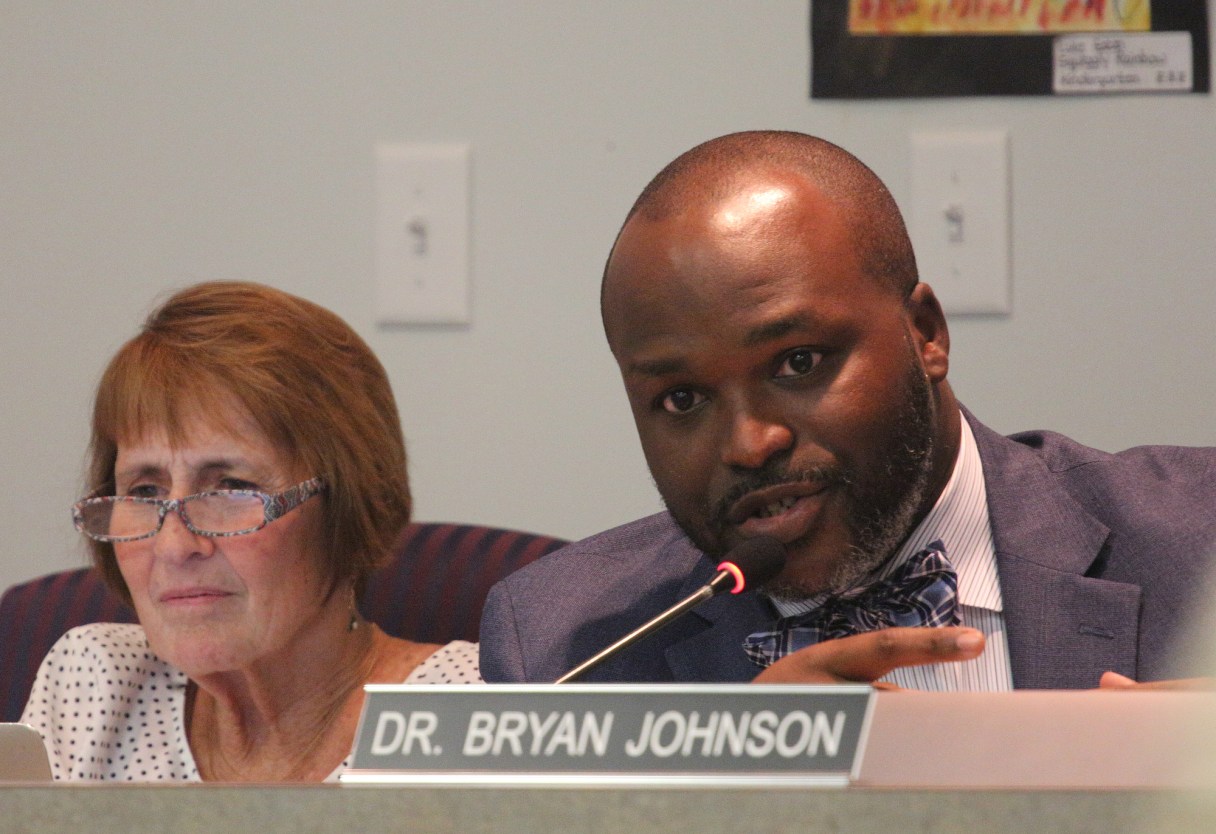

The Hamilton County Board of Education took a ride on the way-back machine during a discussion about equity and the district’s equity task force at Thursday’s monthly meeting.
But we’re not sure the right point was made.
When the talk turned to the district’s magnet schools and how they are populated, board member Karitsa Jones, a graduate of magnet school Chattanooga School for the Arts and Sciences (CSAS) – recalled how the original goal of the school was to have about 50 percent white and 50 percent black (or minority) students.
The original magnet school was, we recall, a way to give parents with children in struggling schools in the then-Chattanooga City Schools a different option for their education. Yes, it was a diverse student body, but the academics were more rigorous, independent work was mandatory and parents had to give of their time to the school. It quickly became one of the top schools in the city.
In time, Chattanooga School for the Liberal Arts (CSLA) opened with virtually the same requirements.
A funny thing happened on the way to 2018, though. The Chattanooga City Schools merged with Hamilton County Schools, more magnet schools opened (with different expectations for students and parents) and eventually even the 50-50 racial expectation for the original magnet schools melted away. Today, the district’s original magnet schools, CSAS and CSLA, are populated by a lottery system, with exceptions made for siblings of current students. The racial makeup of CSAS’s upper school is 50.2 percent white, 49.8 percent nonwhite; the lower school is 63.4 percent white, 36.6 nonwhite. CSLA’s student population is 65.8 percent white, according to 2016-2017 state figures.
In the discussion about equity, Dr. Marsha Drake, the district’s chief equity officer, said not enough economically disadvantaged students and Hispanic students were being served at the district’s magnet schools.
That brought’s Jones’ recollections – she said CSAS is “like a private public school” – and the mention by Superintendent Dr. Bryan Johnson that the district’s magnet schools today are populated by only between 8 and 12 percent of economically disadvantaged students (as defined by the state).
“You want the representation to be a little bit more culture mirroring,” he said. “[In] the district, right now, candidly, it doesn’t. Eight to 12 percent is the rate of free and reduced lunches in our magnet schools.”
We were a little curious about Johnson’s numbers, though, because of the 14 schools listed as magnet schools on the Hamilton County Department of Education website, eight (Barger Academy, Battle Academy, Brown Academy, Calvin Donaldson Environmental Science Academy, East Lake Middle Academy, Lakeside Academy, Tyner Academy, Tyner Middle Academy) are eligible to have every student who attends receive a breakfast and lunch meal at no charge every day.
According to 2016-2017 figures provided by the state, those eight schools have between 45.5 and 88.2 percent economically disadvantaged students.
It turns out, according to information from district spokesman Tim Hensley, Drake and Johnson were referring to only “whole” or “true” magnet schools, of which the district has five: Center for Creative Arts, CSAS (upper and lower schools), CSLA and STEM School Chattanooga.
State numbers show those five schools have between 8.8 and 13.8 percent of their students who are economically disadvantaged – much closer to the superintendent’s numbers.
But back to Jones and her correct recollection of the relatively early years at CSAS.
“If we really want to do this work,” she said, “then we’re going to make some people uncomfortable who have been comfortable for a long time to make some people who have been uncomfortable for a long time a little more comfortable.”
But was she talking about all schools, all magnet schools, the “true” five, or CSAS and CSLA?
It would be admirable if the district were to return to a goal of having the original two be populated with 50 percent white students and 50 percent nonwhite. But before the district makes that a goal again, it should thoroughly examine the reasons those numbers at the CSAS lower school and CSLA slipped.
Were the academics too rigorous? Was independent work too much of an expectation? Could parents not be counted on to give their time?
Ideally, if the district believes its “whole” or “true” magnet schools provide an excellent education, which their test scores show they do, mirroring the culture is not the best answer. It’s an answer, and it’s an answer that worked for CSAS and CSLA at their beginnings. But the best answer is to create more schools just like them. Widen the opportunities.
The district, actually, is in the process of doing that at CSLA. Instead of serving a K-8 population, it will serve a K-12 population when it moves to the current site of Tyner Middle Academy in a couple of years.
Beyond CSAS and CSLA, the other two “whole” or “true” magnet schools already serve special populations. Center for Creative Arts focuses on arts such as music, theater, dance and visual arts, while STEM School Chattanooga was founded with a focus on sciences, technology, engineering and mathematics.
Shoehorning economically disadvantaged students into certain schools may help with culture mirroring, but it doesn’t make practical sense. Making sure those who are economically disadvantaged know about the schools if they do have an interest, can do the work and can get there is another thing entirely.