
Sunday, November 15, 2026Nov 15

Sohn: Joe Biden’s infrastructure plan trades corporate welfare for jobs

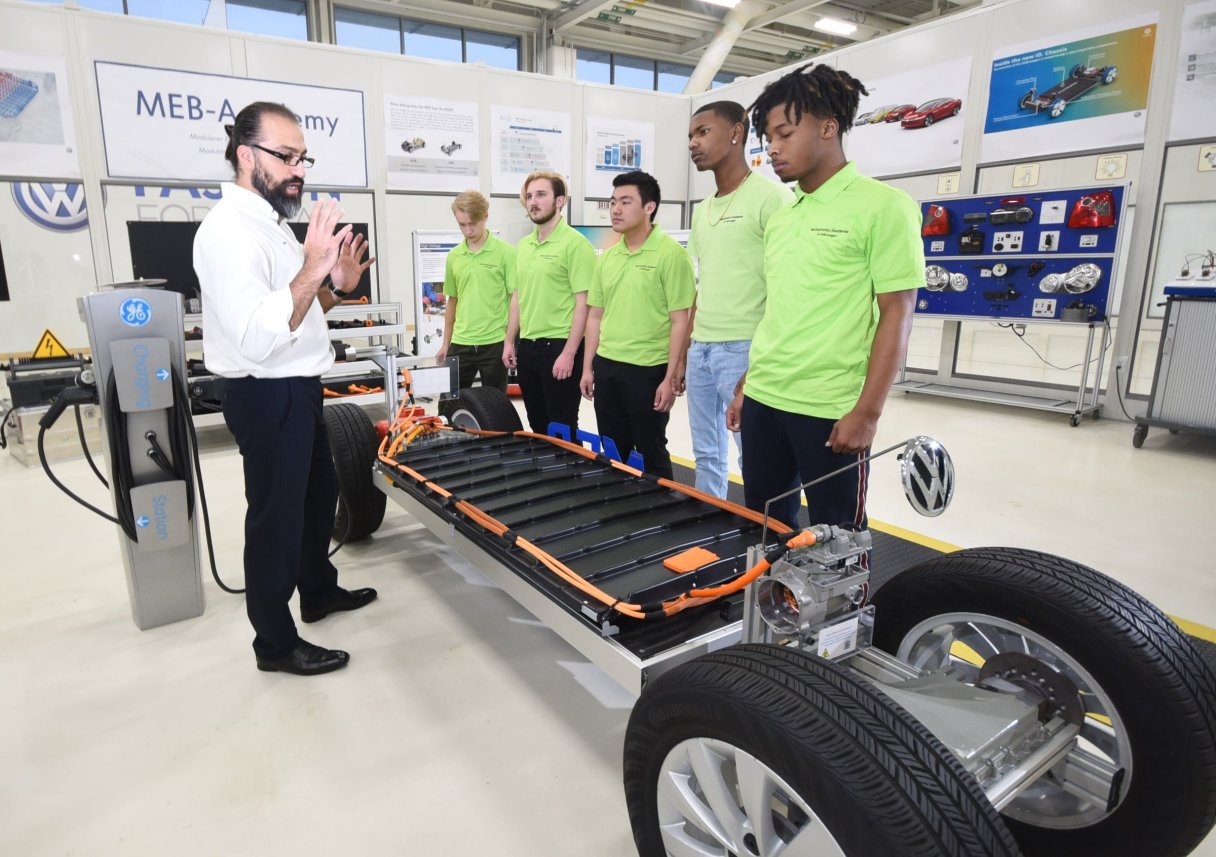
Staff file photo / Hamilton County students, from right, Javier Favors, Jordan Kirby, Aaron Bun, Miles Matthews and Marko Burdeiniy, listens closely as Ilker Subasi, left, assistant manager of technical training at Volkswagen Chattanooga, reveals the change from the Automation Mechatronics Program to the MEB electric training program and the tools that will be needed to produce electric vehicles at Volkswagen during an open house at Volkswagen Academy in February of 2019. The modular electric platform shown is used for training purposes.

The time has been nigh for President Joe Biden to make good on his “Build Back Better” campaign slogan, and this week he laid out a $2 trillion infrastructure blueprint that does, in fact, think big. And it promises big – in terms of bricks and mortar, in terms of climate and in terms of people.

The proposal includes the usual catch-up stuff: $115 billion to repair, rebuild and make resilient bridges, highways and roads, as well as another $100 billion to upgrade and build new schools.

The plan also is futuristic in calling for $100 billion in expansions of high-speed broadband across the entire country, and another $100 billion to expand and improve power lines and an essential grid system to push a clean energy shift, along with another $50 billion to subsidize semiconductor manufacturing.

Finally it goes toward a kind of infrastructure we really haven’t much thought of as infrastructure, though it very much is a rather old-fashioned kind of foundational people stabilizer: $400 billion for the “care economy” – home- and community-based services for the disabled and elderly.

It is big thinking. And it’s good big thinking.