
Thursday, November 12, 2026Nov 12

Can you hear them now? New buoy listens for singing whales

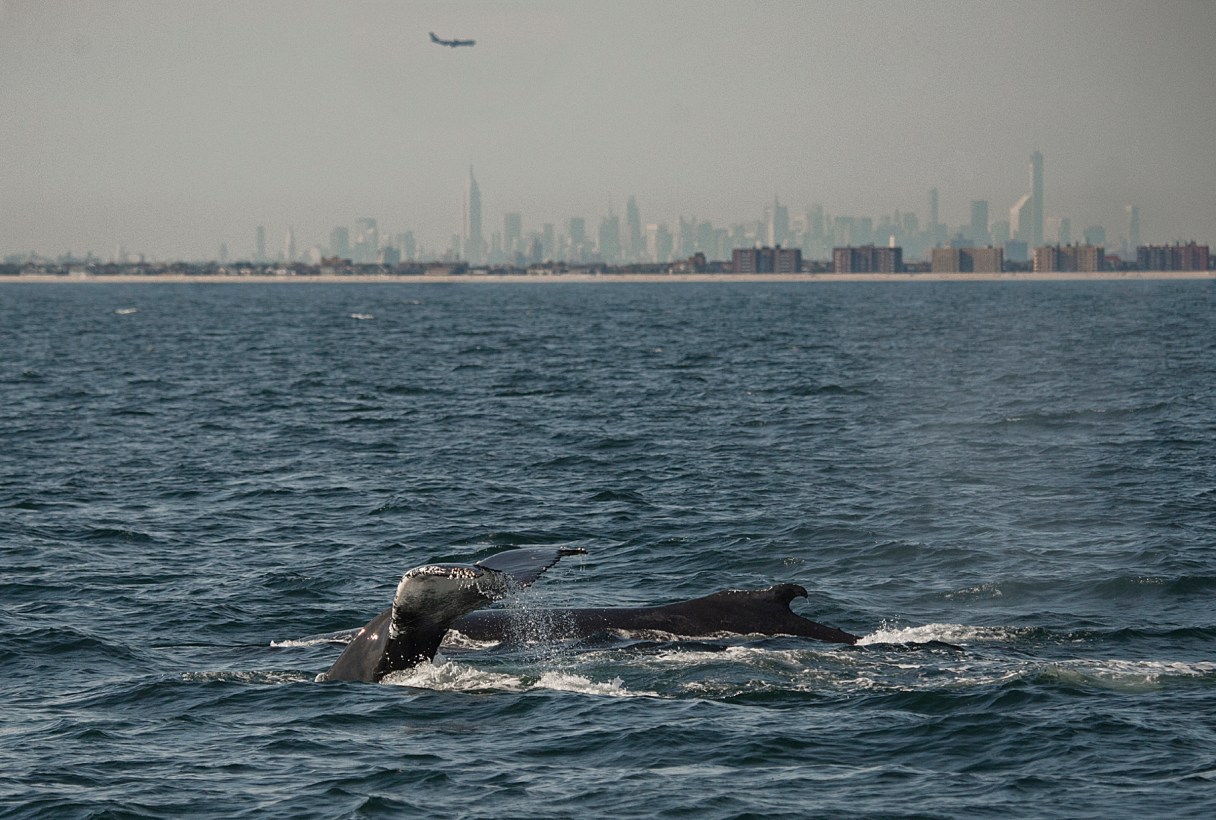
In this Sept. 28, 2014 photo provided by the Wildlife Conservation Society, two humpback whales dive inside what is called the New York Bight, with the New York City skyline in the background. Scientists have deployed a high-tech acoustic buoy in the Bight 22 miles off the coast of New York's Fire Island to monitor several species of great whales in "near real-time. The high-tech acoustic device will eavesdrop on the songs of the whales to better understand and safeguard their movements near two busy shipping lanes entering New York Harbor.
 (Julie Larsen Maher/Wildlife Conservation Society via AP)
In this Sept. 28, 2014 photo provided by the Wildlife Conservation Society, two humpback whales dive inside what is called the New York Bight, with the New York City skyline in the background. Scientists have deployed a high-tech acoustic buoy in the Bight 22 miles off the coast of New York's Fire Island to monitor several species of great whales in "near real-time. The high-tech acoustic device will eavesdrop on the songs of the whales to better understand and safeguard their movements near two busy shipping lanes entering New York Harbor. (Julie Larsen Maher/Wildlife Conservation Society via AP) In this Sept. 28, 2014 photo provided by the Wildlife Conservation Society, two humpback whales dive inside what is called the New York Bight, with the New York City skyline in the background. Scientists have deployed a high-tech acoustic buoy in the Bight 22 miles off the coast of New York's Fire Island to monitor several species of great whales in "near real-time. The high-tech acoustic device will eavesdrop on the songs of the whales to better understand and safeguard their movements near two busy shipping lanes entering New York Harbor. (Julie Larsen Maher/Wildlife Conservation Society via AP)

MINEOLA, N.Y. (AP) – Scientists have deployed a buoy 22 miles off the coast of New York’s Fire Island to monitor several species of great whales in “near real-time.” The high-tech acoustic device will eavesdrop on the songs of the whales to better understand and safeguard their movements near two busy shipping lanes entering New York Harbor.

“We know they’re there, but we know very little about them,” said Dr. Howard Rosenbaum, director of Wildlife Conservation Society’s Ocean Giants Program. His New York-based organization has teamed with the Woods Hole Oceanographic Institution in Massachusetts on the research project.

Scientists last week deployed the buoy, which is four feet in diameter with a mast standing six feet above the sea surface south of Long Island. The buoy is connected by “stretch hoses” to a weighted frame that sits 125 feet below on the sea floor. The frame features high-tech listening devices connected to an underwater microphone.

The devices will focus on obtaining data on the sounds of several species of baleen whales because they are endangered, said Dr. Mark Baumgartner of the Woods Hole Oceanographic Institution. The data will be transmitted back to scientists in near real-time, for analysis within about two hours, Rosenbaum said.

The buoy also will collect the sounds of other whales, but that information will be archived in the listening devices at the bottom of the sea and analyzed when the buoy is retrieved after a year, Baumgartner said.