
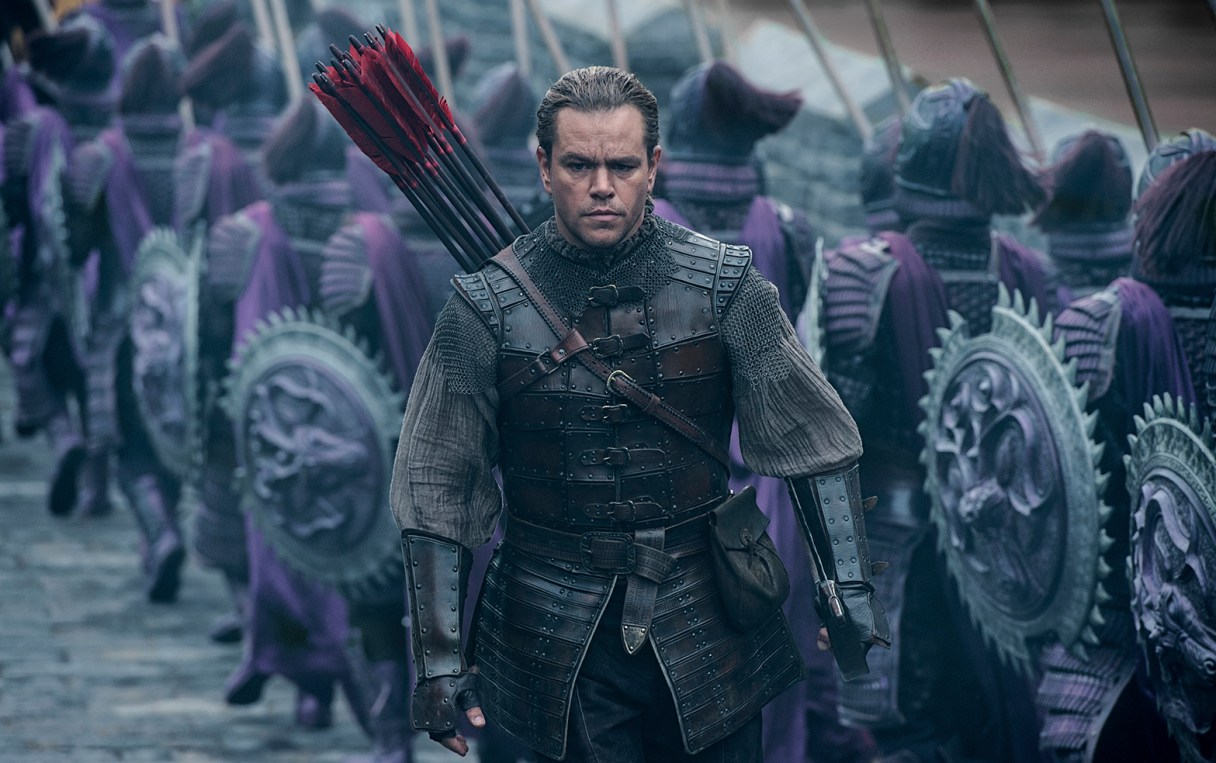
‘The Great Wall’
Rating: PG-13 “for sequences of fantasy action violence.” Running time: 104 minutes.
“Tell the world what you have seen,” a character exclaims in “The Great Wall,” ”and what is coming!”
The warning is about the mythical mass of marauding monsters that are sweeping down northern China but it could just as easily be for the kind of Hollywood-China collaboration that is “The Great Wall.” The first English language feature shot entirely in China, it’s the biggest-budget attempt yet to straddle both sides of the Pacific, plucking a movie star (Matt Damon) from the West for a production in the East. In a movie industry where the two biggest markets are North America and China, it’s Hollywood’s version of having your cake and eating it, too.
But if “The Great Wall” is a forerunner to the cross-cultural blockbustering to come, we may have just as much reason to flee as those being hounded in the film by the Taotie. Those are the four-legged, man-eating creatures of ancient Chinese folklore that are here attacking the Great Wall and the armies that defend it, as the Taotie are said to do every 60 years. They’re the Halley’s Comet of demons.
With acclaimed Chinese filmmaker Zhang Yimou directing and Damon starring, “The Great Wall” would seem to at least promise to be an intriguing artifact, a movie that would, even in failure, illustrate something interesting about the culture clash it’s predicated on. But it turns out to be little more than a monster movie (and a poor one at that) that says more about corporate-driven global moviemaking than anything about either culture. It, after all, originated as a thinly sketched conceit of Thomas Tull, the former chief executive of the now Chinese-owned Legendary Entertainment.