
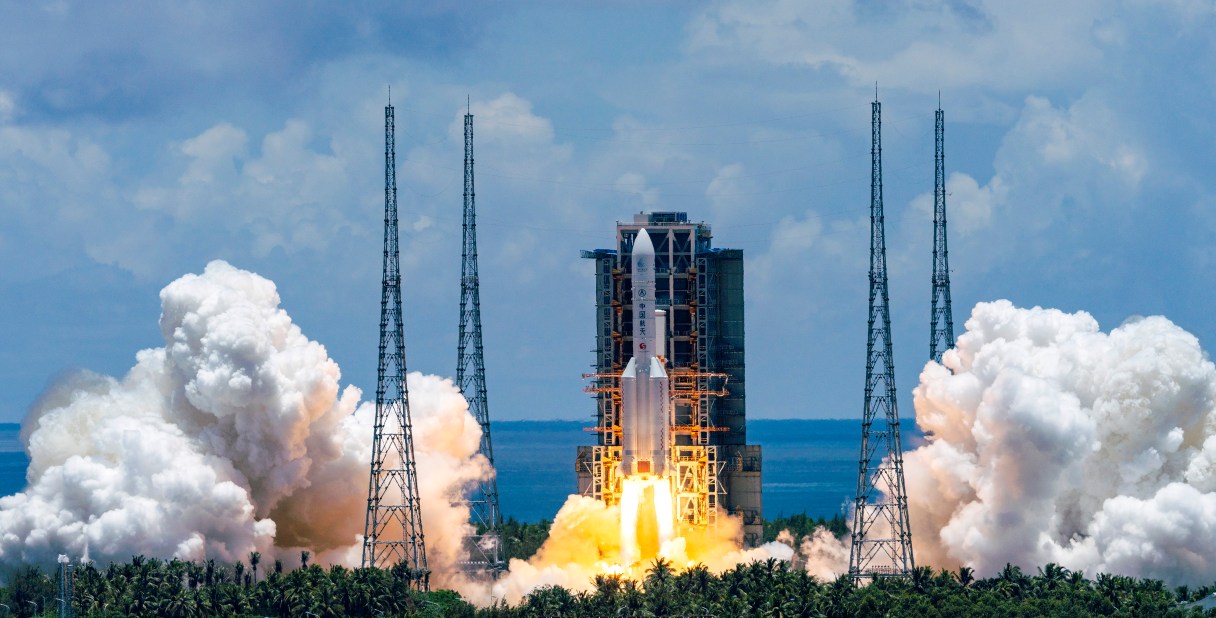
BEIJING (AP) – China launched its most ambitious Mars mission yet on Thursday in a bold attempt to join the United States in successfully landing a spacecraft on the red planet.
Engines blazing orange, a Long March-5 carrier rocket took off under clear skies around 12:40 p.m. from Hainan Island, south of China’s mainland. Hundreds of space enthusiasts cried out excitedly on a beach across the bay from the launch site.
“This is a kind of hope, a kind of strength,” said Li Dapeng, co-founder of the China branch of the Mars Society, an international enthusiast group. He wore a Mars Society T shirt, and was there with his wife, 11-year-old son and 2,000 others on the beach to watch the launch.
Launch commander Zhang Xueyu announced to cheers in the control room that the rocket was flying normally about 45 minutes later. “The Mars rover has accurately entered the scheduled orbit,” he said in brief remarks shown live on state broadcaster CCTV.
China’s space agency said that the rocket carried the probe for 36 minutes before successfully placing it on the looping path that will take it beyond Earth’s orbit and eventually into Mars’ more distant orbit around the sun.