
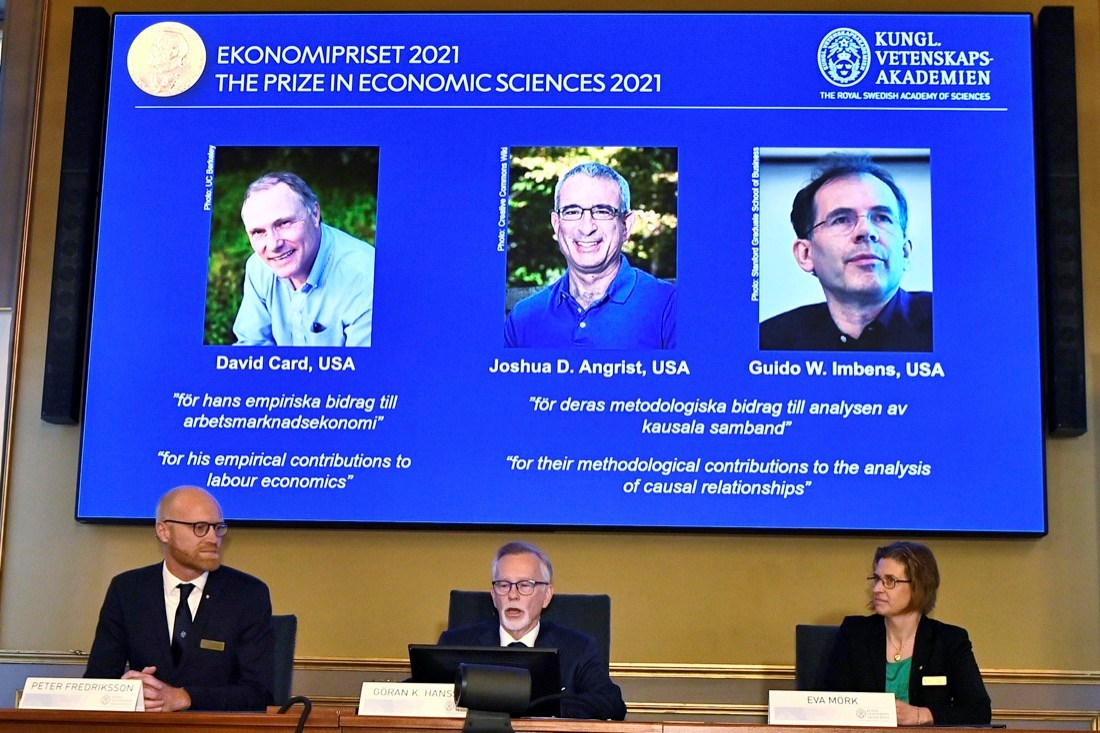
STOCKHOLM (AP) – A U.S.-based economist won the Nobel prize in economics Monday for pioneering research that transformed widely held ideas about the labor force, showing how an increase in the minimum wage doesn’t hinder hiring and immigrants do not lower pay for native-born workers. Two others shared the award for creating a way to study these types of societal issues.
Canadian-born David Card of the University of California, Berkeley, was awarded half of the prize for his research on how the minimum wage, immigration and education affect the labor market.
The other half was shared by Joshua Angrist from the Massachusetts Institute of Technology and Dutch-born Guido Imbens from Stanford University for their framework for studying issues that can’t rely on traditional scientific methods.
The Royal Swedish Academy of Sciences said the three have “completely reshaped empirical work in the economic sciences.”
Together, the three helped rapidly expand the use of “natural experiments,” or studies based on the observation of real-world data. Such research made economics more applicable to everyday life, provided policymakers with actual evidence on the outcomes of policies, and in time spawned a more popular approach to economics epitomized by the blockbuster bestseller “Freakonomics,” by Stephen Dubner and Steven Levitt.