
Monday, November 16, 2026Nov 16

High court won’t take over Tennessee voucher lawsuit

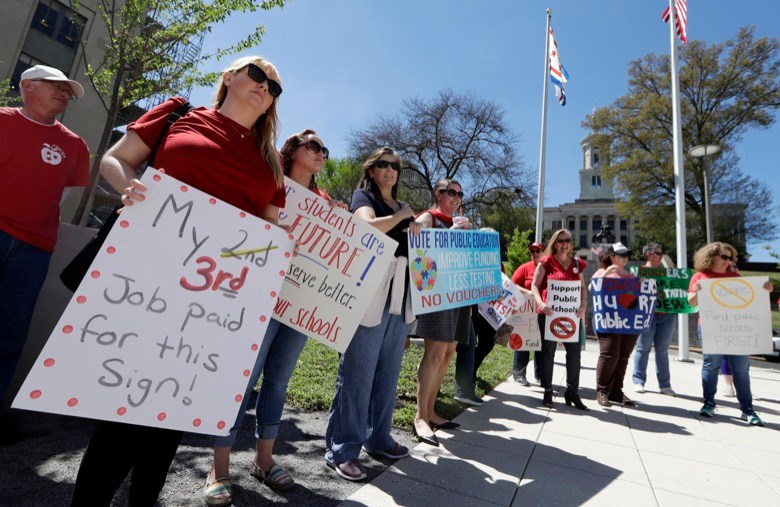
In this April 9, 2019 file photo, people protest against school vouchers in Nashville, Tenn. Tennessee education officials remained largely in the dark on how parents misspent school voucher funds while using state-issued debit cards over the past school year, a review by The Associated Press has found. The Tennessee voucher program is currently modest in scale but is set to expand under Republican leadership over the next year. Under the program, the state gives families of children with certain disabilities the option of removing their student from public school and then provided a state-issued debit card loaded with tax dollars to help cover their children's needs in the private sector. (AP Photo/Mark Humphrey, File)

NASHVILLE, Tenn. (AP) – Tennessee’s highest court declined Thursday to take up an appeal of a lawsuit challenging the legality of a school voucher program that would let parents use public tax dollars for private school tuition.

Voucher supporters had hoped the Tennessee Supreme Court would reach down and take up the case after an appellate court set an Aug. 5 hearing to review the case.

However, the justices’ decision effectively blocks the voucher program from being implemented for the 2020-21 school year because most schools will already be starting by August.

“Based upon the current totality of the circumstances, including the relevant timeline and the procedural posture of this case, the court concludes that this case does not warrant the extraordinary action of the exercise of the court’s authority to assume jurisdiction,” the justices wrote.

Attorney General Herbert Slatery’s office declined to comment on the Supreme Court’s decision.