
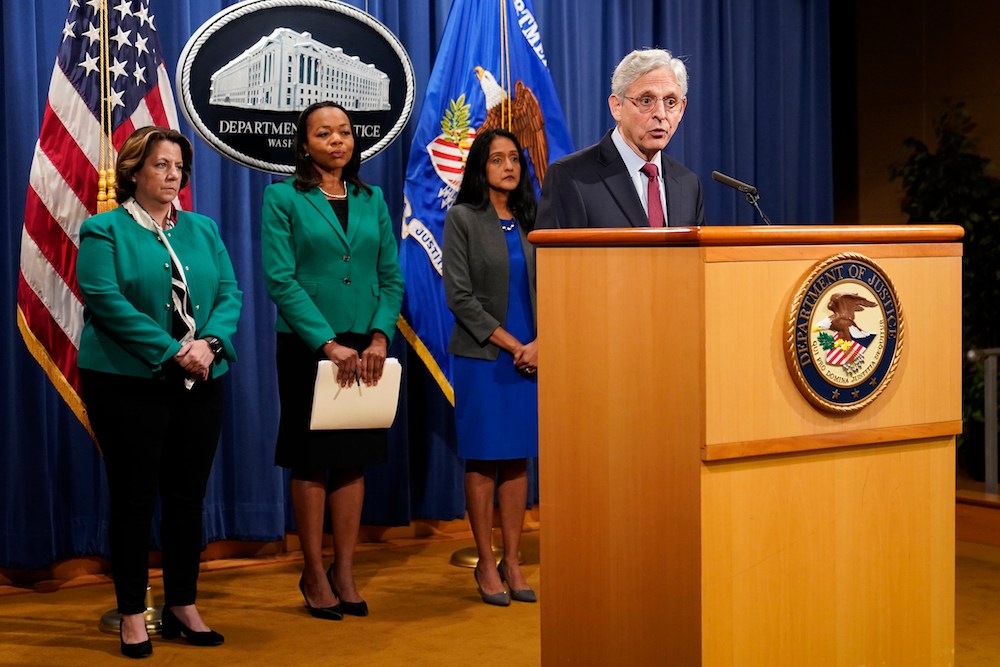
The United States vs. Georgia, a lawsuit filed Friday by Attorney General Merrick Garland, draws a long red line in the sand.
“The rights of all eligible citizens to vote are the central pillars of our democracy. They are the rights from which all other rights, ultimately flow,” Garland said as he announced the suit that accuses a new Georgia law of effectively discriminating against nonwhite voters and seeks to show that Georgia lawmakers intended to do so.
“Today, the Department of Justice is suing the state of Georgia. Our complaint alleges that recent changes to Georgia’s election laws were enacted with the purpose of denying or abridging the right of black Georgians to vote on account of their race or color, in violation of Section II of the Voting Rights Act.”
Garland was making good on a promise that he would bolster the Justice Department’s civil rights unit to challenge policies and legislation that restrict voter access and discriminate against marginalized voters.
And on Friday, he made it clear that Georgia won’t be the only state scrutinized for passing discriminatory voting laws. (As of June 21, 28 restrictive laws had passed in at least 17 states, according to the Brennan Center for Justice, which researches voting and supports expanded access.)