
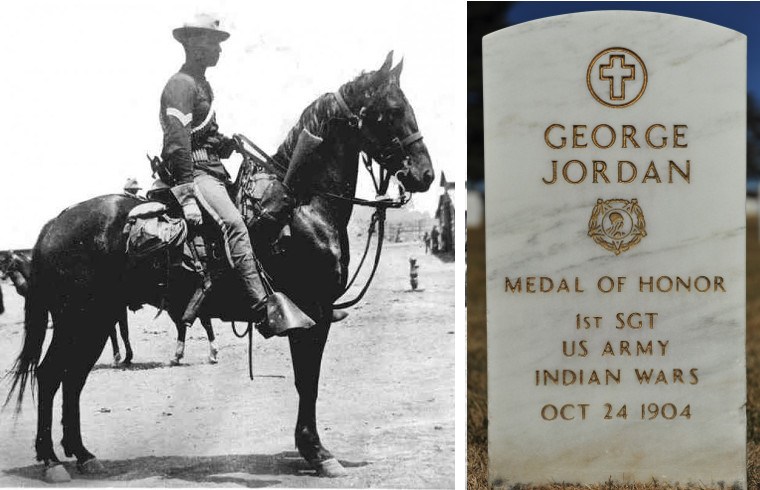
Have you heard of the famed Buffalo Soldiers who served on the Western frontier during the late 19th century? Their history and the heroism of Tennessee’s most famous Buffalo Soldier, Medal of Honor recipient George Jordan of Williamson County, certainly warrant a retelling.
Immediately following the American Civil War, Congress passed legislation authorizing the enlistment of African Americans in the peacetime military, citing the service of more than 180,000 African American Union Army soldiers as the motive for extending service opportunities. The legislation led to the creation of the 24th and 25th Infantry units and the 9th and 10th Cavalry units. These Buffalo Soldiers led military campaigns designed to protect settlers moving into the Plains and Southwest territories, often engaging hostile Native American forces, building roads and protecting U.S. mail carriers, stagecoaches and the steady stream of wagon trains carrying pioneers toward their “American Dream” of property ownership and prosperity. U.S. Army records affirm that they also struggled with obtaining adequate supplies and the hostility from other units within the military.
Interestingly, the term Buffalo Soldiers did not originate within the Army. Instead, Walter Hill, an archivist with The National Archives, reported that the first use of the term occurred in a document drafted by a member of the 10th Cavalry. The story told noted that the Comanche had used the name of their revered animal as a comment on the “toughness” of the soldiers in battle. Whatever the origin of the name, the soldiers considered “Buffalo Soldier” to be a title of respect, and the buffalo often appeared on their patches and in troop sketches.
Tennessee’s most famous Buffalo Soldier, George Jordan, was born a slave in Williamson County in 1847. He enlisted in the U.S. Army in 1866, was assigned to the 38th Infantry Regiment. He would eventually become a first sergeant in the 9th Cavalry Regiment. Like many former slaves, Jordan was illiterate when he joined the military, but, according to records, his intelligence and leadership skills brought him to the attention of a superior officer who assisted Jordan in learning to read and write, opening doors to advancement. He would eventually serve 30 years in the U.S. Army, most in the 9th Cavalry’s K Troop.
Jordan’s courage and valor in two distinct actions during the Indian war campaigns would garner the admiration of the Army’s leadership. On May 14, 1880, Sgt. Jordan, his troops and the residents of Fort Tularosa in New Mexico were attacked by a band of more than 100 Apaches. Although greatly outnumbered in the surprise attack, Jordan and his men successfully fought back the attackers, saving the town with no troop casualties. One year later in Carrizo Canyon, Jordan and his troops became detached from the larger force and were attacked by the Apaches. Once again, Jordan and his troops valiantly repelled the attack, saving the command and avoiding further casualties.