
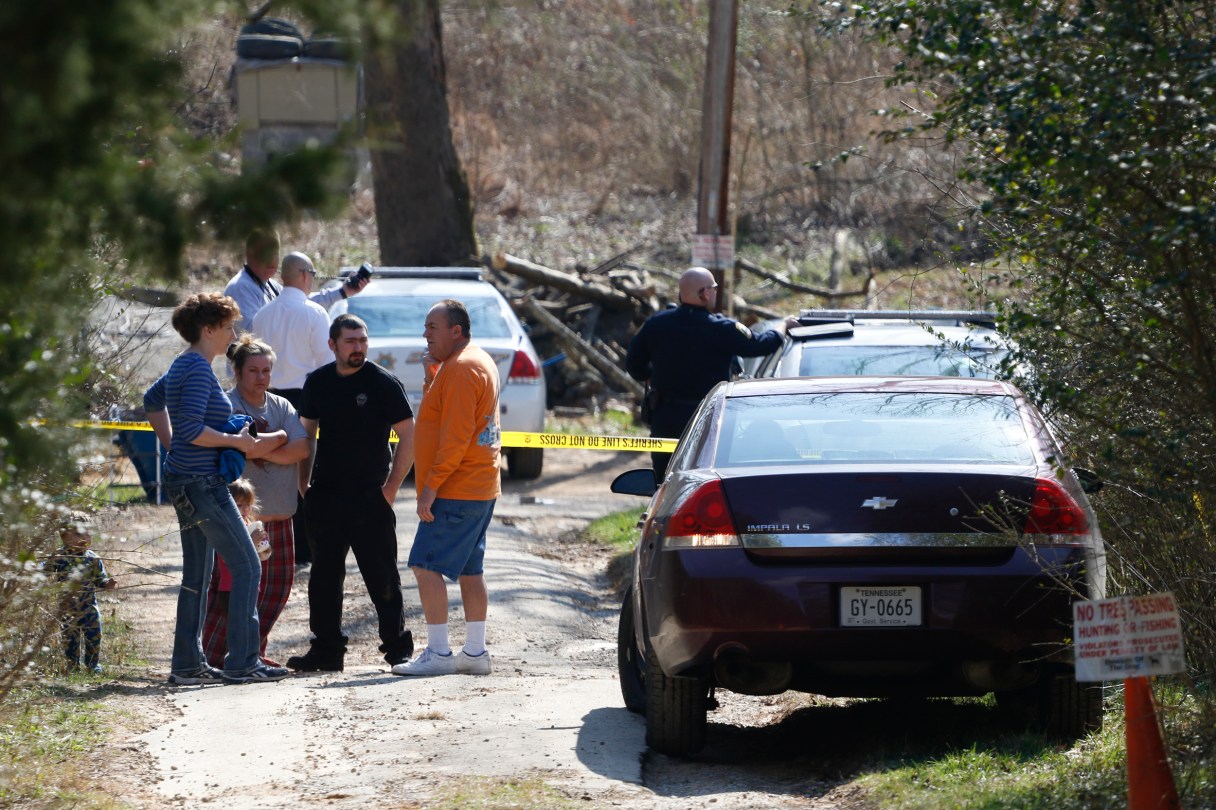
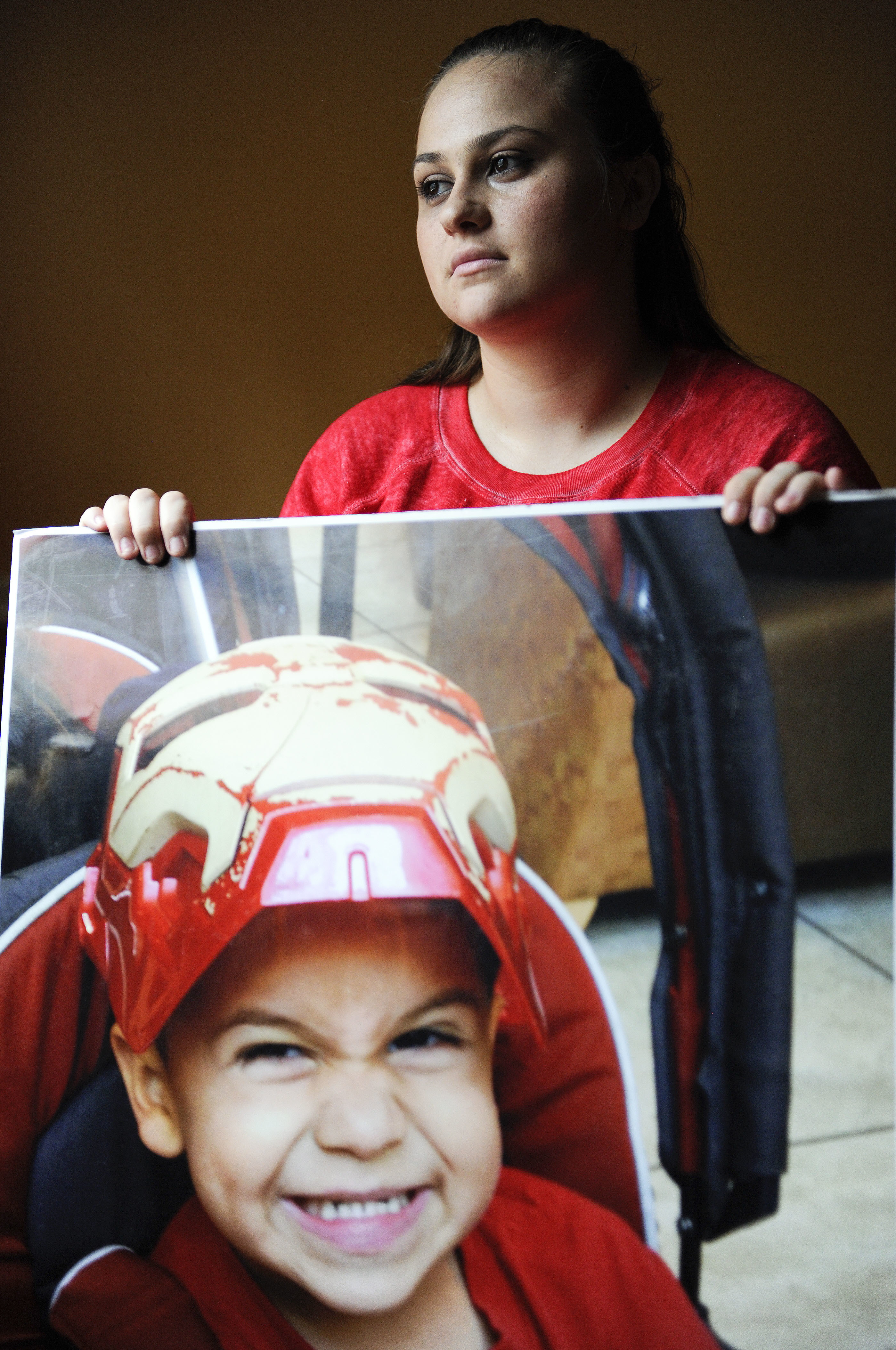
 Crystal Mees poses for a portrait holding a large photo of her son, Bryson, 4, at her home in Houston on Saturday, Aug. 13, 2016. “When you are on the other side,” Crystal recalls telling him, “you are going to see Mommy cry a lot. It’s not because she’s mad. It’s because she misses you.” Bryson accidentally shot himself in January with a .22-caliber Derringer his grandmother kept under the bed. (AP Photo/Eric Christian Smith)
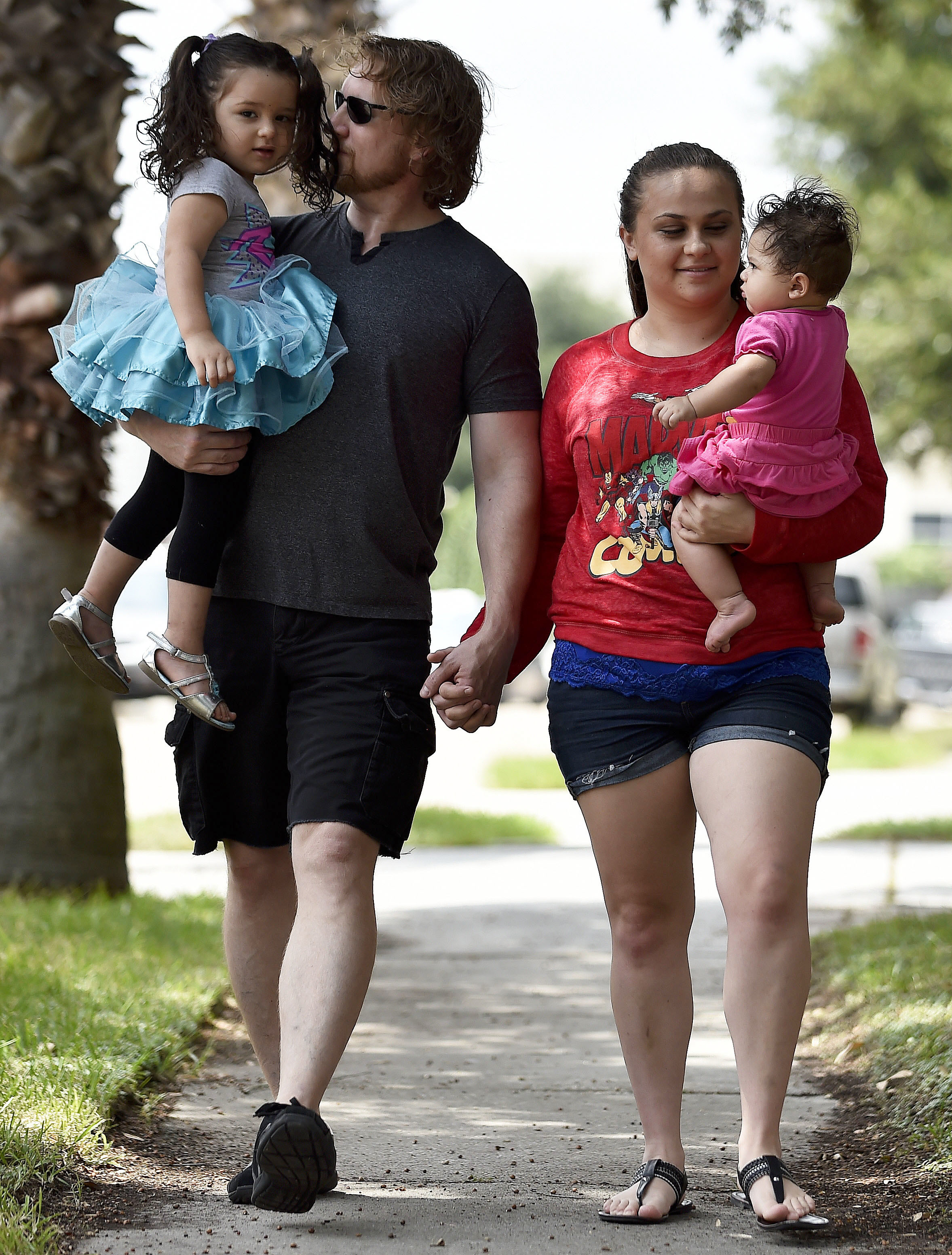 Crystal Mees, right, holds her daughter, Brandy, 8 months, while walking with her husband, Steve Henderson, as he holds Mees’ daughter, Briley, 2, near their home in Houston on Saturday, Aug. 13, 2016. In January 2016, her 4-year-old son, Bryson, accidentally shot himself with a .22-caliber Derringer his grandmother kept under the bed. A grand jury declined to bring charges against Anna Sperber, but Crystal blames her mother for the boy’s death and no longer talks to her or brings her two children around. (AP Photo/Eric Christian Smith)
LOCAL ACCIDENTAL SHOOTINGS OF MINORS
January 2014 through June 2016 Unidentified 17-year-old boy – Wounded – Jan. 12, 2014 A 17-year-old boy was shot in the head at a home on 13th Avenue. He initially told police that an unidentified suspect pulled up in a vehicle, jumped out of the passenger seat and started firing at the teenagers. However, his friend told police they’d been playing with a .22-caliber pistol and one teenager accidentally shot the 17-year-old in the back of the head. The 17-year-old survived. Unidentified 13-year-old boy – Wounded – Aug. 4, 2015 A 13-year-old autistic boy accidentally shot himself in the arm after his mother left him alone for about 20 minutes, according to police. The boy initially told police that the “ice cream man” shot him, but later admitted he shot himself with a gun he said belonged to his mother’s boyfriend. Investigators searched the house and found three handguns. One was stolen, and two were loaded. Officers also found drug paraphernalia. The boy’s mother, Shallon Sales, was charged with aggravated child neglect. Unidentified 13-year-old boy – Wounded – Oct. 25, 2015 A 13-year-old boy is accidentally shot in the face by a family member while the family was posing for photos with guns that were obtained illegally, according to the Hamilton County Sheriff’s office. The boy survived the incident, which happened in Harrison. Gavin Pittman, 3 – Killed – Feb. 29, 2016 After his mother left him alone inside the family minivan to talk on the phone, Gavin Pittman, 3, unbuckled his carseat, crawled to the front of the van, unlatched the glovebox and found a loaded pistol. He accidentally shot himself in the head and died at their home in Apison. His mother, 26-year-old Kelly Pittman, was arrested and charged with criminally negligent homicide and child neglect. She is scheduled to appear in Hamilton County Criminal Court on Nov. 2. Unidentified 15-year-old boy – Wounded – March 14, 2016 A 15-year-old boy was shot in the chest during a fight between his mother and her boyfriend. The woman told police that the gun went off during the argument. Marquel Lane is wanted for aggravated assault. The boy was grazed and his injury was not life-threatening. Source: Times Free Press archives
CLOSER TO HOME
In Tennessee, a state House panel in March did not pass legislation that would have made it a crime for adults to have unlocked loaded guns accessible to children. The bill was named MaKayla’s Law after an 8-year-old Jefferson County girl was killed by an 11-year-old boy using his father’s shotgun.
Hours earlier, he was a happy 4-year-old who loved Ironman and the Hulk and all the Avengers. Now, as Bryson Mees-Hernandez approached death in a Houston hospital room, his brain swelling through the bullet hole in his face, his mother assured the boy it was OK to die.
“When you are on the other side,” his mother, Crystal Mees, recalls telling him, “you are going to see Mommy cry a lot. It’s not because she’s mad. It’s because she misses you.”
And this: “It’s not your fault.”
But whose fault was it?
Bryson shot himself last January with a .22-caliber derringer his grandmother kept under the bed. It was an accident, but one that could be blamed on many factors, from his grandmother’s negligence to the failure of government and industry to find ways to prevent his death and so many others.
The Associated Press and the USA TODAY Network set out to determine just how many others there have been.
The findings: During the first six months of this year, minors died from accidental shootings – at their own hands, or at the hands of other children or adults – at a pace of one every other day, far more than limited federal statistics indicate.
Tragedies like the death of Bryson Mees-Hernandez play out repeatedly across the country. Curious toddlers find unsecured, loaded handguns in OVERSET FOLLOWS:their homes and vehicles, and fatally shoot themselves and others. Teenagers, often showing off guns to their friends and siblings, end up shooting them instead.
Using information collected by the Gun Violence Archive, a nonpartisan research group, news reports and public sources, the media outlets spent six months analyzing the circumstances of every death and injury from accidental shootings involving children ages 17 and younger from Jan. 1, 2014, to June 30 of this year – more than 1,000 incidents in all.
Among the findings:
– Deaths and injuries spike for children under 5, with 3-year-olds the most common shooters and victims among young children. Nearly 90 3-year-olds were killed or injured in the shootings, the vast majority of which were self-inflicted.
– Accidental shootings spike again for ages 15-17, when victims are most often fatally shot by other children but typically survive self-inflicted gunshots.
– They most often happen at the children’s homes, with handguns legally owned by adults for self-protection. They are more likely to occur on weekends or around holidays such as Christmas.
– States in the South, including Tennessee, Alabama, Georgia, Louisiana and Mississippi, are among those with the highest per capita rates of accidental shootings involving minors.
In all, more than 320 minors age 17 and under and more than 30 adults were killed in accidental shootings involving minors. Nearly 700 other children and 78 adults were injured.
The U.S. Centers for Disease Control and Prevention reported that 74 minors died from accidental discharges of firearms in 2014, the latest year for which comparable data are available. The AP and USA TODAY analysis counted 111 for that year, suggesting the federal government missed a third of the cases.
While accidental shootings account for only a fraction of firearm deaths in the U.S., gun safety advocates have long argued that they are largely preventable and thus prefer to call them unintentional shootings, rather than accidental.
They demand stricter laws requiring guns to be kept locked up and unloaded. But gun rights supporters argue those measures make guns less useful in emergencies; citing CDC statistics, the National Rifle Association argues in public statements that such deaths have declined significantly in recent decades and that the chance of a child dying in a firearms accident is “one in one million.”
Bob Anderson, chief of the mortality statistics branch of the CDC’s National Center for Health Statistics, suggested the NRA was citing statistics that underestimate the risk guns represent to American children.
He would not, he said, “put money on that interpretation.”
***
The undercount documented by the AP and USA TODAY Network is “significant and important,” but not surprising, said the CDC’s Anderson.
He said the agency has long suspected that its statistics on accidental firearms deaths are too low; the agency tracks deaths from accidental discharges of firearms but tallies only those that are officially classified that way by coroners on death certificates. Coroners categorize many such deaths as homicides because they can fit the definition of being killed by another. They also can classify them as undetermined, if the cause is unclear.
The AP and USA TODAY Network did not rely on coroners’ findings, but rather counted those shootings that were declared accidental or unintentional by investigating agencies. They were tallied primarily from the Gun Violence Archive, where researchers track media, government and commercial sources to compile a comprehensive database of gun incidents. The review also uncovered a handful of shootings that had not previously been made public.
The findings were in line with prior research done by Everytown for Gun Safety, the advocacy group founded by former New York City Mayor Michael Bloomberg, which keeps a running database of such shootings. The group says that up to 70 percent of accidental shootings could be prevented if parents kept their guns locked and separated from ammunition, as recommended by the American Academy of Pediatrics.
Since the beginning of 2014, more than 80 children ages 4 and under have fatally shot themselves.
“That 3- to 5-year-old age group, they are going to be looking at the gun when they shoot it. They point the gun barrel at themselves and put their thumbs on the trigger,” said Sheriff David McKnight of Marion County, Texas, who is investigating the death of a 3-year-old who killed himself with his father’s gun in July.
In February, 3-year-old Gavin Pittman of Apison, Tenn., was killed when he accidentally shot himself while playing with a gun, according to the Hamilton County Sheriff’s Office.
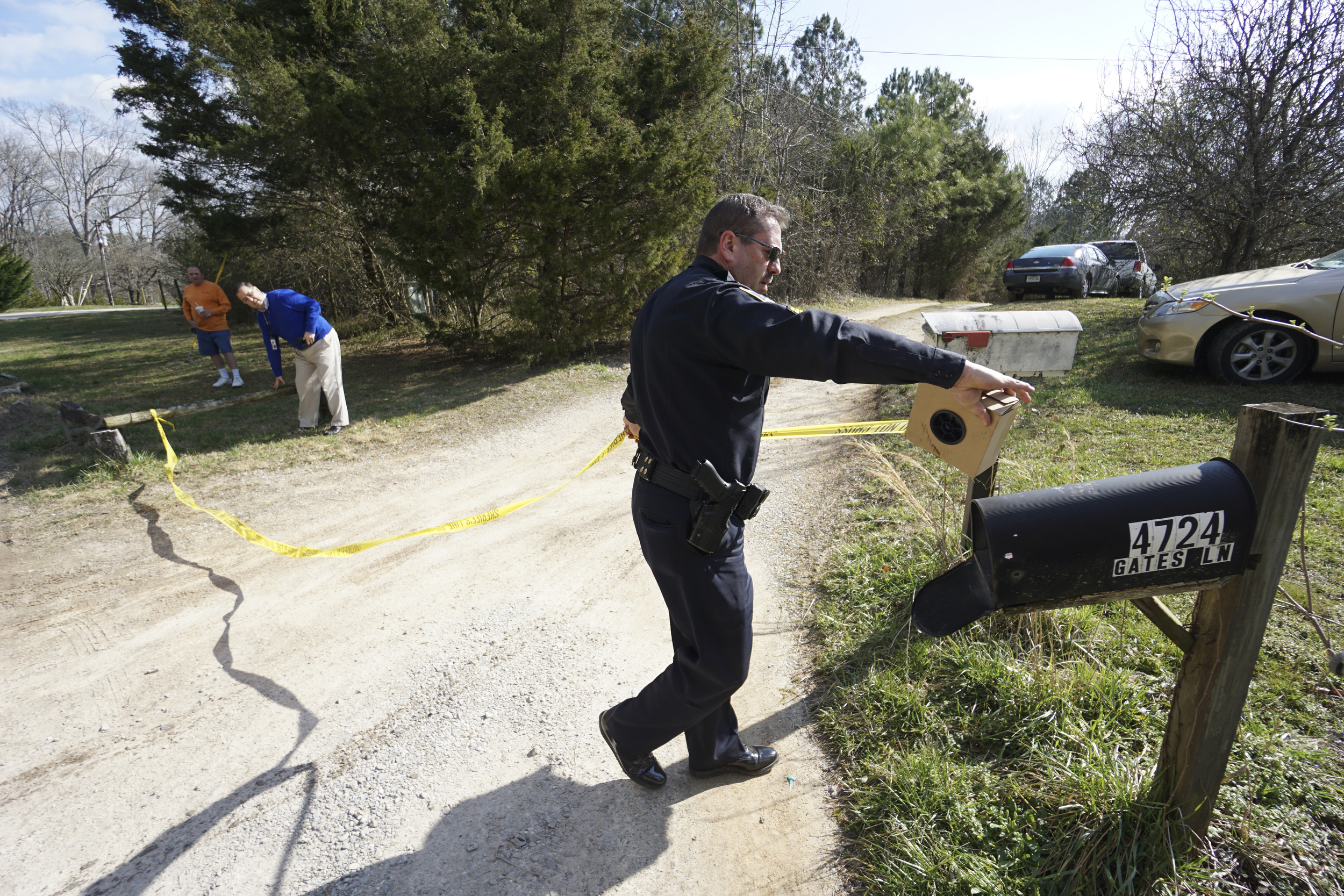
Authorities say the boy’s mother, Kelly Pittman, was talking on the phone when she steered her minivan into the family’s driveway on Gates Lane at 9:18 a.m. on Feb. 29. Leaving her three small children in the van, she stepped outside to continue the phone conversation. Moments later, she told investigators she heard a “pop.”
The 3-year-old had unbuckled his car seat, crawled to the front of the van and unlatched the glovebox. Then he pulled out the loaded pistol that Pittman kept for protection and shot himself in the head. He was pronounced dead at a local hospital.
Kelly Pittman has been charged with criminally negligent homicide.
***
Gun safety advocates have urged a public health approach that includes more research by the federal government, more public awareness and stricter state laws. But the problem of lax gun storage is difficult to address in part because it’s hard to quantify, and the federal government stopped trying 12 years ago.
The CDC had asked Americans about whether they kept loaded, unlocked guns in their homes as part of an annual telephone survey that asked 400,000 adults about various health risks. Using that data, researchers estimated that 1.5 million children lived in such homes – and the results varied greatly by state based on gun ownership levels.
But the CDC scrapped that line of questioning in 2004. State public health officials voted this year not to reintroduce the questions in next year’s survey, in part because of the political sensitivity around asking about gun ownership, which some see as an invasion of privacy.
“Some states did not think they would be allowed to ask such questions by their governor,” said Donald Shepherd, the survey coordinator for Iowa.
Gun control advocates say Child Access Prevention laws – on the books in about two dozen states – act as a deterrent. In general, those laws allow prosecutors to charge parents when children obtain their guns and use them to harm themselves or others.
Supporters say a study of a Florida law suggests they can save lives if implemented correctly. And the concept enjoys wide public approval: Two-thirds of Americans support laws making adults criminally liable for gun safety lapses that endanger children, according to a July AP-GfK Poll.
But efforts to expand those laws have stalled in the face of opposition from the NRA and other gun rights supporters. Bills in several states, including Missouri and Tennessee, to create similar laws were introduced this year and died without action.
The NRA argues that more education and training should be the solution, not more laws and prosecutions. The NRA takes credit for improving safety through its Eddie Eagle Gun Safe program, which warns children not to touch any firearms they come across and to tell adults.
Critics dispute the effectiveness of that message, pointing to academic research that shows curious children will pick up loose guns, even when told otherwise.
***
Bryson Mees-Hernandez’s grandfather had bought the gun and another firearm from his own father the year before, in California. The boy’s grandmother kept them under her side of the bed because she was often home alone, struggled with mobility due to back problems and was concerned for her safety after reading about local break-ins on Facebook.
The guns were kept in a case that had been used to transport them on an airplane back to Texas, and Anna Sperber believed that would keep them away from children. But Bryson was able to open the side of the case, reach in and grab the gun.
“I thought it was secure, but I was wrong. My grandbaby’s gone. And it happened while I was watching him and I failed him,” Sperber said, through tears. “I don’t want anyone to ever, ever go through this. It’s so horrible.”
Crystal Mees blames her mother for her son’s death and no longer talks to her or brings her two children around; she says she had warned her to keep the gun out of children’s reach. She plans to push for a “Bryson’s law” in Texas to make it easier for prosecutors to bring charges against adults who allow children access to firearms.
Both women attended the funeral, where relatives dressed up as Bryson’s beloved Avengers. He was buried with Legos, toy cars and his grandfather’s favorite cologne.