
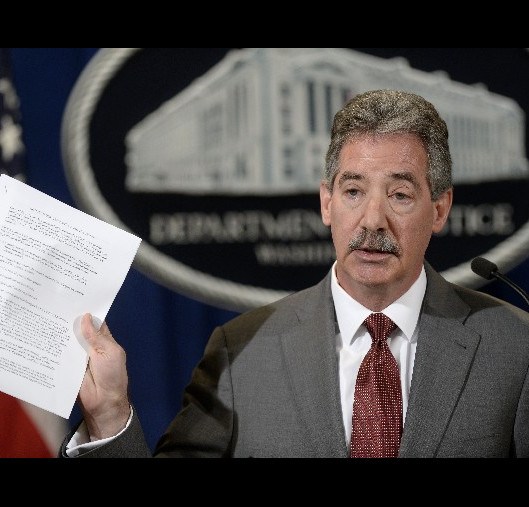
 Deputy Attorney General James Cole hold up a list of guidelines during a news conference at the Justice Department in Washington on Wednesday. Cole announced the new standards that will be considered in deciding whether to recommend clemency for certain nonviolent drug prisoners. Wednesday’s announcement is part of an ongoing effort to trim the nation’s prison population and help convicts who were given what the Obama administration says were unduly harsh sentences for drug crimes.
WASHINGTON – The Justice Department is encouraging nonviolent federal inmates who have behaved in prison, have no significant criminal history and have already served more than 10 years behind bars to apply for clemency, officials announced Wednesday.
The initiative is part of a broader Obama administration effort to trim the nation’s prison population, ease sentencing disparities arising from drug possession crimes and scale back the use of strict punishments for drug offenders without a violent past. The goal is to create a larger pool of eligible prisoners the Justice Department can recommend to the president to consider for shorter sentences.
Deputy Attorney General James Cole laid out half a dozen criteria for clemency that the government will consider in evaluating future inmate applications. The announcement is aimed primarily at drug prisoners, especially those sentenced under old guidelines that resulted in significantly harsher penalties for people caught with crack cocaine than for those who possessed the powder form of the drug. But it also applies to federal inmates imprisoned for other crimes, provided they meet the same criteria.
“These defendants were properly held accountable for their criminal conduct. However, some of them, simply because of the operation of sentencing laws on the books at the time, received substantial sentences that are disproportionate to what they would receive today,” Cole said. “Even the sentencing judges in many of these cases expressed regret at the time at having to impose such harsh sentences.”
To be eligible for consideration, inmates must be deemed nonviolent, low-level offenders with no gang ties, and must have spent at least 10 years behind bars and received a harsher punishment at the time of sentencing than they would have gotten for the same crime today. It’s not clear how many of the tens of thousands of drug offenders currently imprisoned would be viable candidates for consideration.