
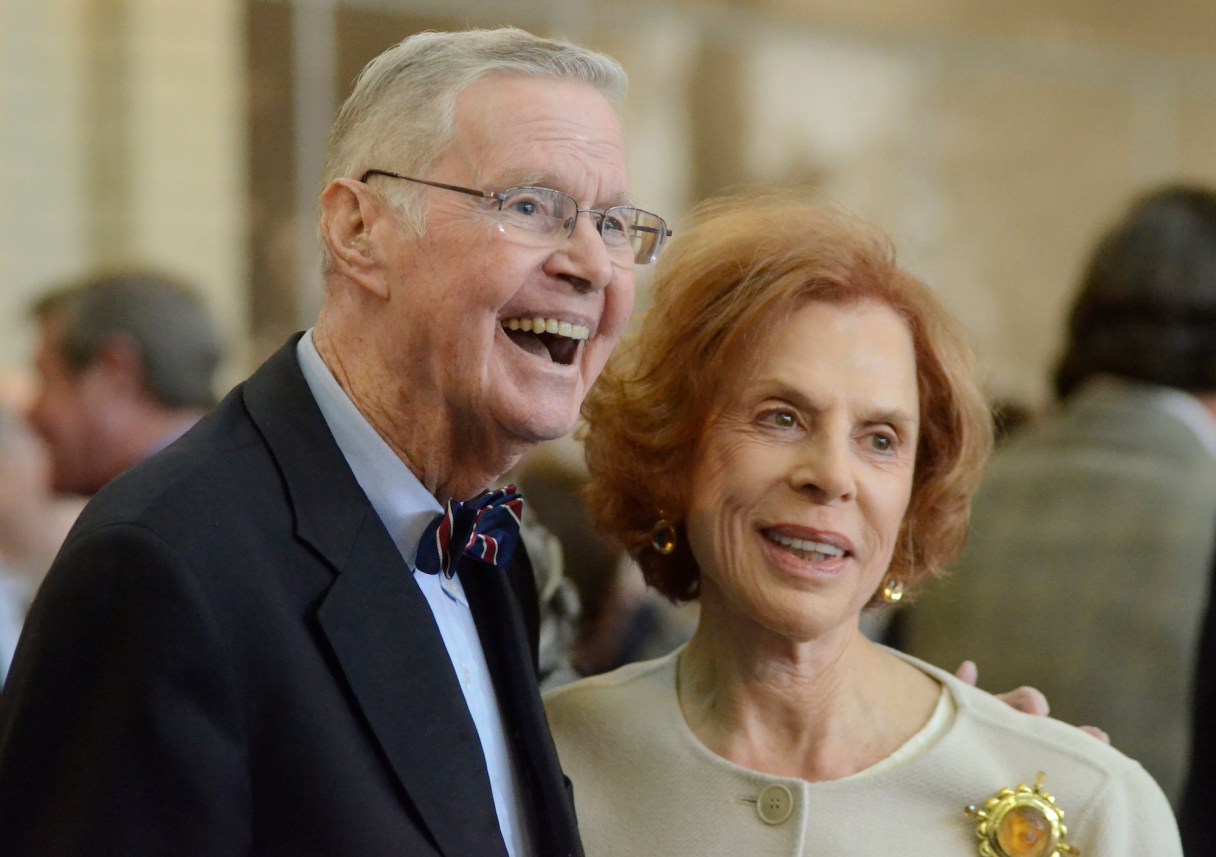
Tennessee has long been noted for the volunteer spirit. Scott Livingston Probasco Jr., who lived for almost nine decades, gave Chattanooga his best in both business and philanthropy. “Scotty” noted that his family had been involved in banking for 10 generations and traced his lineage to Jews in Madrid, Spain, who immigrated to the Netherlands, where they converted to Protestantism. In the 1600s, they sailed for the U.S.
In 1885, Harry Scott Probasco rescued Alice Gray Moore from the floods of the Ohio River in Lawrenceville, Ind., and brought his bride to Chattanooga, where they started a family. Three years later, he formed a partnership and opened the Bank of Chattanooga. The little bank prospered under Probasco’s presidency, and in in 1905, with new partners, he chartered another bank, American National, which absorbed all but the trust business of his earlier venture.
His new institution operated under the American name until 1911, when it was absorbed by First National, a local bank that had been organized after the end of the Civil War. Probasco then had a yen to re-enter the banking business, and in 1912 with his son, Scott L. Probasco, and E.Y. Chapin chartered American Trust and Banking Company. In its first year of business at Eighth and Broad streets with eight employees and a capitalization of $200,000, the bank attracted $381,000 in deposits. Only three years later, the value of its first year’s deposits had doubled.
A conservative banker, Harry Probasco paid no dividends on the bank’s earnings for more than five years. When he finally declared a dividend in mid-1917, accumulated earnings were almost $200,000, 60% of the bank’s capital. At that date, its deposits exceeded $1 million. The enterprise survived the stock market crash in 1929 and the Great Depression and later became American National Bank, SunTrust and more recently Truist Financial Corporation.
(READ MORE: Wiedmer: Probasco nearly impossible to replace)
Harry Scott’s grandson, Scotty, was born in 1928 and attended the Baylor School, where he played on the golf team. He earned a Bachelor of Arts degree in history from Dartmouth College, where he was a cheerleader, and attended the Wharton School of the University of Pennsylvania. He considered a career in ministry before joining the family bank. Famous for his iconic cheer “great work!” his professional and philanthropic leadership reflected a synthesis of business and service. He could further be singled out by his bow-tie and his Honduran cigar.
As a United Way board member and business and civic leader, Scotty aligned with his religious mentor, Dr. James Fowle, and mustered support with gusto, smile and legendary energy. Whether he was representing Chattem, Combustion, Provident, Coca-Cola, Benwood, Baylor School, the UC Foundation, the Community Foundation of Greater Chattanooga, the United Way or the Hunter Museum, his message was consistent, and his infectious spirit, open smile and twinkling eyes were captivating.
In 1982, Probasco continued a family tradition of commitment to the United Way of Greater Chattanooga and became chairman of its first “Loaned Executive” program, with the goal of catalyzing people and organizations in true social change leading to better lives and healthier communities. Chairman Probasco prompted executive-level individuals to assist United Way volunteers and professionals in promoting the agency throughout the community. “Loaned Executive” was immersed in ground-level education of the agencies.
Cindy Wood, a member of the 1982 inaugural “Loaned Executive” cohort, was a young executive at First Federal Savings and Loan, when she found herself being introduced to the need as well as the abundance of generosity that came together under the umbrella of United Way. Early in her career, the experience of “meeting amazing people and learning the ways of United Way” influenced her future at Provident Life & Accident. Today, Cindy remembers that the opportunity “gave her more latitude as a woman in business through the support of disparate networks coming together in the shared goals of the United Way.” The “Loaned Executive” program was an example of the many opportunities for people to serve their community and support their neighbors in need.
Scotty Probasco died at his home on Lookout Mountain at age 86 in 2015, the financial and civic leader who personified the model of a successful, public-spirited citizen. He left behind his loving wife, Betty, four children and 12 grandchildren.
Jennifer Ley Crutchfield is a Chattanooga native, author and educator with a passion for connecting national history to local landmarks for students and families. Join her online at Chattanooga.Adventures.org.