
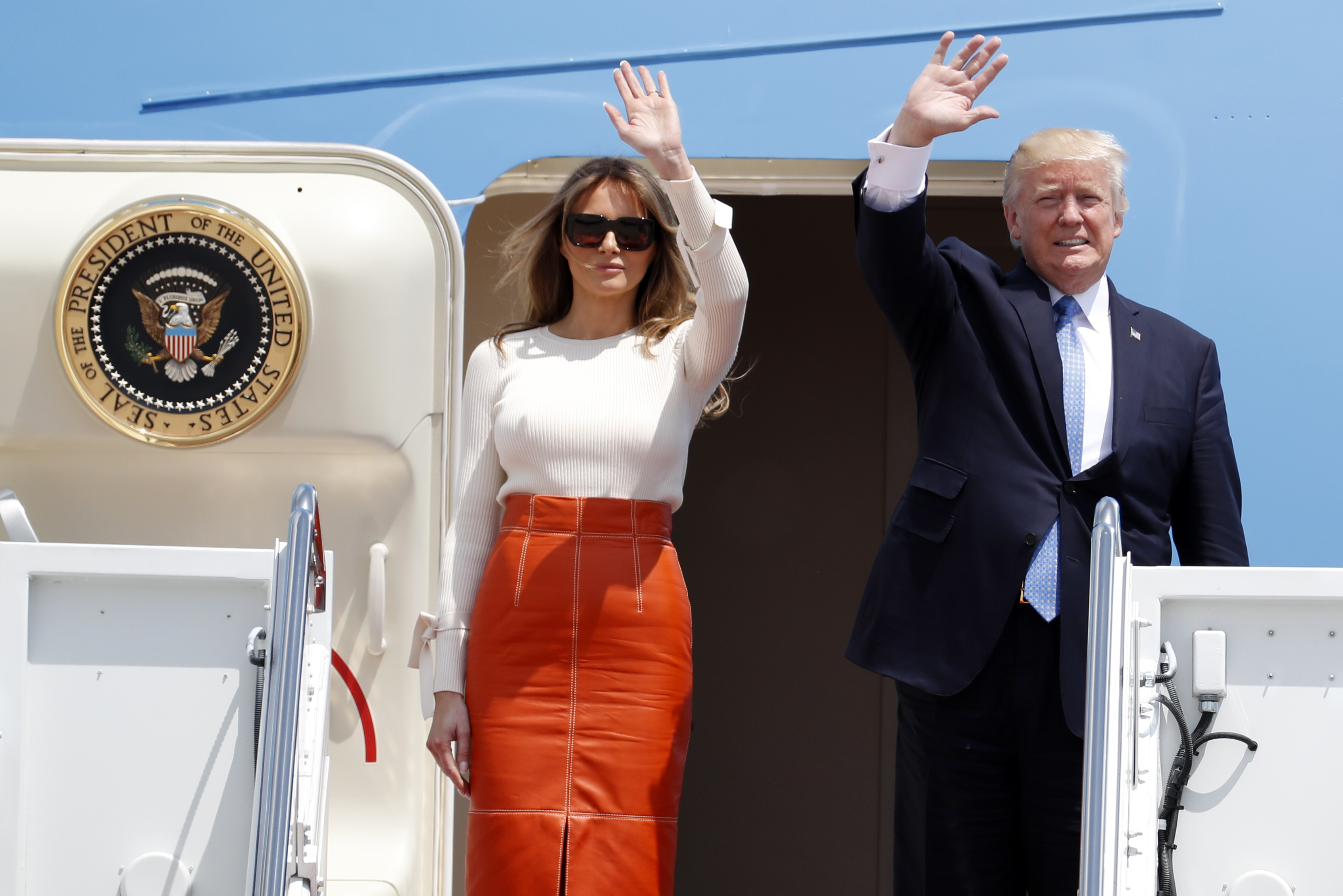
 President Donald Trump and first lady Melania Trump, wave as they board Air Force One at Andrews Air Force Base, Md., Friday, May 19, 2017, prior to his departure on his first overseas trip. (AP Photo/Alex Brandon)
RIYADH, Saudi Arabia (AP) – Even as his administration fights for its travel ban from several Muslim-majority countries, President Donald Trump is using the nation that is home to Islam’s holiest site as a backdrop to call for Muslim unity in the fight against terrorism.
Trump’s Sunday speech, the centerpiece of his two-day visit to Saudi Arabia, will address the leaders of 50 Muslim-majority countries to cast the challenge of extremism as a “battle between good and evil” and urge Arab leaders to “drive out the terrorists from your places of worship,” according to a draft of the speech obtained by The Associated Press.
Trump, whose campaign was frequently punctuated by bouts of anti-Islamic rhetoric, is poised to soften some of his language about Islam. Though during the campaign he repeatedly stressed the need to say the words “radical Islamic terrorism” – and criticized his opponent, Hillary Clinton, for not doing so – that phrase is not included in the draft.
The speech comes amid a renewed courtship of the United States’ Arab allies as Trump is set to have individual meetings with leaders of several nations, including Egypt and Qatar, before then participating in a roundtable with the Gulf Cooperation Council and joining Saudi King Salman in opening Riyadh’s new anti-terrorism center.
The address also notably refrains from mentioning democracy and human rights – topics Arab leaders often view as U.S. moralizing – in favor of the more limited goals of peace and stability.