
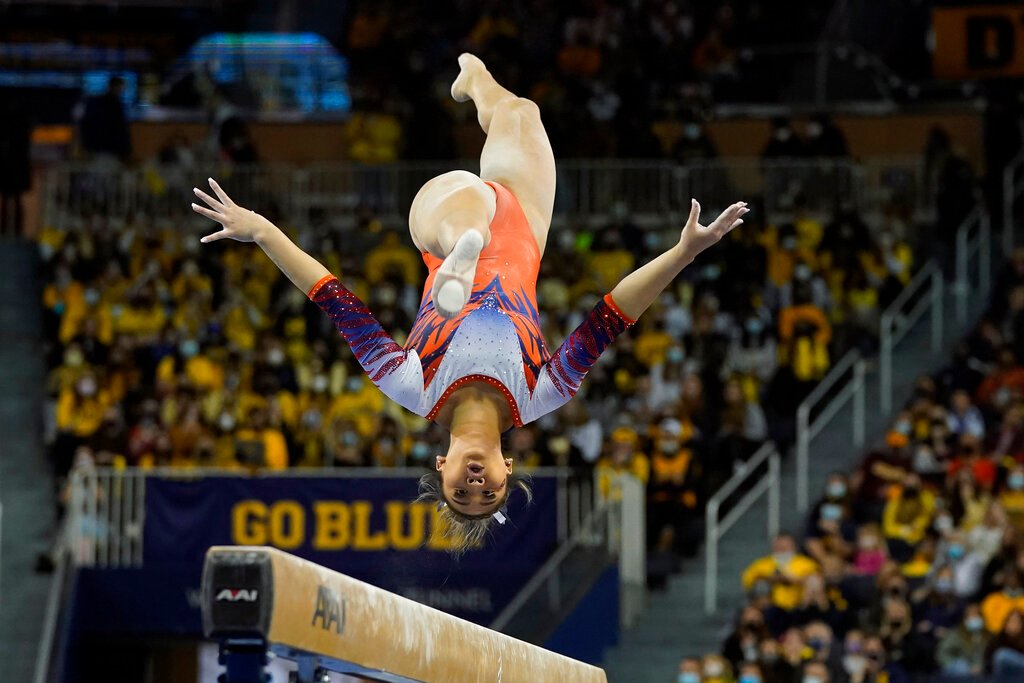
Sunisa Lee and the rest of the Auburn women’s gymnastics team filed out of Stegeman Coliseum on Georgia’s campus in mid-February, equal parts exhausted and giddy. A happy three-hour trip home awaited after the Tigers edged the Gymdogs on the road for just the second time in program history.
Then the doors to the parking lot swung open and what is normally a low-key part of every away meet became something else entirely. A group of 300 or so fans surrounded the Auburn bus, many hoping to grab Lee, the reigning Olympic all-around champion, or one of her teammates for a selfie. Or a signature. Or a wave. Maybe a smile.
“It’s like we were in a boy band,” longtime Auburn coach Jeff Graba said. “It took us an hour to get out of Georgia. It’s exciting.”
And it’s all part of the show in women’s college gymnastics, a sport whose profile is rising with every perfect score. Every packed house. Every viral floor routine. Every TV broadcast. Certainly at every university – from Clemson (student population 23,000-plus) to Fisk (less than 1,000) – looking to join a movement that is very much having a moment.
While elite programs have been struggling in recent years – the U.S., Canada, England and Australia are among the countries whose national governing bodies are scrambling to emerge from the cloud of what athletes say is a “toxic culture” – NCAA gymnastics has become a safe space where young women can reclaim control of their careers and in some cases, regain their passion for a sport that can often take far more than it gives.