
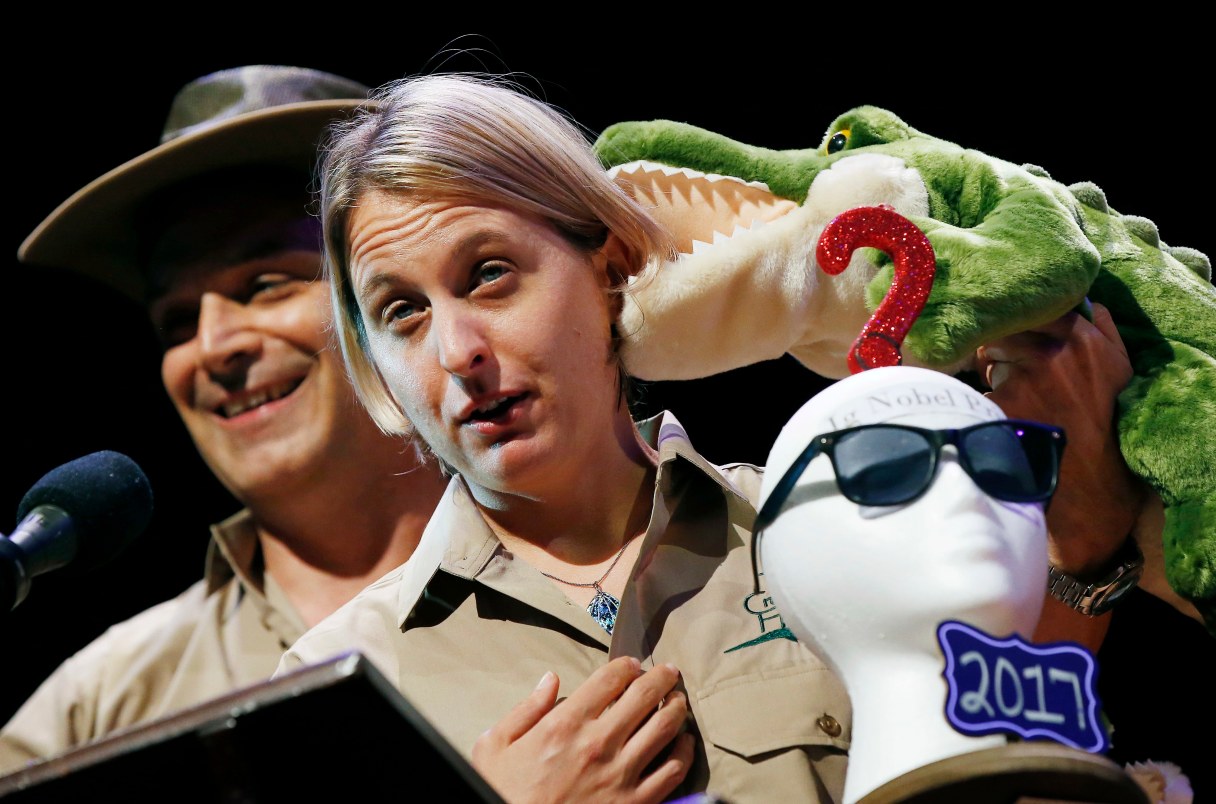
BOSTON (AP) – Scientists who discovered that old men really do have big ears, that playing the didgeridoo helps relieve sleep apnea and that handling crocodiles can influence gambling decisions are among this year’s recipients of the Ig Nobel, the prize for absurd scientific achievement.
The 27th annual awards were announced Thursday at Harvard University. The ceremony featured a traditional barrage of paper airplanes, a world premiere opera and real Nobel laureates handing out the 10 prizes.
“It’s a strange honor to have, but I am thrilled,” Dr. James Heathcote told The Associated Press. A British physician, Heathcote won the Ig Nobel for anatomy for his big-ear research.
The awards are sponsored by the science humor magazine Annals of Improbable Research, the Harvard-Radcliffe Science Fiction Association and the Harvard-Radcliffe Society of Physics Students.
This year’s winners – who each received $10 trillion cash prizes in virtually worthless Zimbabwean money – also included scientists who used fluid dynamics to determine whether cats are solid or liquid; researchers who tried to figure out why some people are disgusted by cheese; and psychologists who found that many identical twins cannot tell themselves apart in visual images.