
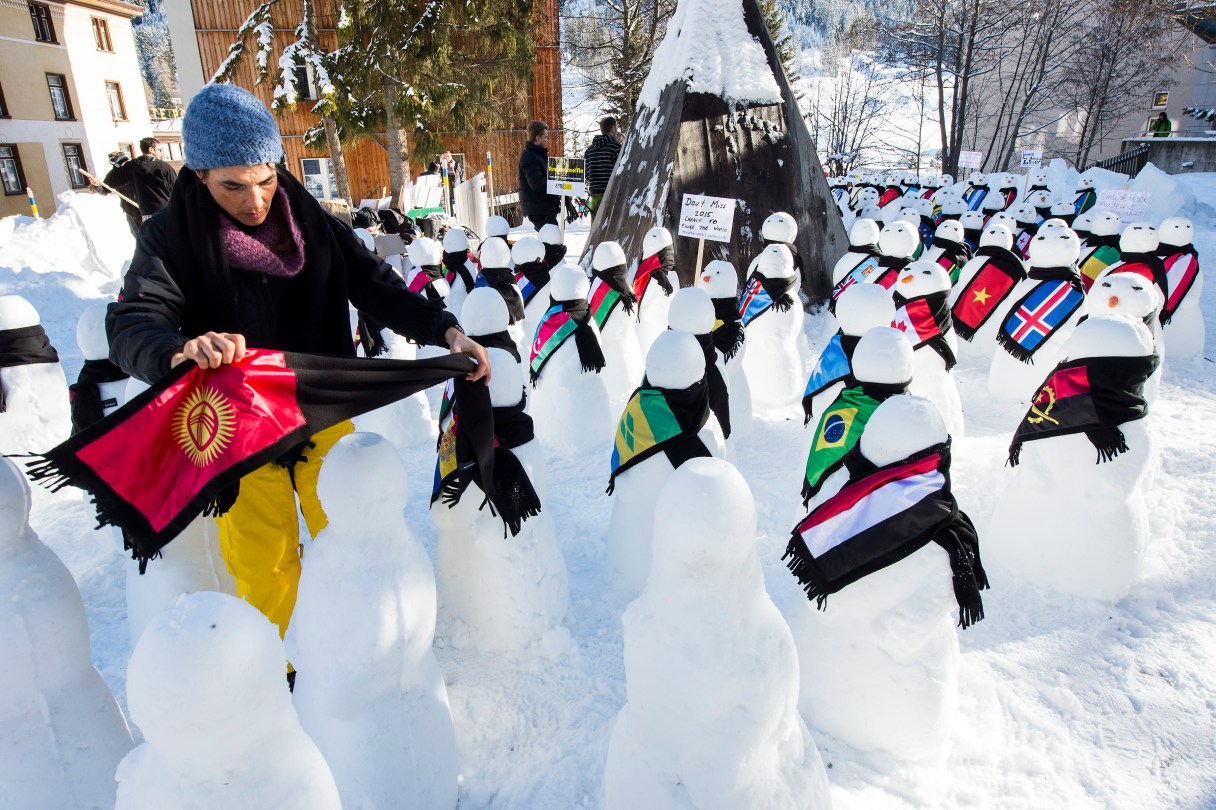
DAVOS, Switzerland (AP) – The World Economic Forum kicks off in the Swiss ski resort of Davos with the goal of “improving the state of the world.” In practice, it’s a massive networking event that brings together 2,500 heads of state, business leaders, philanthropists and artists.
Here are some glimpses of what’s happening Wednesday at Davos:
___
OIL RIPPLES
The acute fall in oil prices and oil’s impact on the global economy featured heavily in discussions at the World Economic Forum.
Most participants agreed the scale of the fall to below $50 a barrel- around 60 percent since last June – represents a big boon for the global economy, especially to net importers of oil such as the United States, China, Japan and the 19-country eurozone. The latter, which is stumbling along from one anemic quarter to the next, needs all the help it can get, even with European Central Bank President Mario Draghi expected to announce some stimulus Thursday.
Kenneth Rogoff, economics professor at Harvard University, thinks the positive repercussions will be “pretty big” within the year and that experts are underestimating the impact.
Clearly not all economies stand to benefit – and Russia may be the country most negatively affected by the sharp slide in oil prices. The International Monetary Fund warned this week that the Russian economy could contract 3 percent this year.
Russia’s deputy prime minister, Arkady Dvorkovich, hoped that the fall in oil prices would soon end, saying only then would Russia’s currency, the beleaguered ruble, find some support.
China’s top central banker, Zhou Xiaochuan, also hoped some stability would return to oil prices and noted a potential negative side effect – it makes investing in alternative energies such as wind or solar power relatively less attractive. In a year when climate change is high on the international agenda, that’s not helpful.
– By Pan Pylas, Twitter: twitter.com/panpylas
___
SWISS FOCUS
Host country Switzerland, in an unusual development, is itself the subject of many discussions this year at the forum. The reason: the massive surge in its currency’s value last week.
The jump in the Swiss franc, which at one point Friday rallied 30 percent against the euro and the dollar in minutes, is seen as a sign of the jitteriness in the global economy.
It has also made attending the forum a whole lot more expensive. That’s not a problem for many attendees, among them chiefs of industry, billionaires and politicians travelling on a government budgets. But it is ballooning the costs for the hundreds of professionals attending the forum to network with the bigwigs.
Those from the U.S. will find their expenses over 15 percent higher, while eurozone attendees looking at a 20 percent hike.
– by Carlo Piovano, Twitter: twitter.com/cpiovano
___
DAVOS PRICES
Even before the Swiss franc’s rise, there is talk every year about the high prices at this tony ski resort – and the suspicion that they are even higher during the World Economic Forum.
One speaker saw the transition in action. She and her husband arrived early at a cozy hotel near the edge of town to ski. They quite enjoyed the restaurant with its fixed-price menu at 25 Swiss francs ($29) a head.
On the morning the forum opened, the hotelkeeper informed them there were a few changes in the menu. It was a tad fancier, our speaker reported. But the big change was at the bottom – the fixed price meal was now 50 francs.
– by Mike Oreskes, Twitter: twitter.com/michaeloreskes