

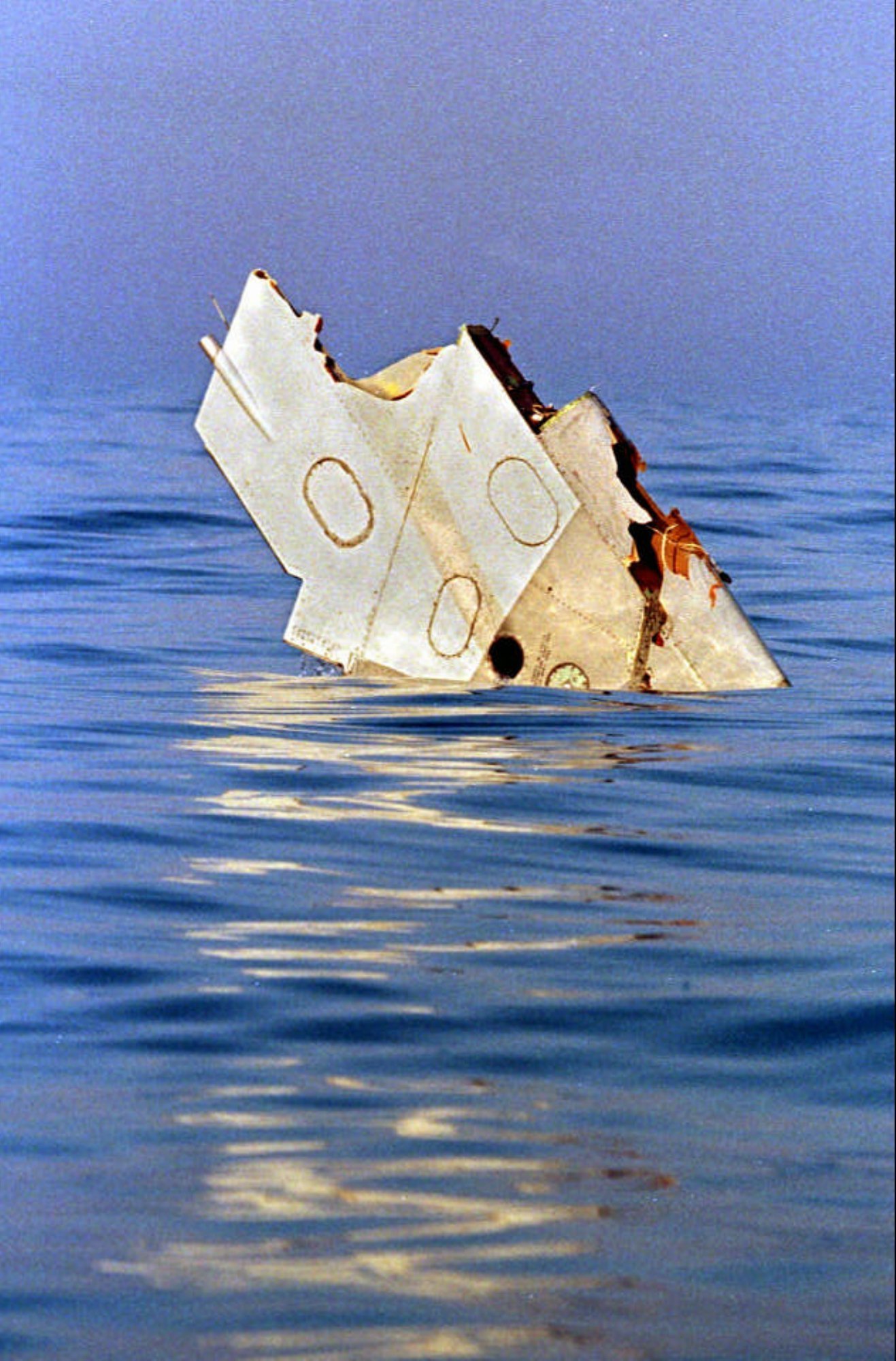
 In this July 18, 1996, file photo, a piece of debris from TWA Flight 800 floats in the Atlantic Ocean off Long Island the day after the Boeing 747, carrying 230 people, exploded in a ball of fire, killing everyone on board. Twenty years later, some still debate National Transportation Safety Board findings that the aircraft was brought down by a center fuel-tank explosion ignited by a spark from a short circuit.
Closer to home
Five members of two families in tiny Stevenson, Ala., about 40 miles southwest of Chattanooga, were among those killed in the crash of TWA Flight 800. Brenda Privette, 46; her son Thomas Weatherby, 13, and the Scott family – Mike, 44; Barbara, 39, and Joseph 13 – left their entire Jackson County community grieving when their dream trip to France, planned for a year, ended in tragedy. The families were close friends, attending the same church, and the two boys were in the Scouts together. A year after the tragedy, fellow church member Michael Ragan recalled for The Chattanooga Times how the sudden deaths rocked the small community. “We’ve never had a tragedy of this magnitude happen here before,” Ragan said. “There are certain things that happen in life that you’ll always remember where you were when you heard, like when Kennedy was killed and men walked on the moon.”
SHIRLEY, N.Y. – For many who lost loved ones from TWA Flight 800, the passage of 20 years has helped them carry on. Others say they will never get over the heartache from what remains one of the most hotly debated air disasters in history.
Soon after the Paris-bound flight took off from John F. Kennedy Airport in New York on July 17, 1996, the Boeing 747 exploded off Long Island, killing all 230 aboard and leaving a surreal, fiery crash site on the water.
Some still question the findings that the jet airliner was brought down by a center fuel-tank explosion ignited by a spark from a short-circuit – a conclusion reached after investigators painstakingly reassembled the wreckage like a jigsaw puzzle.