
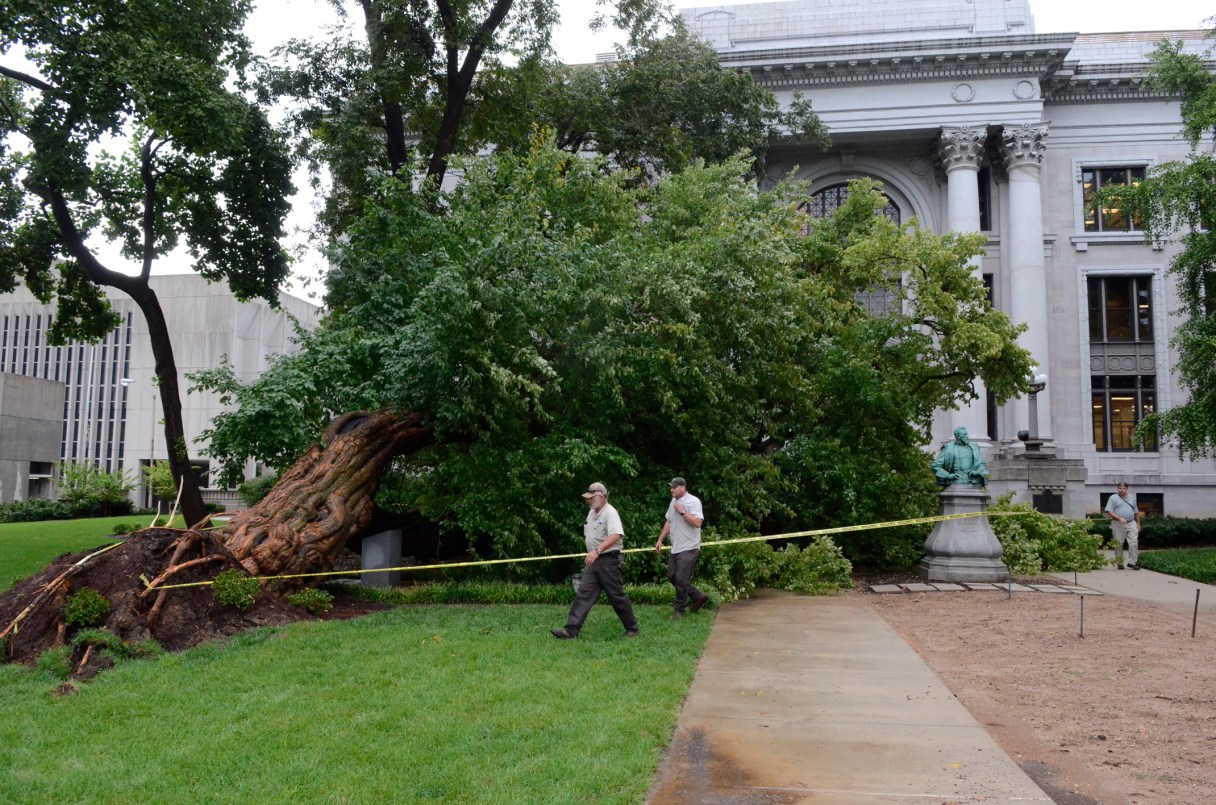
UNDER THE TREE
Thousands of couples were married beneath the osage orange tree at the steps of the Hamilton County Courthouse over the years. The Times Free Press requested couples share their memories about their ceremonies and the tree.”May of 2001 I was married under that tree. This story is so poignant for me as my husband died just a couple of weeks ago. At his visitation on a memory CD of pictures I had a picture of the day we married standing under that tree.”- Cindy Young”I am sad. My wife and I married there April 21, 1999. My fifth grade DARE teacher Edward Gomez was the preacher. He is dead now. That tree held lots of meaning to us. I would love a branch.”- Devin Hodge”We have been married for 3 years now. We had a destination wedding in Isla Mujeres but made it official when our families and us came back to the States. The minister took us outside and under the tree to do the ceremony. Something I thought was going to be so ‘straight to the point’ was very memorable … In fact it was almost as nice as the sun setting in Cancun on the beach as we said our vows there. It’s a shame, it holds a special memory in my heart!”- John Caudill
ABOUT THE TREE• The common name for an osage orange is “bodark,” a name drawn from the French phrase “bois d’arc” or “bow wood,” which was coined when French explorers saw Native Americans using the wood for bows.• The tree is in the same family as the mulberry tree.• The osage orange at the Hamilton County Courthouse is more than 100 years old, though county and city officials are unsure exactly when it was planted. Chattanooga’s city forester, Gene Hyde, is hoping to cut into the tree’s trunk and see if he can identify its age.Source: Great Plains Nature Center, Chattanooga City Forester Gene Hyde.
WHAT’S NEXTBecause of root damage and internal cracking, the osage orange cannot be saved. Workers will begin removing the tree on Saturday morning. They plan to cut up the tree in sections that can be used for future woodcarving projects. County officials are hoping to make some of the wood available to the public.
The young Osage orange tree rooted itself as the Civil War dust was still settling.
It wasn’t a native tree. Osage oranges grew in Texas and Oklahoma, where the tree’s strong and supple wood was prized by Osage and Comanche tribes for bow carving.