
A headline in the May 20 Times Free Press caught my eye. It read: “Two-thirds of Americans would struggle to cover a $1,000 crisis.”
It not only caught my eye, it also broke my heart.
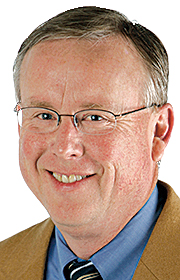 Mark Kennedy
There must be a connection between this crude measure of financial wellness and another startling statistic: 66 percent of Americans think the country is on the wrong track, according to a recent poll by Rasmussen Reports.
The last time I looked, “66 percent” and “two-thirds” were not just in the same ballpark, they were both standing on second base.
Coincidence? I don’t think so.
Pessimism flows like a river and, for many American families, it starts with their checkbooks.
A recent Associated Press poll showed that three-quarters of households earning less than $50,000 a year would have trouble “coming up with $1,000 to cover an unexpected bill.” Even for households with between $50,000 and $100,000 in annual income, two-thirds said they couldn’t instantly raise $1,000 for an emergency.
If you’ve ever wondered what’s fueling the payday-lending phenomenon, this poll alone explains the business model. Most households don’t even have a modest rainy-day fund. And when you don’t have a rainy-day fund, to quote a Robert Cray blues song, “The forecast calls for pain.”
That’s why, even though unemployment is down to 5 percent nationally, most working people feel queasy.
For people of low or modest income, the savings gap is understandable. When you are struggling to make ends meet, setting aside money for savings is sometimes not an option.
However, the most disturbing fact from the Associated Press poll – which was also sponsored by the NORC Center for Public Affairs research – is that even among households making more than $100,000 a year annually, 38 percent would have difficulty coming up with $1,000.
Let that sink in: More than one-third of households making more than $100,000 a year would be strapped by a $1,000 emergency.
Really?
A $1,000 emergency is nothing. It’s a dead tree menacing your house, a precautionary trip to the emergency room with a child, a faulty catalytic converter on your car that won’t pass emissions inspections. These aren’t black swan events; this is everyday life in middle America.
I understand all the reasons that upper-middle class people might feel financially stressed – stagnant white-collar wages, tuition bills for their children, rising health-care costs.
But seriously, there’s nothing short of a debilitating illness or extended unemployment that should excuse a family with a steady six-figure income from not having a $1,000 safety net. If this statistic applies to you – one of the wealthiest 20 percent of Americans – I have important news.
Your house is too big. Your car is too expensive. Your credit cards are maxed out. You can’t say “no” to your kids. You might “deserve” a vacation, but you can’t afford it. Get a grip.
Sorry for the rant, but I’m tired of people with good incomes saying America is broken for them. In fact, much of the economic suffering in our great country today is self-inflicted by people who have too much debt, no savings and want to blame somebody else.
This is not a policy issue.
Frankly, it is a character flaw.
Contact Mark Kennedy at mkennedy@timesfreepress.com or 423-757-6645. Follow him on Twitter @TFPCOLUMNIST. Subscribe to his Facebook updates at www.facebook.com/mkennedycolumnist.