
Get help
If you or you suspect someone you know is experiencing child abuse, you can call 1-855-GA-CHILD 24/7.“We work with the family in partnership and ways to address concerns the family might be going through,” said Catoosa County Department of Family and Children’s Services Director Jonathan Sloan.
Another threat
According to Catoosa County Department of Family and Children’s Services Director Jonathan Sloan, sleep related deaths have been the leading cause of preventable infant deaths in Georgia.It’s another danger to children his agency works to overcome.“From 2009 to 2013 there were 929 sleep related deaths reported to the Georgia Fatality Review Panel,” he said. “The average is 154 infant deaths each year in Georgia. We are trying to get the message out of ‘ABCs,’ meaning Alone, Back and Crib. The baby should be alone, on its back and the mattress should be firm.”
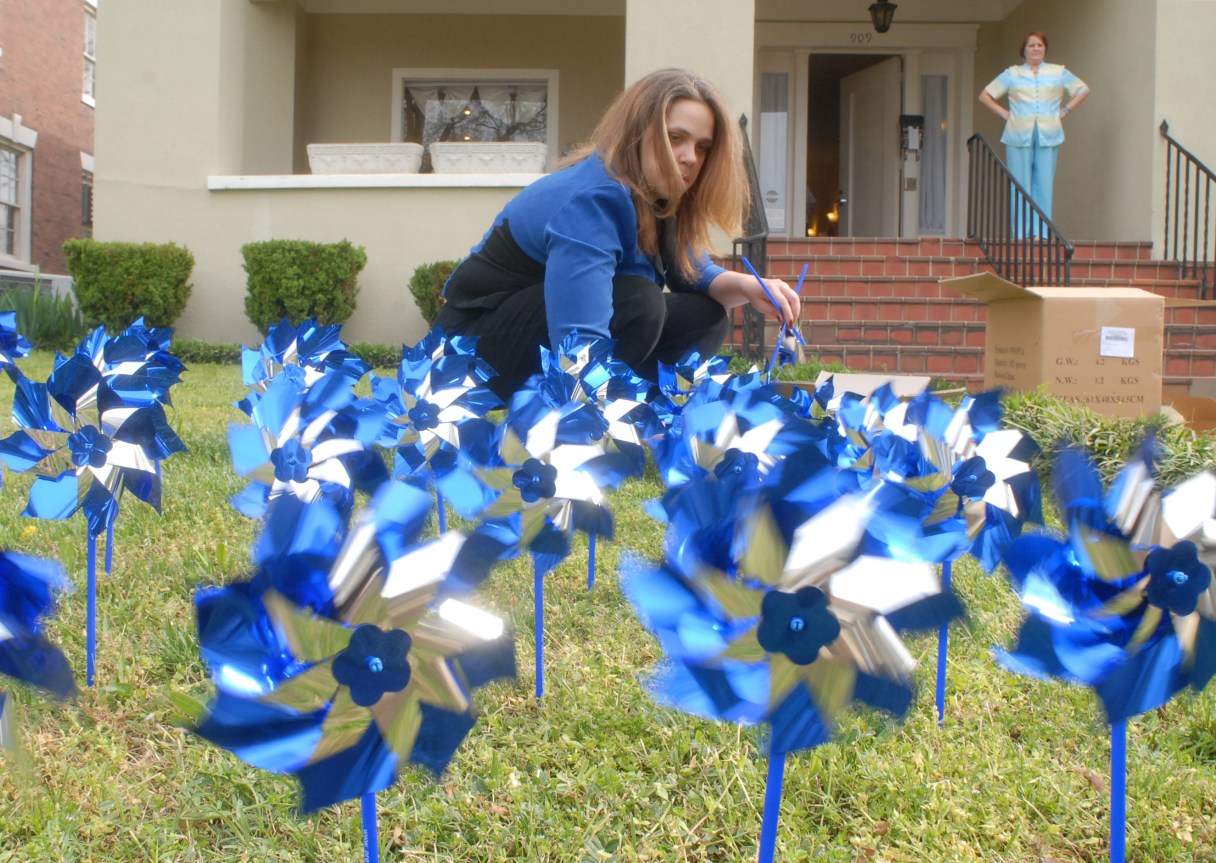
Come April, pinwheels will mark downtown Ringgold.
“Each pinwheel represents a child abuse case in Catoosa County,” said Catoosa County Department of Family and Children’s Services Director Jonathan Sloan. “For 2015 we’ve had 948 reports of child abuse for Catoosa County. It is an increase. In 2012, we had 528 reports.”
He attributes some of that increase to the availability of an 800 number citizens can call for help. The hotline was launched several years ago.
“We want to bring about awareness of this great need,” said Sloan. “The best way to treat child abuse is to prevent it from happening to begin with. We have the Catoosa County Family Collaborative and the Catoosa Prevention Initiative.”
To help raise awareness of child abuse in Catoosa County, the DFCS office is hosting a Blue Ribbon Lunch April 19 at Mt. Peria Baptist Church in Ringgold. The luncheon will begin at 11:30 a.m.
In cases where children have to be removed from their home, foster homes are used to house the children and provide a nurturing environment where they can hopefully recover and flourish.
Catoosa County has 81 children in foster care, said Sloan. There are 11 active foster homes.
That means only 17 of the county’s foster children are placed locally. Some are placed in neighboring counties as far as Metro Atlanta.
“There’s a great need for foster homes in the community,” Sloan said. “If people are interested in being a foster parent they can call 1-877-210-KIDS. We do need a lot more foster parents. We find it extremely important to keep siblings together. The trauma of removal is almost as traumatic as the abuse. Having more foster homes allows us to keep children together. Sometimes we have to make tough decisions about separating siblings.”
His goal is to reach a point where there is no longer a need for DFCS, where the community takes care of itself, he said.
“We need schools, churches and entities to come together to help,” he said. “How, as a community, can we prevent child abuse from happening? My biggest thing is the great need for foster parents in our community. I’ve been in Catoosa most of my life. I am very hopeful that these programs will reduce child abuse and neglect.”
A multi-pronged outreach initiative will specifically target the neighborhoods off Scruggs Parkway behind the Costco in Ringgold. Sloan said that area has been identified by Catoosa County DFCS as a Community of Hope and Need.
“The Northwest Georgia Region of Hope is a regional initiative led by the Northwest Georgia System of Care in partnership with Casey Family Programs, the nation’s largest operating foundation focused on safely reducing the need for foster care and building ‘Communities of Hope’ for children and families across America,” he explained. “The Region of Hope initiative encompasses eight communities across Northwest Georgia that are committed to ensuring the safety, success and hope of every child in their communities. The neighborhood off Scruggs Parkway behind the Costco in Ringgold has been selected as one of these Communities of Hope.”
A local team comprised of DFCS, the juvenile court, mental health practitioners, educators, social services and community stakeholders will conduct assessments of the community’s needs and resources and develop a regional framework that identifies common elements and lessons learned that communities can implement in creating hope and opportunities for its children and families.
“We completed a needs assessment on the community with surveys,” said Sloan. “From that data and survey, now we are forming work groups to identify needs. We are working on mental health needs and bringing community awareness of programs. We are working on food stamps, Medicaid and substance abuse in the community.”