
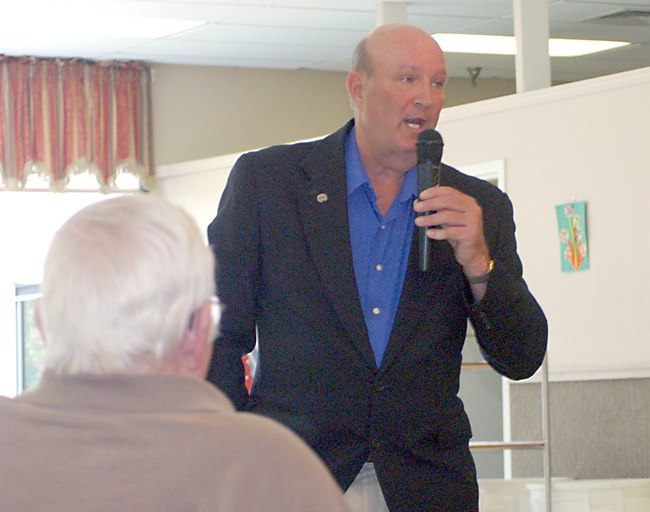
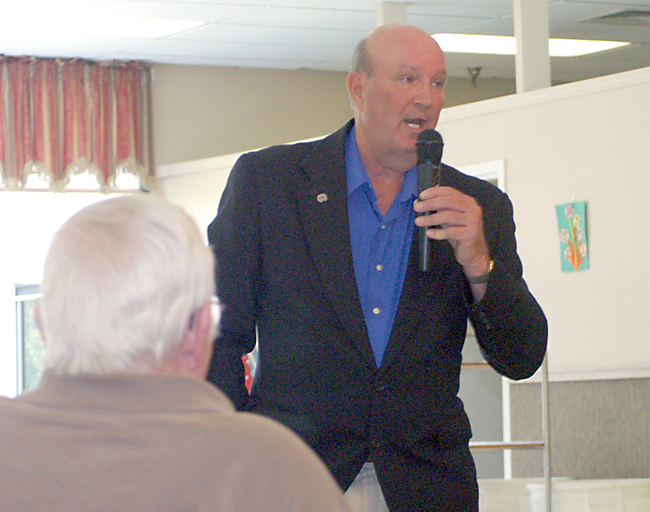
 David Roberts, a sergeant in the 3rd U.S. Infantry, was a guard at the Tomb of the Unknowns in Washington, D.C., from 1972 to 1974. Roberts spoke to residents and veterans at the Bradley County Nursing Home on Tuesday as part of a monthly veterans’ program.
Staff Photo by Ben Benton/Chattanooga Times Free Press
FAST FACTSThe Tomb of the Unknowns at Arlington National Cemetery in Arlington, Va., also known as the Tomb of the Unknown Soldier, never officially has been named. It stands atop a hill overlooking Washington, D.C.On March 4, 1921, Congress approved the burial of an unidentified American soldier from World War I in the plaza of the new Memorial Amphitheater. He was the first soldier to be interred there and was followed by unknown soldiers from World War II, Korea and Vietnam.The Tomb is guarded 24 hours a day, 365 days a year and in any weather by Tomb Guard sentinels. Sentinels, all volunteers, are considered to be the best of the elite 3rd U.S. Infantry (The Old Guard), headquartered at Fort Myer, Va.Source: Arlington National Cemetery website
CLEVELAND, Tenn. – U.S. Army Sgt. David Roberts appears as a young man in the faded 8mm film his sister shot as he stood his post at the Tomb of the Unknowns in Arlington, Va., in the early 1970s.
The first thing Roberts admitted to about 40 residents at the Bradley County Nursing Home on Tuesday is that he “gets a little emotional telling people about the Tomb.”
As residents watched the film, Roberts described the effort it takes to become a Tomb guard, the changing of the guard and the rampage of Hurricane Agnes in 1972.
“I was on the mat [the rubber strip guards walk on in front of the Tomb] when Hurricane Agnes hit,” he said. “I have never seen it rain so hard. You literally couldn’t see the other end of the mat.”
He said he made a point to remember his thoughts and feelings his first time he stood watch.
“I told myself that when I do get up there, when I face down the mat for the first time, I’m going to visualize that so I’ll always remember it,” he said. “I can see the first time I faced down the mat right now.”
Roberts, who served at the Tomb from April 1972 to April 1974, later left the service to become an elementary schoolteacher in his hometown of Gainesboro, Tenn. He retired from Walters State Community College in Morristown, Tenn., as assistant vice president for academic affairs.
Residents and veterans Jim Hixson and Richard Call, who are roommates, said they liked Roberts’ presentation and were proud of his service at the Tomb.
“It’s a great honor for anybody to do that,” said Hixson, a 78-year-old U.S. Air Force veteran who served in Korea from 1952 to 1956.
Call, an 82-year-old U.S. Navy veteran who served from 1951 to 1952, said Roberts’ service contains “tremendous symbolism.”
“It says to the moms who lost their sons in combat, ‘They paid the supreme price and you can be proud of them,'” he said.
Roberts’ presentation was part of the facility’s monthly events, organizers said.
“For many Americans, there’s something special about the Tomb,” said organizer Jerry Venable, an Army Vietnam veteran and member of Chattanooga Masonic Lodge 430.