
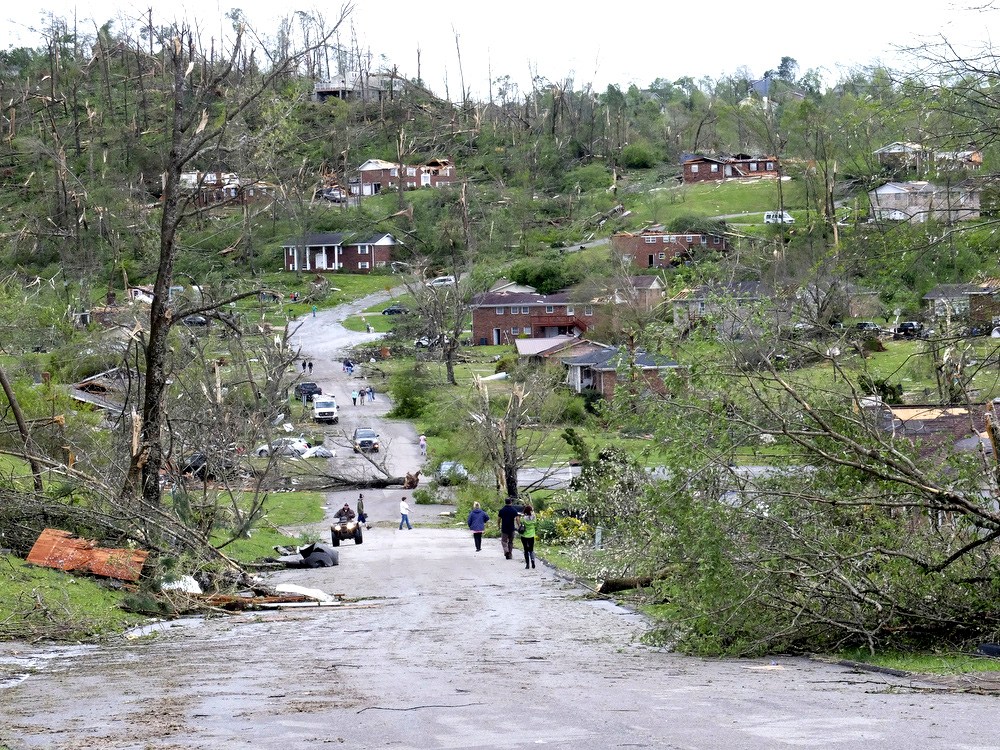

The orange “X” sprayed at the foot of the driveway by the Meigs County rescue squad volunteer certified our Holly Hills home Monday afternoon. It had been checked, and residents had been accounted for.
It was a stamp that told us what we had gone through more than 12 hours before had really happened. A tornado. Our neighborhood. Our home.
The COVID-19 virus and now this?
For those weary weather watchers who like us had tuned into the Weather Channel or watched their local television station meteorologists throughout the evening Sunday and saw tornadoes race through Mississippi and Alabama, it had looked like the worst was almost over.
The models showed 11 p.m. to have the potentially worst weather moving through Chattanooga, but heavy rain and thunderstorms had come and gone. It appeared the city had missed the swath of twisters that hit its neighboring states to the southwest. And, by 1 a.m. Monday, the meteorologist models had been showing, the threat would be out of our local viewing area.
Where it comes to something as unpredictable as a tornado, though, residents can never be too cautious. They can never say, “It won’t happen here,” “the mountains will protect us,” “it’s not warm enough,” or “we’re on a hill.”
Suddenly, the meteorologist had a piece of paper. A tornado warning had been issued by the National Weather Service, with a potential tornado on the ground near Camp Jordan in East Ridge. But Camp Jordan, as the crow flies, is only an invisible border away from highly populated East Brainerd. Residents only had a few minutes to take action.
For us, that action consisted of stuffing three grown people into a first-floor coat closet and closing the door. We didn’t have to wait long. Amid a whispered prayer and “I love yous,” there was no proverbial freight train noise but the sound of debris hitting the house, the house shaking, some heavy thumps landing and then the fresh smell of trees. It was all over in a manner of moments.
When we finally exited the closet, we expected the roof to be missing, portions of the house to be collapsed or crushed cars. But a quick check found the house intact save a hole in the garage ceiling through which water trickled down. We were fortunate and, as we would find out as dawn broke the next morning, far more fortunate than most in our neighborhood.
(READ MORE: Loss of life, property comes into focus as Chattanooga area reels after violent storms)
After seeing that 10 or 12 trees either were on top of our house or had been uprooted from the yard and fell onto the side of the house, we walked down the hill into the older part of our neighborhood to check on other residents. There we glimpsed vistas never visible before because scores of trees had been ripped away.
Slowly, as we stepped over downed wires and around felled trees, neighbors began coming out of homes. We met residents who, like us, had lived in the neighborhood for decades but never crossed our paths. But they all had a familiar mantra when exchanging reasonably social distant greetings: We’re thankful to be alive.
Before we could walk the extent of the neighborhood, before the sun completely rose over the hills, volunteers were walking into the streets with chainsaws. They weren’t with tree services. They weren’t called by a local rescue squad. They were simply volunteers with power tools willing to help. People helping people.
Throughout the day, people came into Holly Hills – and other neighborhoods across East Brainerd – with equipment, food and offers of help. It didn’t matter if the residents were black or white, Republican or Democrat, old or young, male or female, gay or straight. They were in a predicament, and something within their fellow Chattanooga area dwellers welled up to help.
(MORE: Videos and photos: Drone footage of storm and tornado damage in the Chattanooga area)
The pandemic could wait. Talk of hospital beds and respirators and assigning blame for the virus could be put on hold. Whether the area had tornado sirens and how much money would be available in government relief could be subjects for another day. People had immediate needs of shelter and the removal of debris that kept them trapped in their homes.
At the end of the day, the orange “X” sprayed at the base of our driveway showed what was most important to everyone in the devastated Holly Hills neighborhood, and others like it – the residents were accounted for. Our neighborhood and others in the vicinity had no deaths despite the ferocity of the EF-3 tornado (though two died in Hamilton County), and very few injuries.
What was in abundance – whether one’s house was unlivable or had relatively minor damage – was the reaction of friends, family members, churches and total strangers to the human needs of suffering.
So, despite what we may believe about the country’s hyperpartisanship and intolerance, until that desire of one person helping another disappears, it’s not too late for us. It’s not to late for us to remain, as President Abraham Lincoln described America in his message to Congress in 1862, “the last, best hope of Earth.”