
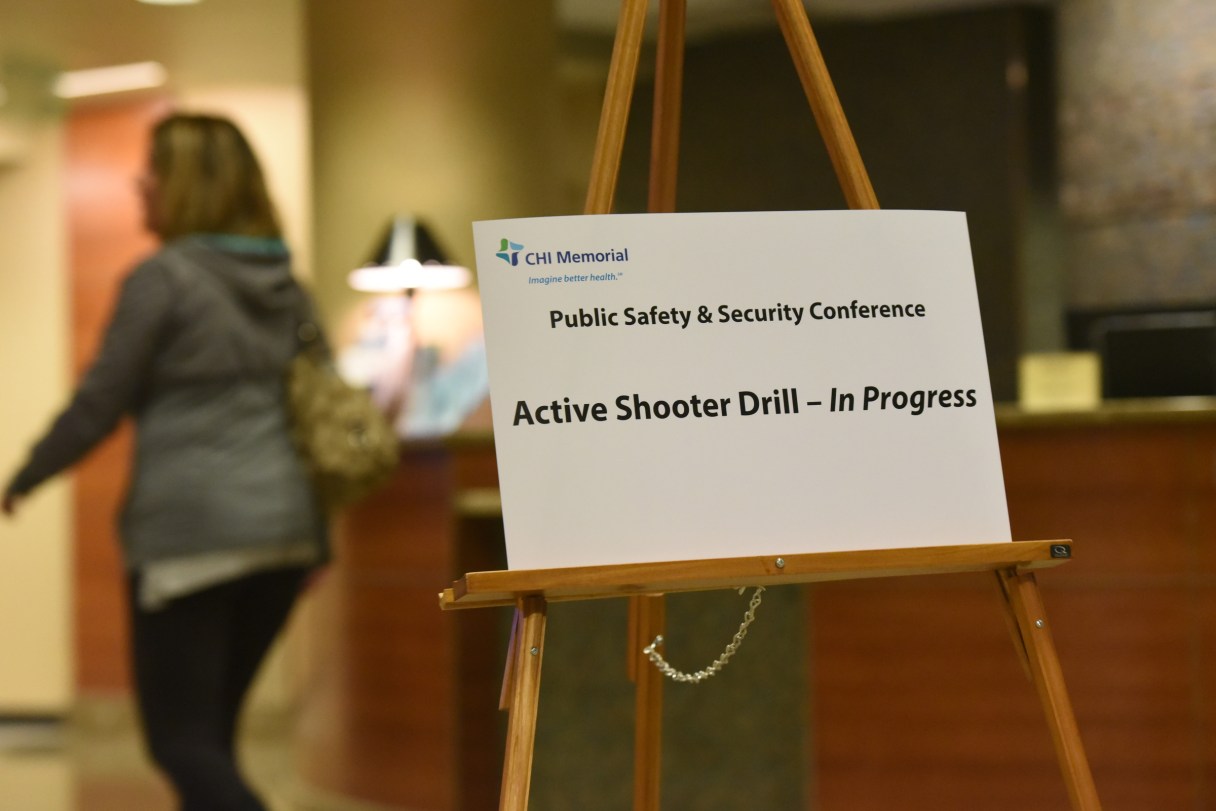
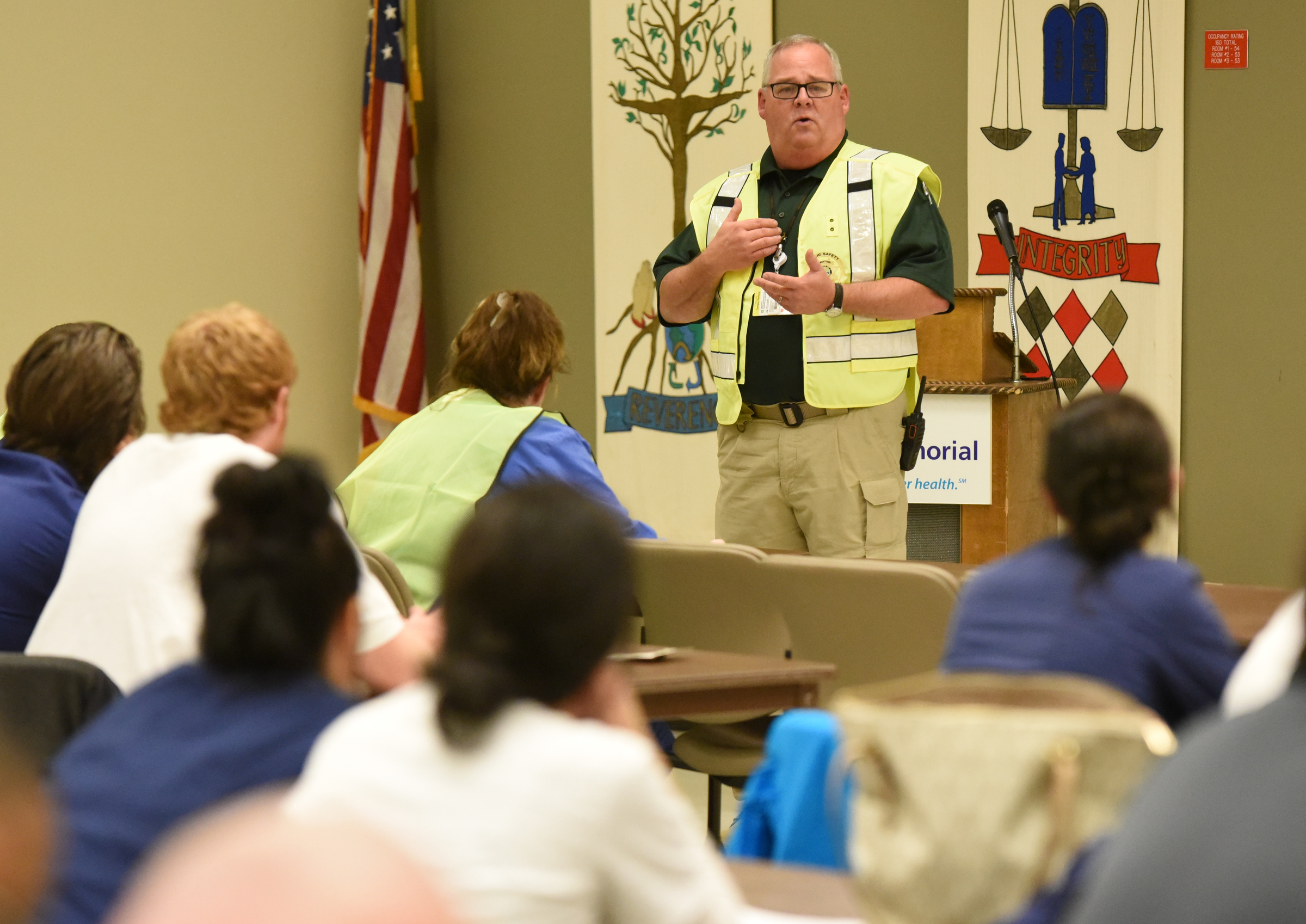
 CHI Memorial Public Safety Director Thomas Wiggonton debriefs employees, Chattanooga Fire, Police and EMS Tuesday morning following the first round of an Active Shooter Drill on the second floor of the hospital. Approximately 50-60 people participated in the several-hour exercise.
The young man waving a gun burst through the double doors leading into CHI Memorial’s emergency department Wednesday morning. As staffers scrambled for cover, he moved methodically around the facility, firing, seemingly at random, before crouching down in a cubicle, weapon in hand, to await police officers.
A nurse and doctor who had hidden as he moved past followed him at a distance and tried to help those who were wounded.
Hospital staffers alerted police, fire and emergency medical teams, while doctors and nurses rushed to the adjacent rooms and floors to move patients out of harm’s way.
The hospital’s management team hurried to a control room to coordinate its response. A button was pressed, locking many of the doors in the rambling, multistoried medical facility, although some failed to secure properly.
Within minutes, police officers burst into the emergency room and shot the attacker.
And then everyone – police, medical staff and EMTs – moved to a large downstairs room to share a lunch of Mexican food and discuss what they did right and wrong in coping with the intruder in the mock incident designed to help with future security.
Mock or not, the atmosphere after Wednesday’s drill was not all smiles.
“We lost 17 people in there; 17 people are dead,” Memorial Director of Public Safety Tommy Wiggonton told the group. “We have to do better.”
The drill was staged to give both hospital staff and first responders a taste of what a real emergency would be like and to find ways to resolve unexpected problems. It came on the same day as the latest U.S. mass shooting, in San Bernardino, Calif.
Police Lt. Mark Schmelzer said officers were able to find their way around the complex medical facility because they already had floor plans from Homeland Security planning. The event gave them a chance to see if the plans were up to date and had kept up with Memorial’s recent building boom.
Schmelzer said Wednesday was the first time Chattanooga police officers had participated in a shooting drill at Memorial.
“Today we took a small step,” he said, “and now we need to build on that.”
One problem pointed out at the debriefing was communications – the difficulty in finding a way to talk to all of those involved in responding to a shooter.
Police officers, firefighters and EMT personnel could talk on a common radio frequency, but the hospital’s security guards don’t have that capacity.
Hospital staff have cellphone numbers for a group of managers, so they can use their smartphones to communicate during an emergency, said Lisa McCluskey, Memorial’s vice president for marketing communications.
The staff practices regularly on how to remove patients from the facility in an emergency; it is part of their training for dealing with a nuclear attack or major weather emergency, McCluskey said. But it isn’t easy emptying such a huge building of several thousand staffers and hundreds of patients – many of them requiring respirators or other attached medical devices.
About 100 police officers, firefighters, EMT personnel, and Memorial medical staff participated in the morning’s drill.
Another group of officers and Memorial staff repeated the drill again later in afternoon, this time with a “shooter” walking into the crowded waiting room of a hospital clinic.
In reality, such scenarios are very rare. In the only local incident in recent years, a man entered the ICU waiting room at Hutcheson Medical Center in Fort Oglethorpe in January 2012 and shot and killed his estranged wife and her mother. In that incident, the shooter drove to the nearby police station and turned himself in.
According to a study by researchers at Johns Hopkins University, between 2000 and 2011, 154 hospital-related shootings occurred in the U.S., although only 91 were inside the hospital.
Most of those were cases of domestic violence and not directed at hospital staff, the study concluded. Only 3 percent involved doctors and 5 percent nurses.
Contact reporter Steve Johnson at sjohnson @timesfreepress.com, 423-757-6673, on Twitter @stevejohnsonTFP or on Facebook, at stevejohnsonTFP.